
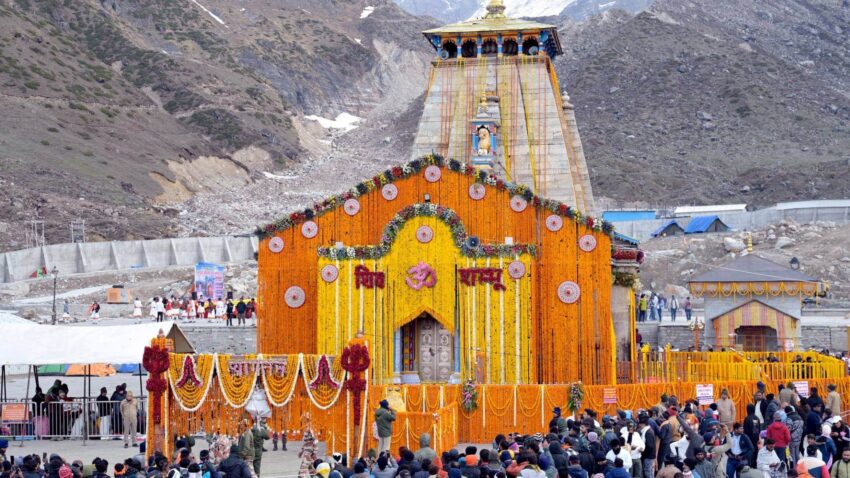
The spiritual legacy of Adi Shankaracharya is deeply interwoven with the sacred aura of Kedarnath Temple, one of the holiest shrines dedicated to Lord Shiva. Nestled in the majestic ranges of the Himalayas, Kedarnath is not just a pilgrimage destination but also a powerful symbol of India’s spiritual continuity, much of which was revitalized by Adi Shankaracharya during a time of religious transition and philosophical transformation.
Adi Shankaracharya, believed to have lived in the 8th century, was one of the greatest philosophers and spiritual reformers in Indian history. He is best known for consolidating the doctrine of Advaita Vedanta, a philosophy that teaches the oneness of the individual soul and the ultimate reality. During his relatively short life, he traveled extensively across the Indian subcontinent, reviving ancient traditions, establishing monastic centers, and re-energizing the spiritual fabric of the land. His journeys were not merely intellectual pursuits but also deeply devotional, connecting sacred places with philosophical meaning.
Kedarnath held a special place in Shankaracharya’s mission. At the time, many ancient temples in the Himalayan region had fallen into neglect due to harsh weather, geographical isolation, and shifting socio-political conditions. Recognizing the spiritual importance of these shrines, Shankaracharya undertook efforts to restore them and re-establish their significance among devotees. Kedarnath, being one of the twelve Jyotirlingas of Lord Shiva, was among the most important of these sacred sites.
It is widely believed that Adi Shankaracharya played a key role in reviving the Kedarnath Temple and organizing regular worship practices there. By doing so, he ensured that the temple remained an active center of devotion rather than fading into obscurity. His efforts helped integrate Kedarnath into the larger pilgrimage traditions of India, making it a vital part of the spiritual journey for countless devotees. The temple eventually became a cornerstone of the Char Dham Yatra, further solidifying its importance in Hindu religious life.
One of the most profound aspects of Shankaracharya’s connection to Kedarnath is the belief that he attained samadhi near the temple. A shrine dedicated to him, known as his samadhi, is located just behind the temple, marking the place where he is said to have left his physical body. This association adds a deeply personal dimension to his connection with Kedarnath, transforming it from a site he merely revived into a place that holds his eternal spiritual presence.
The presence of his samadhi at Kedarnath symbolizes the union of knowledge and devotion. Shankaracharya is often seen as a philosopher who emphasized the pursuit of knowledge, yet his life also demonstrated profound devotion to the divine. Kedarnath, dedicated to Lord Shiva, represents both the formless absolute and the personal deity, aligning perfectly with Shankaracharya’s teachings. His association with the temple reinforces the idea that true spirituality lies in balancing intellectual understanding with heartfelt devotion.
Another important contribution of Adi Shankaracharya was the establishment of an organized system of worship and pilgrimage. By creating a network of sacred sites and linking them through spiritual routes, he made it easier for people to engage with their faith in a structured manner. Kedarnath’s inclusion in these networks ensured that it remained accessible and relevant despite its remote location. This system continues to guide pilgrims even today, reflecting the lasting impact of his vision.
The harsh environment of Kedarnath further highlights the significance of Shankaracharya’s work. Located at a high altitude and surrounded by snow-covered peaks, the temple is accessible only for a few months each year. Maintaining religious practices in such conditions requires dedication and organization, both of which were strengthened by Shankaracharya’s efforts. His influence helped establish a tradition of resilience and devotion that continues to define the pilgrimage experience.
In modern times, the connection between Adi Shankaracharya and Kedarnath has gained renewed attention, especially after natural disasters like the 2013 floods. Despite the destruction around it, the temple remained standing, and the nearby samadhi of Shankaracharya was later restored with great care. This has reinforced the belief that his spiritual presence continues to protect and bless the region.
Ultimately, the relationship between Adi Shankaracharya and Kedarnath is a powerful example of how one individual’s vision can shape the spiritual destiny of a place. His efforts not only revived a sacred temple but also ensured that it would continue to inspire generations of devotees. Kedarnath today stands as a testament to his enduring legacy, where philosophy, devotion, and history come together in a timeless expression of faith.
God Idols, Pooja Murti, Religious Statues, Handmade God Statues Hotels in Uttarkashi – Uttarkashi Hotels Hotels in Chardham Chardham Hotels Online Chardham Hotels in Badrinath – Badrinath Hotels Hotels in Kedarnath – Kedarnath Hotels Hotels in Yamunotri – Yamunotri Hotels Hotels in Gangotri – Gangotri Hotels Hotels in Barkot – Barkot Hotels Hotels in Sitapur – Sitapur Hotels