
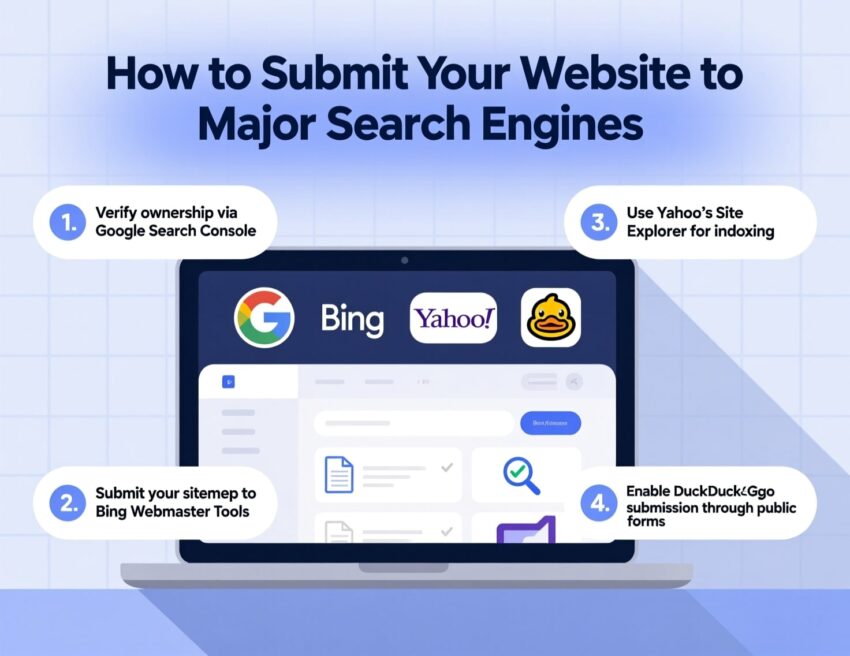
Considering the internet as an enormous, crowded place, launching a new website is somewhat like opening a new store. You have the layout just right with great products or content ready for business. But, of course, the biggest problem of them all—there’s no one who knows your address. Thus comes the understanding of how to submit website to search engines. This is basically a procedure to raise your hand and say to platforms such as Google and Bing, “Hey! I’m here.” Although search engines do have a very sophisticated way of finding content by themselves, actually submitting a site can serve as a strong wake-up call for accelerating the process of indexing it. Thus, it becomes visible to the end-users—folks whom you are trying to target. The submission process becomes your first step in the search engine optimization (SEO) journey—the process of bringing your site from one that has been hidden to one that is found.
The Foundation: Preparation Before You Submit
Before anything else, one thing should be kept in mind: never think about submission before laying the groundwork! A premature or ill-done submission could prove harmful to building anything good. Search engines crawling over your site provide the first contact with your site.
First and foremost, ensure your site is well-off and gives a good user experience. For example:
- No Broken Links: Use tools like Screaming Frog SEO Spider or link-redirect trackers in Google Search Console for 404 problems.
- Mobile-Friendliness: It is essential that your site supports mobile visitors, as a majority of site traffic comes from mobile. Google primarily uses your mobile site to develop the mobile index for you.
- Fast Loading Speed: A website that loads slowly is poor both for the users as well as the search engine algorithm. Potentially use Google’s PageSpeed Insights, which is a convenient way to find weaknesses in the performance of your site.
- High-Quality Content: The site shall need good, original, and substantial material relevant to what your target audience wants to find information about. Very thin or copied content shall cause concern.
- Clear Site Structure: Clear and understandable information architecture using simple navigation enables both visitors and bots to understand what is on your site.
Having all of these in order and in full readiness assures that the website is ready for its debut. Subsequently, all that is remaining to be done is creating the webmaster tools and verifying the site with the major search engine. This is now the beginning of the actual management.
Why You Should Submit Website to Search Engines Directly
You may have known that as time goes by, the search engines will come to you anyway, so why waste time with all the filing hassle, right? Well, let me tell you as a fact: Direct submission gives a boost to some key advantages that merely passive discovery cannot:
- Faster Indexing: Direct submission reduces indexation time. By submitting your website directly to a search engine, you reduce the time required for the bots to process your website and add it to the search results.
- Initial Crawl Budget Allocation: Crawling budget refers to the limit on the number of pages that a search engine would be willing to crawl on your website within a given time frame. The crawl budget for new sites tends to be severely limiting. By submitting only the critical pages like your homepage and other top-ranking landing pages first, you command them to be scanned first.
- Access to Vital Tools: Website submission usually involves some type of verification of ownership; this is the standard according to Google and Bing. With the verification, one gets access to a treasure trove of tools and data proving critical in SEO, like analyses of performances, index coverage status, and enhancements.
- Early Error Detection: These webmaster tools immediately start highlighting areas like crawl errors, security risks, and problems with mobile-friendliness, enabling recovery before they cause harm with search visibility.
A Step-by-Step Guide to Submitting Your Site
Let’s break down the specific process for the two major players in the search engine world: Google and Bing.
1. Submitting to Google via Google Search Console
Google dominates the search market, making this your top priority.
- Step 1: Create and Verify Your Site. Create and Verify the Site. Open the Google Search Console and enter your website/URL in consideration (the location). Using any prompt, reconfirm that you are the owner. Several choices may be available to you for this verification: simple, for example, would include inserting an HTML tag in the header of the Web server or uploading a specific HTML file. Several hosts and CMSs, including Yoast SEO for WordPress, handle this in quite a simple procedure.
- Step 2: Submit Your Sitemap. Site Map Submission. Any website should contain a map of all pages to help crawlers browse it. The XML file would specify locations of all-important pages and provide metadata about each. As a general rule, the sitemap is automatically generated by either the CMS or a plug-in inserted into the CMS config. Once your site has passed through this inspection, you can now access the section named “Sitemaps” from the menu on the left-hand pane of the page. Select Sitemap, enter the URL, and finally click “Submit.”
- Step 3: Request Indexing (Optional but Helpful). Requesting Indexing. Under the “URL Inspection” page, one can request indexing for their main pages, such as the homepage. Type the URL of that particular page into the search bar at the top and click “Return” to see the individual page details. If all looks good, then you have an option to submit, saying “Request Indexing” for that page directly.
2. Submitting to Bing via Bing Webmaster Tools
While smaller than Google, Bing powers a significant portion of searches, including those on Yahoo and DuckDuckGo, so it should not be ignored.
- Step 1: Add Your Site. Go to Bing Webmaster Tools. Sign in with your Microsoft account and click “Add a site.” Enter your website’s URL.
- Step 2: Verify Ownership. Similar to Google, Bing requires verification. You can use the same verification method (e.g., the HTML tag) you used for Google to make the process seamless.
- Step 3: Submit Your Sitemap. Once your site is verified and added, go to the “Sitemaps” section under “Configure My Site.” Submit the URL of your sitemap, and Bing will begin processing it.
Beyond Submission: What to Do Next
You don’t just submit your site and walk away. That marks the beginning of a long-term relationship with search engines.
- Monitor Your Performance: You must check your Search Console and Bing Webmaster Tools dashboard regularly. Monitor your indexing status, the search queries that brought people to your site, and all crawl errors that may pop up.
- Build Quality Backlinks: The strongest signal for engines is links from other authoritative sites. Earn these backlinks through developing great content and using digital PR, or community outreach, and it tells engines that your site is one worth ranking as an authoritative source.
- Publish Fresh Content Consistently: A static website will not sustain its ranking on a long-term basis. A blog or news section giving a crawler a reason to come back often by publishing regularly helpful, relevant content will reward you with more visibility.
Be Patient: SEO. It requires from a few days to a maximum of weeks for total indexing of your site before it can be searched. Focus on the best user experience and authority in content.
Launching a new website is probably the most exciting milestone, but it relies on one factor very strongly: visibility. If you prepare your site well and also proactively and formally submit website to search engines, you will create a strong, responsive foundation for all your future SEO efforts. It’s the easiest and most efficient way to make sure that the digital storefront is officially open for business and welcoming its first visitors from search.