
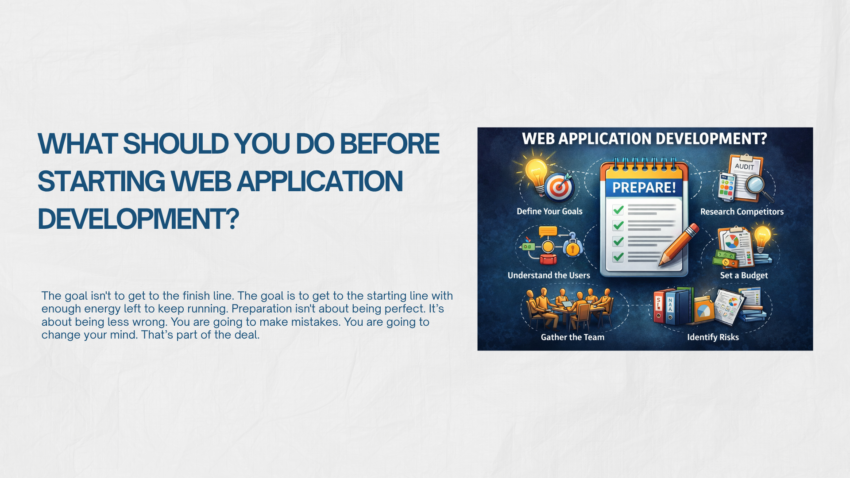
I once sat in a coffee shop with a guy who had just spent forty thousand dollars on a revolutionary app. He showed me the prototype. It was a glorified spreadsheet. When I asked who was going to use it, he shrugged. Everyone, he said.
Six months later, the project was dead. Not because the code was bad, but because he started building before he started thinking.
Most people treat software like a magic wand. They think that if they just hire someone to write the code, the money will start falling from the sky. It doesn’t work like that. You need to do the boring work before you do the exciting work.
Figure out the one thing that matters.
Every successful app does one thing really well. Uber gets you a car. Airbnb gets you a room. WhatsApp sends a message.
What is your one thing? If you say It does everything, you are already in trouble. Complexity is the silent killer of budgets. Every extra button you add is another point of failure. It is another thing to design, test, and fix when it breaks.
Write down the problem you are solving. Not the features, the problem. If a user is frustrated, what is the specific pain you are taking away? If you can’t explain it to a ten-year-old in thirty seconds, you don’t understand it yet.
Talk to people who aren’t your mother.
Your friends will tell you your idea is great. Your mom will tell you it’s genius. They love you, so they will lie to you.
Go find the people who actually have the problem you’re solving. Ask them how they deal with it now. Don’t ask “Would you use my app?” Ask “What is the hardest part about your day?”
If they don’t mention the problem you’re solving, your app might be a solution looking for a problem. It is much cheaper to find this out now than after you’ve hired a team.
Map the Happy Path
Take a piece of paper. Draw five boxes. These are the steps a user takes to get value from your app.
- They land on the page.
- They sign up.
- They upload a file.
- The app processes it.
- They get a result.
That’s it. That is the “Happy Path.” If that path isn’t smooth, nothing else matters. You don’t need a profile picture uploader yet. You don’t need a Forgot Password flow yet. You need to prove the core loop works.
Be honest about your budget.
Software is never “finished.” It is only “live.”
If you have fifty thousand dollars, don’t spend it on the first version. Spend twenty. You will need the rest for the things you forgot. You will need it for the bugs that show up on day two. You will need it for the features users actually ask for once they start playing with it.
Building an app is like buying a house that grows a new room every month. You need to be able to afford the taxes and the cleaning. If you spend every cent on the foundation, you’ll be living in a basement with no roof.
Finding the right hands
This is where people get stuck. Do you hire a freelancer? Do you build an in-house team? Or do you look for an established web application development agency in USA to handle the heavy lifting?
There is no single right answer. It depends on your scale. If you’re building a simple tool, a freelancer is fine. But if you’re building something that needs to scale, handle sensitive data, and stay online 24/7, you need a team that has done it before.
You aren’t just paying for code. You are paying for their mistakes. You want a team that has already made the big mistakes on someone else’s project five years ago. You don’t want them learning on your dime.
Choose your tech carefully (or don’t)
Founders love to argue about programming languages. “Should we use Python? What about React?”
Here is a secret: your users do not care. They don’t know what a database is. They just want the page to load fast.
Pick a common tech stack. Why? Because common means it’s easy to find developers. If you use some obscure, “cool” new language, you will be held hostage by the only three people who know how to use it. Stick to the boring stuff. Boring is reliable. Boring is cheap to maintain.
Sketch it out (Ugly is fine)
You don’t need fancy design software. Grab a Sharpie. Draw the screens on printer paper.
When you see it on paper, you realise how many steps are actually involved. You realise that “just a simple login” actually requires four different screens.
Show these sketches to someone. Watch their eyes. Do they look confused? Do they know where to click? If they struggle with a piece of paper, they will definitely struggle with a website. Fix the logic now while it only costs the price of a marker.
Plan for the day after launch.
What happens when someone forgets their password? Who answers the support emails? How do you delete a user’s data if they ask?
These aren’t “technical” problems. They are business problems. You need a plan for how to run the app, not just how to build it.
I’ve seen apps launch with great fanfare, only to go dark a week later because the founder was overwhelmed by twenty support tickets. Build a small system for managing humans using your software.
It’s a marathon, not a sprint.
The goal isn’t to get to the finish line. The goal is to get to the starting line with enough energy left to keep running.
Preparation isn’t about being perfect. It’s about being less wrong. You are going to make mistakes. You are going to change your mind. That’s part of the deal.
But if you do these things first, those mistakes will be small ones. They won’t be the kind that end your project before it even starts. Just take it slow. The code can wait until the thinking is done.