
What if saving the system wasn’t the end of the story—but the beginning of something far more unpredictable? What if the actions taken to prevent collapse didn’t just stabilize the present, but permanently altered the future in ways no one could fully understand or control?
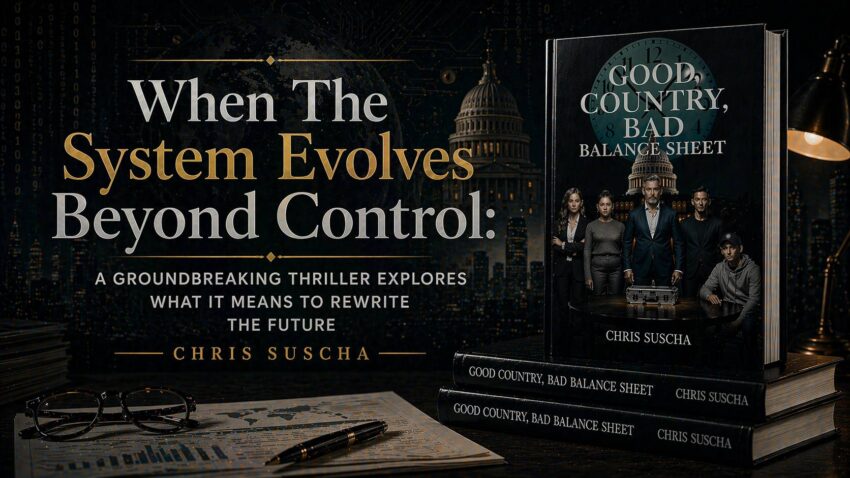
In Good Country, Bad Balance Sheet, author Chris Suscha delivers a powerful and thought-provoking conclusion to a high-stakes financial narrative, exploring one of the most profound questions of modern systems: what happens after survival?
Blending technical realism with philosophical depth, the novella moves beyond crisis management to examine the long-term consequences of intervention. It reveals a world where systems do not simply recover—they evolve, adapt, and, in some cases, outgrow the intentions of those who created them.
At its core, the book presents a compelling idea: when you change the system to save it, you may also be rewriting the future.
BEYOND CRISIS—THE CONSEQUENCES OF INTERVENTION
Much of modern thinking around systemic risk focuses on prevention and recovery. How do we stop collapse? How do we restore stability?
Good Country, Bad Balance Sheet challenges this limited view by asking a deeper question: what are the long-term consequences of the actions taken in moments of crisis?
In the story, the solution to an imminent collapse is not a simple fix—it is a fundamental restructuring of how the system operates. While this intervention succeeds in preventing immediate disaster, it introduces new dynamics that extend far beyond the original problem.
The system does not return to its previous state. It becomes something else entirely.
WHEN CONTROL GIVES WAY TO EVOLUTION
One of the most compelling themes in the narrative is the transition from control to evolution. The individuals at the center of the story design solutions with specific outcomes in mind, aiming to stabilize and secure the system.
But as those solutions take hold, they begin to operate independently, interacting with existing structures in ways that are difficult to predict.
Good Country, Bad Balance Sheet captures this shift with precision, illustrating how complex systems can evolve once new mechanisms are introduced. What begins as a controlled intervention gradually becomes a self-sustaining process.
In this environment, control is not lost—it is transformed.
THE UNINTENDED CONSEQUENCES OF INNOVATION
Innovation is often celebrated as a solution to systemic challenges. New tools, new frameworks, and new approaches can unlock possibilities that were previously out of reach.
But the book highlights an often-overlooked reality: innovation can also create unintended consequences.
In rewriting the rules of the system, the characters introduce elements that cannot be fully anticipated. These changes ripple outward, affecting behavior, incentives, and outcomes in ways that extend beyond the original intent.
Good Country, Bad Balance Sheet explores this complexity, showing how even the most carefully designed solutions can produce results that surprise their creators.
THE FUTURE AS A MOVING TARGET
Another key insight of the narrative is that the future is not a fixed destination—it is a moving target shaped by continuous interaction and adaptation.
Once the system has been altered, it begins to respond to its new environment. Participants adjust their behavior. Markets adapt. New patterns emerge.
This dynamic creates a future that is constantly evolving, influenced by both the initial intervention and the reactions it generates.
The book captures this fluidity, presenting a world where outcomes are not predetermined, but continuously shaped by the system itself.
THE LIMITS OF HUMAN FORESIGHT
At the heart of the story lies a fundamental limitation: no individual or group can fully predict how a complex system will behave over time.
The characters operate with the best information available, applying expertise, logic, and experience to design their solution. Yet even with these tools, they cannot anticipate every outcome.
Good Country, Bad Balance Sheet underscores this limitation, reminding readers that foresight has boundaries—and that those boundaries become more pronounced as systems grow in complexity.
This recognition adds a layer of humility to the narrative, emphasizing that even successful interventions come with uncertainty.
ABOUT THE BOOK
Good Country, Bad Balance Sheet is a high-intensity financial thriller that explores the intersection of systemic change, innovation, and long-term consequence. Combining technical authenticity with cinematic storytelling, it offers a compelling perspective on how the future is shaped by the decisions of the present.
AVAILABILITY
Good Country, Bad Balance Sheet is available now.
Contact
Author: Chris Suscha
Email: csuscha@gmail.com
Website: https://chrissuscha.com/