
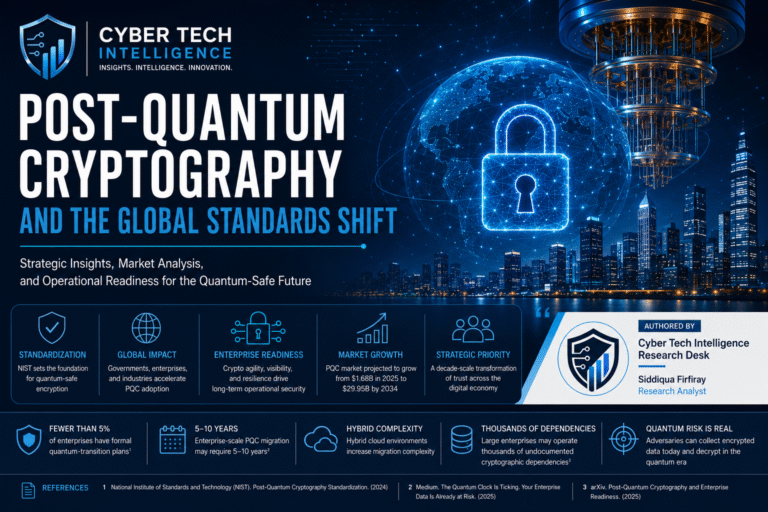
The rapid advancement of quantum computing has elevated Quantum Cryptography and The State of Post-Quantum Cryptography into central concerns for governments, cloud providers, financial institutions, and critical infrastructure operators worldwide.
As quantum technologies continue to evolve, widely deployed asymmetric cryptographic systems—particularly RSA and ECC—are expected to become vulnerable to quantum-enabled attacks. This shift is forcing organizations to rethink long-established security foundations.
In response, post-quantum cryptography (PQC) represents one of the most significant milestones in modern cryptography since the introduction of public key encryption, while Quantum Cryptography introduces fundamentally new approaches to secure communication based on quantum principles.
The core question is no longer whether quantum threats will emerge, but how quickly enterprises can achieve readiness.
Key Market Indicators
- The National Institute of Standards and Technology (NIST) finalized its first PQC standards in 2024, including ML-KEM and ML-DSA¹
- IBM projects cryptographically relevant quantum computers could emerge within the next decade
- McKinsey & Company estimates enterprise migration to PQC may require 5–10 years depending on infrastructure complexity
- Gartner forecasts that by 2029, most traditional asymmetric cryptography used in communications could be at risk
Strategic Observation: The State of Post-Quantum Cryptography
The current State of Post-Quantum Cryptography reflects a transition from research-driven exploration to enterprise-scale implementation planning.
PQC migration is no longer a theoretical exercise—it is a strategic transformation involving:
- Infrastructure modernization
- Cryptographic agility development
- Vendor ecosystem alignment
- Regulatory compliance readiness
- Enterprise-wide cryptographic visibility
Quantum Cryptography, while still emerging in practical deployment, complements this shift by exploring fundamentally different secure communication models based on quantum mechanics.
Global Standardization Accelerates Adoption
Standardization efforts have significantly reshaped enterprise confidence in PQC adoption.
Why Standardization Matters
Historically, cryptographic innovation required formal standards and interoperability frameworks before enterprise adoption could scale. The absence of standards limited real-world deployment.
The formalization of PQC standards by NIST has fundamentally changed The State of Post-Quantum Cryptography, enabling organizations to move from experimentation to structured adoption planning.
Key Industry Developments
NIST has standardized:
- ML-KEM (formerly CRYSTALS-Kyber) for encryption
- ML-DSA (formerly CRYSTALS-Dilithium) for digital signatures
- SLH-DSA for long-term signature resilience
Major cloud providers such as IBM, Google Cloud, and Cloudflare are actively advancing PQC testing and hybrid deployment models.
Financial regulators in North America and Europe are increasingly evaluating quantum readiness as part of systemic risk assessments.
Governments across the US, UK, and EU are introducing structured migration programs aligned with national cybersecurity modernization strategies.
Industry Adoption Trends
PQC adoption is accelerating across sectors most exposed to long-term data sensitivity and regulatory pressure.
Financial Services
- Long-term financial record protection
- Cross-border encrypted transactions
- Regulatory compliance obligations
- Trust infrastructure dependency
Healthcare
Healthcare systems face heightened risk due to long data retention periods and exposure to “harvest now, decrypt later” threats.
Defense and Government
National security organizations are prioritizing:
- Secure communications infrastructure
- Classified data protection
- Supply chain cryptographic integrity
- Satellite and defense encryption modernization
Telecommunications
Telecom operators are embedding crypto agility into:
- 5G infrastructure
- Secure routing systems
- IoT ecosystems
- Edge computing environments
Why This Matters to Security Leaders
The State of Post-Quantum Cryptography has shifted PQC readiness into a core enterprise resilience requirement.
Security leaders must now understand:
- Where cryptography is deployed
- Which systems rely on vulnerable algorithms
- How quickly infrastructure can be replaced
- Whether vendors support crypto agility and hybrid cryptographic systems
Key Enterprise Risks
1. Long-Term Data Exposure
Data encrypted today may be decrypted in the future when quantum computing becomes operationally viable.
2. Supply Chain Vulnerabilities
Third-party software and embedded systems may contain hidden cryptographic dependencies.
3. Regulatory and Compliance Pressure
Quantum-readiness frameworks are expected to become mandatory in regulated industries.
4. Operational Complexity
Migration requires:
- Certificate lifecycle replacement
- Key management redesign
- Protocol modernization
- Vendor coordination
- System-wide validation and testing
Enterprise Readiness Metrics
- The global PQC market is projected to grow at 37.72%, reaching $29.95 billion by 2034²
- Large enterprises may operate thousands of undocumented cryptographic dependencies
- Delayed migration significantly increases cost and operational complexity
Cyber Tech Intelligence Framework
To assess readiness for The State of Post-Quantum Cryptography, enterprises must evaluate five key layers:
1. Cryptographic Discovery
Identify cryptographic usage across applications, APIs, cloud workloads, endpoints, and identity systems.
2. Data Longevity Mapping
Assess which data remains sensitive long enough to be impacted by future quantum threats.
3. Crypto Agility Assessment
Determine whether systems can:
- Rapidly replace algorithms
- Rotate certificates dynamically
- Support hybrid cryptographic models
4. Third-Party Dependency Analysis
Evaluate vendor readiness and inherited cryptographic risk.
5. Quantum Threat Exposure Scoring
Prioritize migration based on sensitivity, criticality, compliance requirements, and adversarial attractiveness.
Strategic Findings
The primary enterprise risk is not algorithm failure alone, but lack of visibility into cryptographic usage and insufficient migration agility.
Organizations with fragmented IT systems, legacy infrastructure, and complex vendor ecosystems face the highest transition complexity.
Conclusion
Quantum Cryptography and The State of Post-Quantum Cryptography together define a major transformation in global cybersecurity architecture.
Post-quantum migration is becoming a foundational requirement for digital trust, driven by NIST standardization, increasing quantum investment, and rising awareness of long-term data exposure risks.
Enterprises that invest early in cryptographic visibility and crypto agility will be significantly better positioned to navigate the quantum era.
Ultimately, this transition is not just a technology upgrade—it is a multi-decade restructuring of global security infrastructure.
FAQs
1. Are quantum attacks a current threat?
Not yet. However, encrypted data collected today may be decrypted in the future.
2. What is the biggest barrier to PQC adoption?
Lack of visibility into where cryptography is used across enterprises.
3. Which industries should prioritize migration?
Financial services, healthcare, government, telecommunications, defense, and critical infrastructure.
4. Will PQC replace all existing cryptography?
No. Hybrid cryptographic models will likely coexist for many years.
5. What should CISOs do first?
Begin with enterprise-wide cryptographic discovery and inventory mapping.
About Us
CyberTechnology Insights (CyberTech) is a trusted repository of high-quality IT and security news, insights, and trends analysis, founded in 2024. We curate research-based content across 1,500-plus IT and security categories to help CIOs, CISOs, and senior security professionals navigate the evolving cybersecurity landscape. Our mission is to empower enterprise security decision-makers with actionable intelligence, deliver in-depth analysis across risk management, network defense, fraud prevention, and data loss prevention, and build a community of ethical, compliant, and collaborative IT and security leaders committed to safeguarding digital organizations and online human rights.
Contact Us
1846 E Innovation Park Dr, Suite 100, Oro Valley, AZ 85755
Phone: +1 (845) 347-8894, +91 77760 92666