
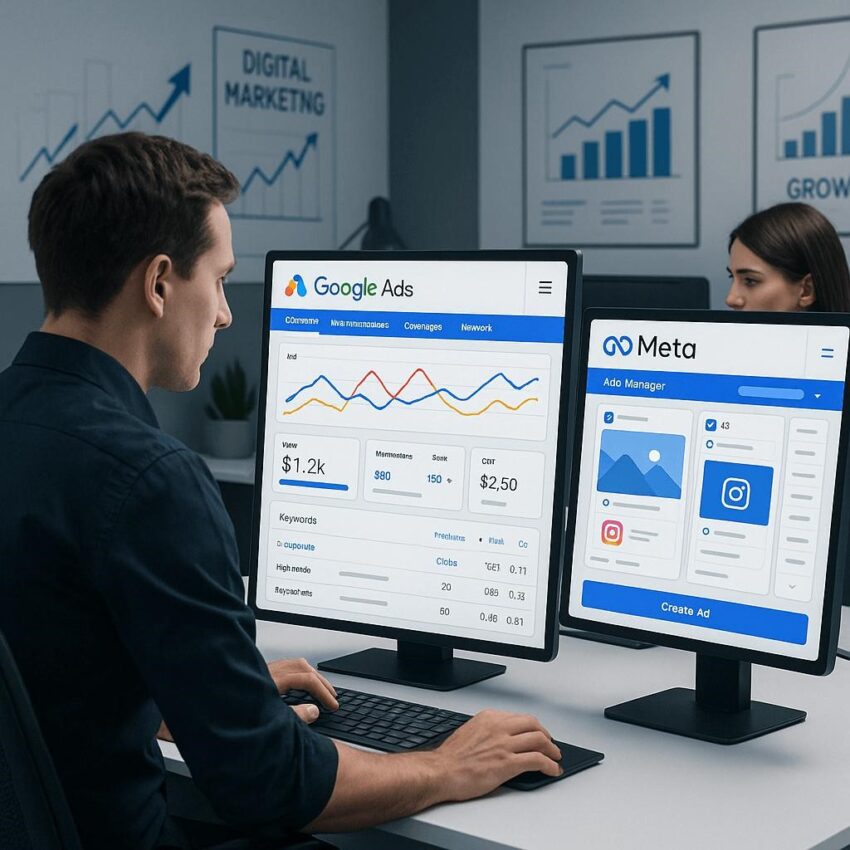
Every week, thousands of medium businesses start Meta Ads campaigns. They decide on a budget, choose an audience, write a caption, and then wait.
Two weeks later, they have spent thirty thousand rupees. They only have three leads to show for it. Two of these leads never even replied to follow-up messages.
The conclusion most of these businesses reach is that Meta Ads do not work for their business.
But the actual conclusion they should reach is harder to hear: the platform is fine — it is their strategy that’s the problem.
The Real Problem With How Indian Businesses Run Ads in 2026
India’s digital advertising market is growing fast. More businesses than ever are running paid campaigns.
A lot of the money they spend is being wasted.
This is not because the platforms are broken. It is because the approach they are using was designed for 2019, not 2026.
Here is what has changed.
Meta’s algorithm is now a lot more powerful. Its Advantage+ system makes thousands of decisions every second. It decides who sees your ad, when they see it, on which device, and at what cost.
The brands that are seeing good results in 2026 are not the ones that are obsessively tweaking their targeting. They are the ones that are giving the algorithm what it needs to work:
- High-quality creative
- Accurate conversion data
- A clear funnel that actually converts
Meanwhile, businesses that are stuck in the old way of doing things are fighting the algorithm instead of working with it.
They are:
- Splitting their audiences into many groups
- Running ads to people who do not know them
- Not having a plan to reach out to them again
- Using images in a world where short videos are now the best way to get people to buy things
The difference between businesses that understand this and those that do not is growing fast.
In 2026, this difference is starting to show up in the money they make.
What Does Performance Marketing Actually Mean Now?
The term “performance marketing” is used a lot.
In 2026, it has a very specific meaning. Most businesses are not actually doing it.
True performance marketing is not just running ads and hoping for conversions. It is a system.
It starts with understanding what a customer is worth. It uses that data to set targets that the algorithm can optimise toward. It tests creative all the time, not once. It measures attribution accurately.
Importantly, it treats every rupee of ad spend as an investment that should have a measurable return.
It does not just pay Facebook for visibility.
The businesses that have made this shift are seeing results that look almost too good to be true:
- A seventeen times return on ad spend on a travel campaign
- A four hundred percent surge in sales for a fashion brand
- A seven times improvement in return on ad spend for a direct-to-consumer product over eight months
These are not one-time things.
They are the outcome of a properly structured performance marketing system.
Why Has Short-Form Video Changed Everything?
If there is one shift in digital marketing that has had the most impact in the last eighteen months, it is this:
Short-form video is no longer just for branding. It is for getting people to buy things.
Instagram Reels, YouTube Shorts, and Meta video feed placements are doing better than images across almost every industry.
They are not just getting engagement — they are actually getting more sales.
The reason is simple: video can say a lot in a short time.
A well-made thirty-second Reel can do more to get people to buy things than a static ad that runs for a month.
For brands, this creates both an opportunity and a challenge.
The opportunity is that high-quality video content is now accessible.
The challenge is that most businesses either:
- Do not have a video content strategy at all
- Or are producing content that looks good but is not made to get people to buy things
There is a difference between a video that gets views and a video that makes people buy.
Understanding that difference is what separates performance marketing from expensive content production.
The SEO Problem That Nobody Is Talking About
While most of the attention in digital marketing has shifted toward paid media, SEO is undergoing a transformation that very few businesses are prepared for.
Google’s AI-powered search experience is changing what “ranking” actually means.
The old way of doing things is not dead. It is no longer the whole story.
In 2026, a lot of search queries are being answered directly by AI overviews without the user clicking on a website.
This means businesses need to think about what they want from SEO.
It is no longer about ranking.
It is about being the source that AI systems cite and recommend.
That requires content built around expertise and authority — not content written to trick an algorithm.
The businesses that are investing in this kind of content now are building an asset that will get more valuable over the next three to five years.
Those that are still producing keyword-stuffed content are building on sand.
What Actually Works for Businesses Right Now?
Based on what is genuinely producing results in the Indian market in 2026, a few clear patterns have emerged.
Businesses that combine Meta Ads with Google Search consistently do better than those that run either channel alone.
The funnel works across platforms, not within one.
Businesses that invest in creative see better returns from the same ad spend.
Businesses that work with agencies or partners who treat their growth as a shared objective tend to move faster and waste less money finding out what does not work.
The Bottom Line
Indian businesses are not failing at marketing because the tools do not work.
They are failing because their approach has not kept up with how the tools have evolved.
In 2026, the businesses that are winning share a common characteristic:
They have stopped treating digital marketing as an expense and started treating it as a system.
The technology to do this has never been more accessible.
The knowledge required to do it well has never been more available.
The only thing standing between businesses and significantly better results from their marketing spend is the decision to stop guessing and start being strategic.
If you are looking to build a performance marketing system that actually delivers revenue growth, you can visit AdsMagnify to explore what a results-focused digital marketing partnership looks like.