
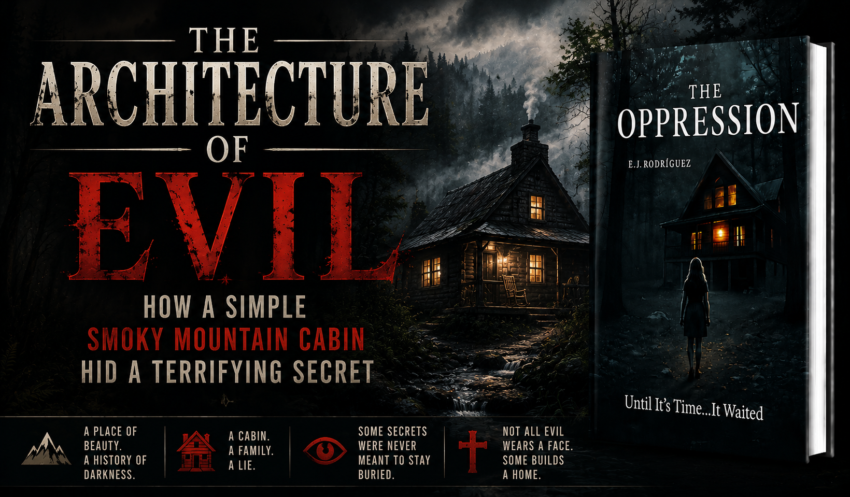
There is a distinctly American dream associated with the Great Smoky Mountains. Millions of tourists flock to the misty ridges of Eastern Tennessee every year, seeking a quiet reprieve from the relentless grind of modern life. We envision rustic log cabins, crackling wood-burning fireplaces, and the serene isolation of a misty morning in the woods. It is a landscape that promises peace.
But what happens when that isolation is not peaceful, but predatory? What happens when the walls of a beautiful mountain getaway absorb a history so dark that the physical structure itself becomes a vessel for malice?
In E.J. Rodriguez’s masterfully crafted supernatural thriller, The Oppression, the true horror does not begin in a gothic castle or a sprawling, decrepit mansion. It begins in a highly desirable, three-bedroom cabin priced just $20,000 below market value. By anchoring the origin of a demonic attack in the mundane world of real estate viewings and property investments, Rodriguez taps into a deeply relatable, thoroughly terrifying premise: You can inspect the foundation, check the roof, and review the property taxes, but how do you appraise the spiritual rot of a home?
The Illusion of Rustic Charm
From the moment retired Air Force veteran Gabe Aldana pulls his truck up the steep, winding driveway of “Big Bertha”—the local moniker for the mountain where the cabin resides—Rodriguez meticulously builds a sense of environmental dread.
The author doesn’t rely on cheap scares; he uses the landscape itself to signal that something is fundamentally wrong. The cabin is perched on an outcrop, surrounded by a stand of dead, skeletal trees—the remnants of a localized fire that inexplicably stopped right at the property line. The lush canopy of the Smokies gives way to an area where the sun seems oddly hidden, casting a perpetual, ominous gray pall over the home.
Then there is the real estate agent, Diane. In a brilliant subversion of the eager-to-sell realtor trope, Diane leads Gabe and his young son, Ryan, to the front door but flatly refuses to step inside. She blames her asthma and a fictitious cat allergy, choosing instead to stand nervously on the mossy stone pathway, obsessively rubbing a turquoise talisman around her neck.
As a reader—and certainly through the lens of a cinematic adaptation—the tension in this scene is palpable. Gabe, a man whose entire career was built on situational awareness and threat assessment, senses the deception immediately. The cabin is visually stunning. It features a double-barreled chimney, pristine wood flooring, and the distinct, comforting smell of soot. But the air is heavy. The silence is too thick. The physical space feels like a held breath.
Symbols in the Woodwork
The brilliance of The Oppression lies in its attention to the intersection of history, culture, and the preternatural. As Gabe walks through the first floor, he notices intricate carvings etched into the wooden crossbeams above every entrance. They look like native art—bows, arrows, and the hunchbacked flute player, Kokopelli.
Diane dismisses them as mere aesthetic choices made by the previous owners. But Gabe, an expert in wilderness survival with a deep respect for indigenous cultures, suspects they serve a darker, more superstitious purpose.
It is only later in the novel that the terrifying truth of the architecture is revealed. The cabin previously belonged to Dale Richards, a desperate father whose teenage daughter, Judy, had fallen victim to a horrific, cult-like group operating in the mountains. Following severe trauma and occult involvement, Judy brought a preternatural attachment back to the cabin.
The carvings on the beams were not decorations. They were desperate, localized wards. Written in a 19th-century Cherokee syllabary and burned into the wood with a blowtorch, they were prayers of protection advised by Diane’s Native American husband in a frantic attempt to contain the evil within the walls.
Rodriguez effectively turns the cabin into a spiritual pressure cooker. The physical home was modified to act as a cage for a demonic entity. And when Gabe Aldana—a strong, protective family man—walks through those warded doors, the trapped entity recognizes a new, prime target.
The Attic: A Spiritual Ground Zero
In the theology of spiritual warfare, demons do not randomly haunt physical spaces; they are invited in, and they attach themselves to the trauma, sin, and malice of the living. In The Oppression, the epicenter of this infestation is the cabin’s attic.
This narrow, unfurnished, eight-by-eleven-foot room is where Dale’s daughter spent hours locked away, writing letters to a dark presence, performing isolated rituals, and offering herself to the entity in exchange for a distorted promise of love. The attic became a spiritual ground zero—a space heavily saturated with human despair and demonic invitation.
When Gabe climbs the narrow staircase to inspect the room, the novel shifts from an eerie mystery into pure, adrenaline-pumping terror. The door violently slams shut on its own. A distinct, guttural animal growl reverberates in the pitch-black space. And then, Gabe sees it: a towering, impossibly dark mass that disrupts the very dust particles in the air. It is a moment of visceral horror that completely shatters Gabe’s understanding of the natural world.
The entity isn’t just haunting the attic; it has claimed it. And because Gabe dared to step into its territory, the entity decides to claim Gabe.
The Ethics of Preternatural Real Estate
Beyond the supernatural terror, Rodriguez introduces a fascinating, grounded conflict: the ethics of disclosure.
When Gabe flees the attic and confronts Diane in the driveway, the narrative briefly shifts into a remarkably human confrontation. Gabe is furious—not just because he was attacked by a shadow figure, but because a real estate agency was actively trying to sell a cursed, dangerous property to an unsuspecting family just to secure a commission.
“If I’m going to spend $240,000 on a purchase, it’s my right to find out everything I need to know about the property I’m getting into,” Gabe demands.
It is a chilling thought for any working professional or prospective homeowner. Property laws require the disclosure of lead paint, asbestos, and flood damage. But there is no legal requirement to disclose that a home was the site of occult rituals, or that its previous occupants fled for their lives from an oppressive, invisible force. The cabin in The Oppression is a pristine, turn-key nightmare.
A Warning in the Walls
The Oppression elevates the “haunted house” narrative by grounding it in the grueling realities of spiritual warfare and human deceit. The Smoky Mountain cabin is not merely a setting; it is an active antagonist in the story. It is a physical structure that absorbed the grief of a broken family and incubated an ancient evil.
Rodriguez’s meticulous world-building serves as a terrifying warning. Evil does not always announce itself with thunder and lightning. Sometimes, it waits quietly behind a beautiful wooden door, tucked away in the scenic foothills of a coveted vacation destination, waiting for the next buyer to simply turn the key.
For thriller enthusiasts and filmmakers looking for a story that blends psychological intensity with terrifying, location-based horror, the cabin in The Oppression is a masterclass in suspense. It reminds us that once a door to the unseen world is opened, it cannot be easily closed—and no amount of sage, structural renovations, or carved wooden beams can keep the darkness from following you home.