
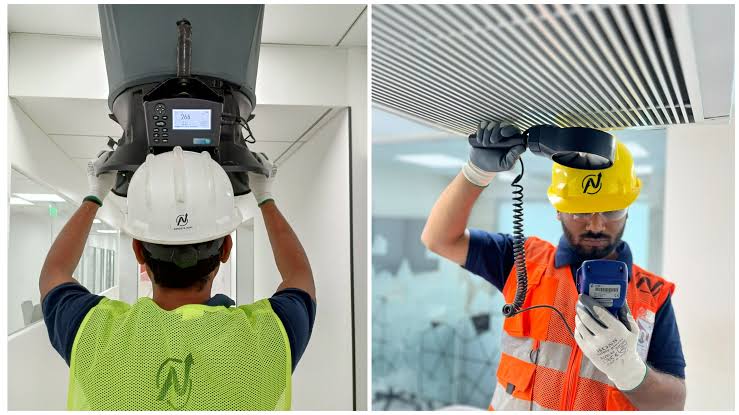
As energy costs continue to rise and sustainability goals become more ambitious, building owners are increasingly focused on improving operational efficiency. Achieving optimal building performance requires more than installing modern equipment—it demands a systematic approach to testing, verification, and energy management. This is where NEBB-certified TAB contractors and AEE-certified energy professionals play a critical role.
Understanding Building Performance Methodology
Building performance methodology is a structured process used to evaluate, optimize, and maintain the efficiency of building systems. It focuses on how various components—such as HVAC, lighting, controls, and building envelopes—work together to deliver comfort, indoor air quality, and energy efficiency.
The methodology typically includes:
- Performance Assessment – Evaluating existing building systems and identifying inefficiencies.
- Data Collection and Analysis – Measuring energy consumption, airflow, temperatures, and system operations.
- Testing and Verification – Confirming that equipment operates according to design specifications.
- Optimization Measures – Implementing corrective actions to improve performance.
- Ongoing Monitoring – Continuously tracking system performance to sustain results.
This process helps facility managers reduce operating costs, improve occupant comfort, and extend equipment life.
The Role of NEBB-Certified TAB Contractors
The National Environmental Balancing Bureau (NEBB) certification is recognized as a benchmark of excellence in Testing, Adjusting, and Balancing (TAB) services. NEBB-certified TAB contractors ensure that HVAC systems perform as intended by verifying airflow, water flow, pressure relationships, and overall system operation.
Their responsibilities include:
- Measuring and balancing air distribution systems.
- Verifying hydronic system performance.
- Testing ventilation effectiveness.
- Identifying installation and operational deficiencies.
- Supporting commissioning and retro-commissioning projects.
Accurate TAB services are essential because even the most advanced HVAC equipment cannot achieve peak efficiency if airflow and water flow rates are incorrect. A properly balanced system improves comfort, reduces energy waste, and ensures compliance with design requirements.
The Value of AEE-Certified Energy Professionals
The Association of Energy Engineers (AEE) certifies professionals who specialize in energy management, auditing, and sustainability practices. Certifications such as Certified Energy Manager (CEM) demonstrate expertise in identifying opportunities to reduce energy consumption and improve operational efficiency.
AEE-certified professionals contribute by:
- Conducting detailed energy audits.
- Developing energy management strategies.
- Evaluating utility consumption patterns.
- Recommending cost-effective efficiency measures.
- Supporting decarbonization and sustainability initiatives.
Their knowledge helps organizations make informed decisions about energy investments and operational improvements. By combining technical analysis with financial evaluation, they ensure that efficiency projects deliver measurable returns.
Integrating TAB and Energy Management for Better Results
While TAB contractors focus on system performance verification, energy professionals concentrate on overall building efficiency. Together, they create a powerful framework for improving building operations.
For example, an energy audit may reveal excessive HVAC energy consumption. A NEBB-certified TAB contractor can then investigate airflow imbalances, control issues, or improper system settings that contribute to the problem. Once corrections are implemented, the energy professional can verify energy savings and establish long-term monitoring procedures.
This collaborative approach ensures that identified opportunities translate into real performance improvements rather than theoretical recommendations.
Building Energy Case Studies
Case Study 1: Office Building HVAC Optimization
A 200,000-square-foot office building experienced high energy bills and frequent occupant comfort complaints. An AEE-certified energy professional conducted an energy assessment and identified HVAC inefficiencies as a primary concern.
A NEBB-certified TAB contractor performed a comprehensive balancing study and discovered significant airflow imbalances throughout the building. Several zones received excessive conditioned air, while others received insufficient airflow.
After system balancing and control adjustments:
- HVAC energy consumption decreased by 18%.
- Occupant comfort complaints dropped significantly.
- Equipment runtime was reduced, extending system life.
- The building achieved a payback period of less than two years.
Case Study 2: Healthcare Facility Performance Improvement
A healthcare facility sought to improve indoor air quality while reducing operating expenses. Maintaining proper pressurization and ventilation was critical due to strict healthcare requirements.
The project team included both AEE-certified energy specialists and NEBB-certified TAB professionals. Through detailed testing and performance verification, they identified several ventilation issues and control system inefficiencies.
Project outcomes included:
- Improved pressure relationships in critical spaces.
- Enhanced indoor air quality and compliance.
- Energy savings of approximately 15%.
- Reduced maintenance costs through optimized system operation.
Case Study 3: University Campus Energy Reduction
A university implemented a campus-wide energy management program aimed at reducing utility expenditures. Energy professionals analyzed consumption trends across multiple buildings and prioritized facilities with the greatest savings potential.
TAB specialists verified HVAC performance and corrected deficiencies in airflow distribution and hydronic balancing.
Results included:
- Annual energy savings exceeding hundreds of thousands of dollars.
- Improved classroom comfort conditions.
- Reduced greenhouse gas emissions.
- Stronger support for institutional sustainability goals.
Conclusion
High-performing buildings require both accurate system verification and strategic energy management. NEBB-certified TAB contractors provide the technical expertise needed to ensure HVAC systems operate according to design intent, while AEE-certified energy professionals identify and implement broader efficiency opportunities.