
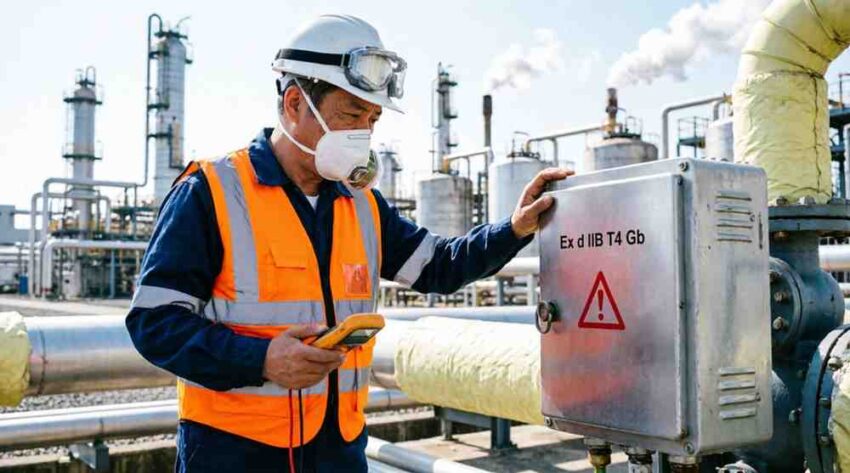
Working near flammable gas or combustible dust changes everything about equipment choice. IECEx Certification is the global system that proves equipment and people are safe in these environments.
This guide explains what it is, why it matters, and how it actually works.
What Is IECEx Certification
IECEx Certification is an international scheme that certifies equipment, systems, and personnel for use in explosive atmospheres. It confirms compliance with IEC standards for hazardous areas worldwide.
The scheme covers three main areas:
- Equipment Certification – confirms products won’t ignite explosive atmospheres
- Personnel Certification – confirms individuals understand hazardous area work
- Service Facility Certification – confirms repair shops meet safety standards
IECEx replaces the need for separate national certifications in most participating countries. One certificate, recognized globally, saves time and cost.
Unlike regional schemes, IECEx operates under the International Electrotechnical Commission. That gives it worldwide credibility across oil, gas, mining, and chemical sectors.
Why IECEx Certification Matters
IECEx Certification matters because a single spark in a hazardous area can trigger an explosion. Certification proves equipment and staff won’t create that spark.
Consider what’s at stake without it:
- Uncertified equipment can ignite gas or dust
- Untrained staff can misjudge hazardous zone risks
- Insurance claims can get denied after uncertified incidents
- Contracts and tenders often require proof of compliance
A real example: a refinery in the Gulf once installed uncertified lighting in a Zone 1 area. A minor gas leak combined with heat from the fixture caused a small fire. No one died, but the plant shut down for two weeks.
That incident cost more than certification ever would have. Prevention beats repair every time.
How the IECEx System Works
The IECEx System works through independent testing labs, auditors, and certification bodies working together. No single party controls the whole process.
Here’s the basic flow:
- Manufacturer submits equipment for testing and review
- Ex Testing Laboratory (ExTL) tests the product against IEC standards
- Factory audit confirms consistent manufacturing quality
- Ex Certification Body (ExCB) reviews all findings
- Certificate gets issued and listed on the IECEx database
For personnel certification, the process shifts slightly:
- Candidate completes accredited training
- Candidate passes written and practical assessments
- Certification body issues a Certificate of Personnel Competence
Anyone can verify certificates through the public IECEx online database. That transparency stops fraud and builds buyer confidence.
Industries That Require IECEx
Industries with explosive gas, vapor, or dust risks require IECEx Certification. This includes oil and gas, mining, chemical plants, and food processing facilities.
Common industries include:
- Oil and gas – drilling platforms, pipelines, refineries
- Petrochemical plants – reactors, storage tanks
- Mining – underground coal operations
- Chemical manufacturing – solvent and reagent handling
- Pharmaceutical production – solvent-based drug manufacturing
- Food and grain processing – flour mills, sugar refineries
- LNG facilities – liquefaction and storage units
Each industry has classified zones where explosive atmospheres exist regularly or occasionally. IECEx certified equipment protects those exact zones.
Types of IECEx Certifications
IECEx offers three certification types: equipment (IECEx CoC), personnel (CoPC), and service facility certification. Each targets a different part of hazardous area safety.
| Certification Type | What It Covers | Who Needs It |
|---|---|---|
| Equipment Certificate (CoC) | Products used in hazardous zones | Manufacturers, suppliers |
| Personnel Certificate (CoPC) | Individual competency in Ex work | Engineers, technicians |
| Service Facility Certification | Repair and overhaul facilities | Equipment repair shops |
Equipment certification protects the product. Personnel certification protects the people installing and maintaining it. Both work together on a real site.
Understanding zone classifications and protection concepts helps clarify which certification type applies to your situation.
Basic Certification Process
The certification process moves through documentation review, lab testing, factory audit, and final approval. Most equipment certifications take three to six months.
Simple version of the process:
- Define your certification scope and zone requirements
- Prepare technical documentation and design files
- Submit samples for laboratory testing
- Pass a factory audit for quality consistency
- Receive final review and certificate issuance
Documentation gaps cause most delays, not testing failures. Get your technical file complete before applying.
Businesses in Gulf markets should also check IECEx certification requirements in the UAE, since local enforcement varies by sector and project type.
Common Misconceptions
Many businesses misunderstand what IECEx covers and requires. Clearing up these myths saves confusion during planning.
- “IECEx and ATEX are the same.” False. ATEX is a European Union directive; IECEx is a global voluntary scheme.
- “All electrical equipment needs IECEx.” False. Only equipment in classified hazardous zones needs it.
- “IECEx is mandatory everywhere.” False. Some countries reference it in law; others treat it as voluntary but market-expected.
- “Certification never expires.” False. Certificates require periodic surveillance audits and renewal.
- “IECEx and Compex certify the same thing.” False. IECEx often covers equipment and personnel; Compex focuses on personnel competency in specific regions. Compare IECEx vs Compex certification for clarity.
IECEx vs ATEX
| Factor | IECEx | ATEX |
|---|---|---|
| Scope | Global | European Union |
| Legal Status | Voluntary scheme | Legally mandatory in EU |
| Governing Body | IEC | European Commission |
| Recognition | Worldwide | Primarily EU markets |
| Covers Personnel | Yes | Not directly |
Many manufacturers hold both certifications to serve global and EU markets simultaneously.
Benefits for Companies
Companies gain market access, fewer accidents, and stronger client trust through IECEx Certification. It also simplifies compliance across multiple countries.
Key business benefits:
- Access to international oil, gas, and chemical markets
- Fewer explosion-related incidents and shutdowns
- Stronger position in tenders and contracts
- Reduced insurance premiums in many cases
- One certificate accepted across many countries
A pump manufacturer in the UAE expanded into Saudi and Qatari markets after certifying products through IECEx. One certificate opened three markets at once.
Review this IECEx certification cost breakdown to plan your budget before starting the process.
Benefits for Professionals
Professionals gain better job opportunities, higher pay, and stronger technical credibility through IECEx personnel certification. Employers actively seek certified engineers and technicians.
Career benefits include:
- Recognition across international hazardous area projects
- Eligibility for senior maintenance and inspection roles
- Stronger technical understanding of explosion protection
- Portable credentials across employers and countries
An instrumentation engineer certified under IECEx can work confidently on rigs, refineries, or mines anywhere. That mobility matters in global industries.
Explore IECEx certification training programs to start building these credentials. A structured training guide for 2026 also breaks down course levels clearly.
Frequently Asked Questions
What is IECEx Certification?
It’s a global scheme certifying equipment, systems, and personnel for hazardous areas.
Is IECEx Certification mandatory?
It depends on your country. Many nations adopt it as their legal baseline standard.
Why is IECEx Certification important?
It prevents explosions by proving equipment and staff meet safety standards.
Who requires IECEx Certification?
Oil, gas, mining, chemical, and food processing industries typically require it.
What industries use IECEx Certification?
Oil and gas, mining, chemical manufacturing, pharmaceuticals, and LNG facilities use it most.
How is IECEx different from ATEX?
IECEx is global and voluntary. ATEX is a legally mandatory EU directive.
How does IECEx Certification work?
Testing labs check equipment, auditors check factories, and certification bodies issue final certificates.
IECEx Certification protects people, equipment, and business operations in hazardous areas. Whether you’re certifying products or building your career, this system opens doors globally. Start with clear scope, proper documentation, and the right training partner.