
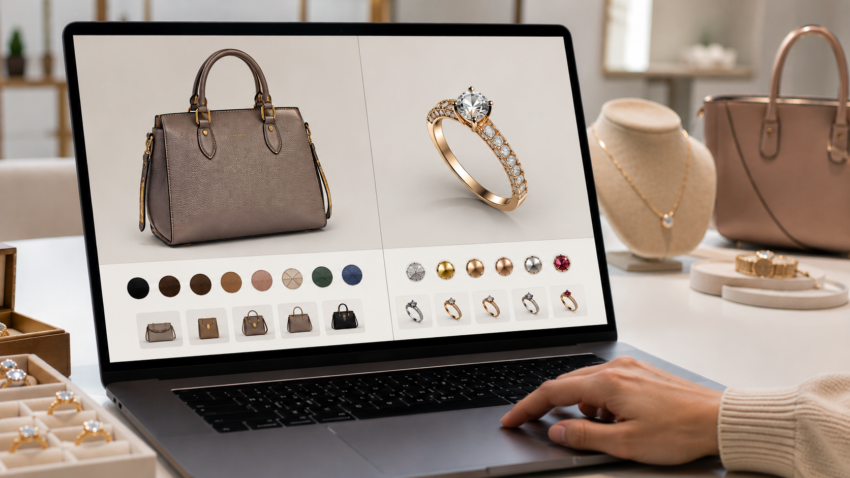
Online shopping has always had one problem that never quite went away. You cannot touch the fabric. You cannot see how a ring catches the light. You cannot tell if that jacket will actually look the way it does on the model. For years, retailers tried to solve this with better photography and longer product descriptions. It helped, but it never fully closed the gap between browsing a screen and holding something in your hands.
That gap is finally starting to close, and a 3D product configurator is one of the main reasons why.
What Exactly Is a 3D Product Configurator
A 3D product configurator is a tool that lets shoppers build and view a product in three dimensions, right inside their browser. Instead of scrolling through a fixed set of photos, customers can rotate the item, zoom into the stitching or the gemstone setting, and swap colors, materials, or components on the fly.
Think of it as a digital showroom that responds to what you want to see. Pick a different leather finish and watch the bag update instantly. Swap a gold band for platinum and the ring re-renders in real time. There is no waiting for a new photoshoot or a page reload. The change happens live, because the product is being modeled and rendered on the spot rather than pulled from a static image library.
This is different from a simple image gallery. A gallery shows you what already exists. A configurator shows you what could exist, based on choices you make yourself.
Why Fashion Brands Are Paying Attention
Fashion is a visual and tactile category, which makes it a tricky fit for e-commerce. A shirt can look completely different depending on the fabric weight, the cut, or even the lighting in a photo. Shoppers often hesitate before buying clothing online because they are not confident the item will match their expectations once it arrives.
A 3D configurator addresses that hesitation directly. Shoppers can view a garment from every angle, check how a pattern wraps around a sleeve, or preview how a dress moves in a simplified animation. Some tools even let customers adjust size proportions to get a rough sense of fit before checkout.
There is also a growing appetite for personalization. Younger shoppers in particular want products that feel unique to them, not mass-produced. A configurator lets a shopper choose their own combination of color, trim, and material, then see the finished product before committing to buy. That sense of participation tends to build more confidence in the purchase than a static photo ever could.
Brands benefit too. Instead of photographing every possible color and fabric combination, a company can build one accurate 3D model and let the configurator generate the rest. This cuts down on photography costs and shortens the time it takes to launch new product variants.
The Jewelry Case: Precision Meets Emotion
Jewelry shopping carries its own set of challenges. Purchases are often tied to big moments such as engagements, anniversaries, or milestone gifts. That emotional weight makes shoppers want to get every detail right, from the metal type to the stone cut to the exact way a setting catches light.
A 3D configurator is particularly useful here because jewelry is defined by fine detail. Shoppers can zoom in far closer than a standard photo would allow, examining facets, prongs, and engravings. They can switch a stone from a round cut to a princess cut and immediately see how the silhouette changes. They can compare rose gold against white gold without needing separate photo sets for each.
For custom pieces, the benefit goes even further. A shopper designing a ring can select a band width, choose a stone size, and preview the finished piece as a rendered 3D object rather than a rough sketch. This reduces the uncertainty that often comes with ordering something that cannot be seen in person before it ships.
Because jewelry purchases tend to involve higher price points and more deliberation, giving shoppers a clearer preview can meaningfully affect how comfortable they feel completing the order.
How the Technology Actually Works
Most 3D configurators rely on a base 3D model of the product, built using detailed measurements and reference photography. This model separates out the changeable elements, like color, texture, and material, from the fixed structure of the product. When a shopper picks a new option, the configurator applies that change to the model and re-renders it, usually within a second or two.
Modern configurators run directly in a web browser using WebGL or similar rendering technology, so shoppers do not need to download an app or install any special software. Everything happens on the same page where they are already browsing.
Lighting and material accuracy matter a lot in this process. A configurator needs to simulate how metal reflects light, how fabric folds, or how a gemstone refracts, closely enough that the digital version matches what a customer would see in person. This is why the more advanced tools invest heavily in realistic texture mapping and lighting simulation rather than just spinning a flat 3D shape.
Impact on Returns and Buyer Confidence
One of the most practical outcomes of this technology is a reduction in returns. A large share of online returns, especially in fashion, happen because the product did not match what the customer expected. When shoppers can preview color, texture, and fit more accurately before buying, that mismatch happens less often.
Confidence at the point of purchase also tends to improve. Shoppers who can interact with a product, rather than just look at it, generally spend more time engaging with the page and report feeling more certain about their choice. That certainty translates into fewer abandoned carts and fewer post-purchase regrets.
Retailers tracking these tools have also noticed longer browsing sessions. People enjoy the process of customizing something, which keeps them on the page longer and gives them more exposure to the product’s details before they decide to buy.
Where This Is Headed
As rendering technology continues to improve, 3D configurators are becoming faster and more realistic, even on mobile devices with limited processing power. Augmented reality is starting to layer on top of this trend as well, letting shoppers see a virtual ring on their own hand or a jacket on their own body through a phone camera.
Fashion and jewelry are likely just the starting point. Any product category where visual detail, personalization, or fit plays a major role in the buying decision stands to benefit from similar tools. What began as a niche feature for a handful of forward-looking retailers is becoming a standard expectation in online shopping.
The core idea behind all of this stays the same. Shoppers want to feel sure about what they are buying before they hand over their money. A 3D product configurator gets them closer to that certainty than a photo ever could, and that shift is quietly reshaping how people shop for the things they care about most.