
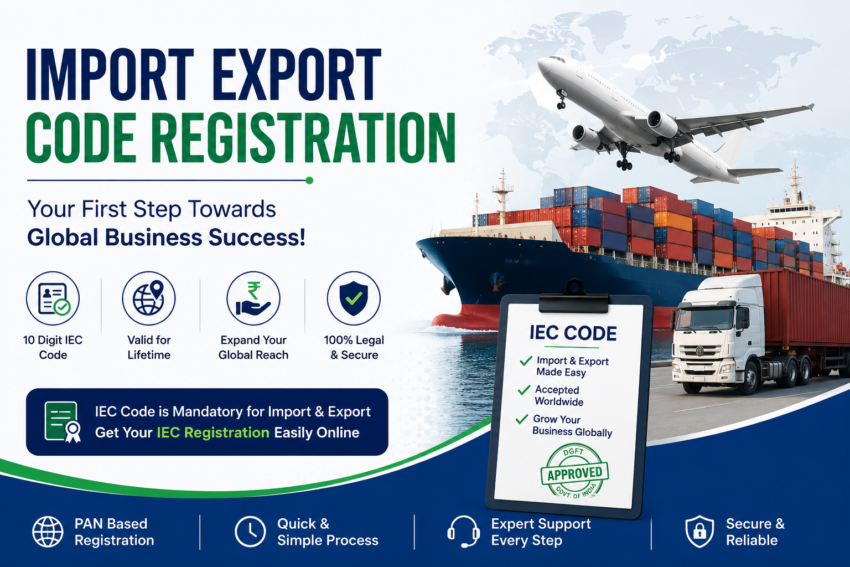
Import Export Code Registration becomes necessary the moment a seller ships products outside India, whether through Amazon Global Selling, an independent export order, or a cross-border marketplace. Selling only within India on Amazon.in or Flipkart doesn’t need an IEC — GST registration covers that. The line is simple: domestic selling runs on GST, cross-border selling runs on IEC.
Do Amazon and Flipkart Sellers Always Need an IEC?
No, not for regular domestic listings. A seller shipping products only to buyers within India, through Amazon.in or Flipkart’s domestic marketplace, operates entirely under GST rules. No customs clearance happens in that flow, so the Import Export Code simply isn’t part of the picture.
The requirement changes the instant a product crosses the border. That’s when DGFT and customs authorities step in, and an IEC becomes non-negotiable.
When Does IEC Become Mandatory for E-Commerce Sellers?
An IEC is required in these situations:
- Selling through Amazon Global Selling, which lets Indian sellers list products across 18+ international marketplaces including the US, UK, and UAE
- Fulfilling international orders placed directly through your own website
- Sending inventory to an overseas Amazon fulfillment center under FBA
- Participating in B2B export marketplaces that connect Indian sellers with global buyers
Each of these routes involves a shipment leaving Indian customs, and customs won’t clear an export without a valid IEC attached to the seller’s PAN.
What Documents Does Amazon Global Selling Ask For?
Amazon verifies a specific document set before activating an international selling account:
- Import Export Code (IEC) issued by DGFT
- Active GST registration certificate
- PAN card of the business or proprietor
- Bank account details, along with an AD (Authorised Dealer) Code from that bank
- A recent utility bill or bank statement matching the registered address
Sellers targeting the US market may also go through an additional identity verification step, occasionally including a short video call, along with a tax interview covering US business connections.
How Long Does It Take to Get IEC-Ready for Amazon Global?
Applying for an IEC through the DGFT portal generally takes a few working days for approval, though sellers should budget more time for the entire onboarding chain. Beyond the IEC itself, registering an AD Code with your bank and filing a GST LUT (Letter of Undertaking) for zero-rated exports both need to happen before shipments can move smoothly.
Getting all three pieces — IEC, AD Code, and LUT — in place before applying to Amazon Global Selling avoids a stop-start onboarding experience later.
Is IEC Required for Selling on Flipkart’s Cross-Border Program?
Yes, the same logic applies. Any Flipkart seller program that ships products to international buyers requires an active IEC, alongside GST registration and export documentation like a commercial invoice, packing list, and airway bill or bill of lading.
Flipkart’s domestic marketplace, much like Amazon.in, doesn’t touch export compliance, so sellers staying purely domestic can skip IEC without any legal risk.
Do Independent Website Sellers Need IEC Too?
Absolutely, and this is where many D2C brands get caught off guard. A brand running its own Shopify or WooCommerce store, shipping orders internationally through a courier or freight forwarder, still needs an IEC. The marketplace name doesn’t matter to customs — what matters is whether goods are physically leaving the country.
Small parcel exports through international couriers still require IEC-linked shipping documentation
Bulk shipments through freight forwarders always ask for IEC before booking cargo space
Payment gateways processing international customer payments often request IEC details during KYC
What Happens If an International Seller Skips IEC Registration?
Shipments get stopped at customs, plain and simple. Beyond the immediate delay, a seller risks:
- Rejected shipping bills, leading to inventory sitting idle at the port
- Blocked international payment settlement through banking channels
- Difficulty claiming export incentives like RoDTEP once eligible
Given the government fee for IEC sits at a flat ₹500, sellers planning any cross-border activity gain little by delaying registration.
Note: Need to register your business? StartupIndiaOnline provides expert assistance for Company Registration, documentation, and post-incorporation compliance.
Summary
Domestic sellers on Amazon.in and Flipkart don’t need Import Export Code Registration since GST covers those transactions. The moment a seller moves into Amazon Global Selling, cross-border marketplace programs, or independent international shipping, IEC becomes a hard requirement alongside GST, an AD Code, and often an LUT. Getting these pieces ready early keeps international expansion smooth instead of stalled at the customs desk.
FAQ
Q1. Do I need IEC to sell only on Amazon.in within India?
No, domestic-only selling on Amazon.in or Flipkart runs on GST registration and doesn’t require an IEC.
Q2. Is IEC enough on its own for Amazon Global Selling?
No, sellers also need active GST registration, an AD Code from their bank, and usually a GST LUT for zero-rated exports.
Q3. Can a proprietorship apply for IEC to sell internationally?
Yes, proprietorships, partnerships, LLPs, and private limited companies can all register for IEC and use it for cross-border selling.
Q4. Does selling through FBA (Fulfillment by Amazon) still need IEC?
Yes, sending inventory to an overseas Amazon fulfillment center counts as an export and requires a valid IEC.
Q5. Is IEC required for shipping single international parcels through my own website?
Yes, even individual cross-border shipments through couriers need IEC-linked export documentation.