
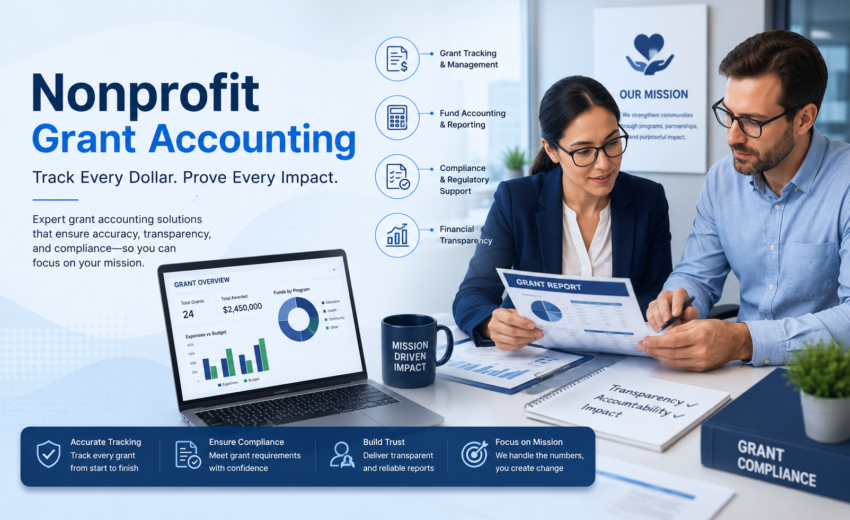
In 2026, nonprofits are managing increasingly complex funding arrangements, multiple programs, restricted funds, and detailed reporting requirements. A reliable grant accounting process can help organizations avoid compliance problems, prepare accurate reports, and build greater trust with funders.
The good news? Grant accounting doesn’t have to be overwhelming. With the right system and habits, nonprofits can make every dollar easier to track and every report easier to prepare.
What Is Nonprofit Grant Accounting?
Grant accounting is the process of tracking grant-related revenue and expenses while ensuring the funds are used according to the terms established by the grantor.
Unlike general accounting, grant accounting requires nonprofits to connect financial activity to specific funding requirements.
For example, imagine a nonprofit receives a $150,000 grant for a community education program.
The organization may need to track:
- How much of the grant was received
- Which expenses were charged to the grant
- How much remains
- Whether expenses are allowable
- Whether spending matches the approved budget
- When reports are due
- What documentation supports each expense
The goal is simple: create a clear financial trail from the grant award to the final dollar spent.
Why Grant Accounting Matters in 2026
Nonprofits rarely depend on a single source of funding.
An organization might receive money from government grants, private foundations, corporate sponsors, individual donors, and fundraising campaigns—all with different expectations.
That can make financial tracking complicated.
A nonprofit may have several grants funding the same general program but with different restrictions. Without proper tracking, expenses can accidentally be charged to the wrong funding source.
Strong grant accounting helps organizations:
- Maintain accurate financial records
- Monitor grant budgets
- Avoid unauthorized spending
- Meet reporting deadlines
- Prepare for audits
- Identify budget problems early
- Improve financial transparency
- Maintain funder confidence
In other words, good grant accounting isn’t just about compliance. It helps protect the nonprofit’s ability to continue doing its work.
Step 1: Understand the Grant Before Spending
One of the easiest ways to create accounting problems is to start spending before fully understanding the grant agreement.
Every grant should be reviewed carefully before funds are used.
Look for details such as:
- Approved expenses
- Unallowable costs
- Grant start and end dates
- Reporting requirements
- Budget categories
- Matching requirements
- Spending restrictions
- Documentation requirements
- Deadlines
Don’t assume that an expense is allowable simply because it supports the nonprofit’s mission.
A cost can be reasonable for the organization but still not be permitted under a particular grant.
Step 2: Create Separate Grant Tracking
When multiple grants are involved, simply recording everything under broad expense categories isn’t enough.
Nonprofits should establish a system that allows transactions to be associated with the appropriate grant, program, department, or funding source.
For example:
| Grant | Award | Spent | Remaining |
|---|---|---|---|
| Youth Development | $100,000 | $62,000 | $38,000 |
| Community Health | $200,000 | $145,000 | $55,000 |
| Job Training | $125,000 | $81,000 | $44,000 |
This type of tracking gives management a much clearer picture of available funding.
It also makes reporting easier because financial information can be pulled for each grant without rebuilding the records from scratch.
Step 3: Compare Actual Spending With the Budget
A grant budget is not something you should look at only when a report is due.
Regular budget-to-actual reviews can help identify problems early.
Suppose a grant allocated $30,000 for employee costs, but the nonprofit has already spent $27,000 halfway through the grant period.
That should raise a question.
Is spending occurring faster than expected? Was the original budget unrealistic? Is a budget adjustment required?
Finding the issue early gives the organization time to respond.
Waiting until the end of the grant period can leave very few options.
Step 4: Keep Documentation Audit-Ready
If someone asks, “Why was this expense charged to the grant?”, you should be able to answer quickly.
Supporting documentation may include:
- Invoices
- Receipts
- Payroll records
- Timesheets
- Contracts
- Purchase orders
- Bank statements
- Expense approvals
- Allocation calculations
Good documentation should make it possible to trace a transaction from the accounting system back to its original source.
This is especially important when expenses are shared across multiple grants or programs.
For example, if an employee works on three grant-funded programs, the nonprofit should have a reasonable method for allocating that employee’s costs.
Step 5: Monitor Reporting Deadlines
A strong grant accounting process can still fail if reports are submitted late.
Create a centralized grant calendar that includes:
- Grant reporting deadlines
- Financial report dates
- Program report dates
- Grant expiration dates
- Renewal deadlines
- Budget modification deadlines
- Audit requirements
Assign responsibility for each deadline.
Don’t rely on one person’s memory or an email sitting in an inbox.
A shared system makes deadlines visible and easier to manage.
Step 6: Reconcile Grant Accounts Regularly
Reconciliation is another important part of grant accounting.
Nonprofits should regularly compare their accounting records with bank activity, grant records, payroll information, and supporting documentation.
This can uncover:
- Missing transactions
- Duplicate expenses
- Incorrect classifications
- Unusual balances
- Unrecorded deposits
- Expenses charged to the wrong grant
Monthly reviews are generally much easier than trying to correct an entire year’s records at once.
Common Grant Accounting Mistakes to Avoid
Even organizations with experienced finance teams can make grant accounting mistakes.
Some of the most common include:
Mixing restricted and unrestricted funds
Grant money may have specific restrictions. Mixing it with unrestricted funds can make tracking and reporting difficult.
Waiting until the deadline to review spending
Last-minute reviews can uncover problems when there isn’t enough time to correct them.
Poor documentation
An expense without adequate supporting evidence can become difficult to defend during an audit or review.
Using the wrong grant code
A transaction charged to the wrong funding source can create inaccurate grant reports.
Ignoring budget variances
Small differences can become significant if they aren’t monitored regularly.
Technology Can Make Grant Accounting Easier
In 2026, nonprofits have more opportunities to use technology to improve financial tracking.
Cloud accounting platforms, automated transaction feeds, digital document storage, reporting dashboards, and workflow tools can reduce manual work and improve visibility.
Technology can help teams quickly answer questions such as:
How much of this grant has been spent?
Which expenses are approaching budget limits?
What reports are due this month?
Which transactions still need documentation?
But technology is only as useful as the process behind it. A sophisticated accounting system cannot replace clear grant policies, accurate data, and regular financial reviews.
A Simple Monthly Grant Accounting Checklist
A monthly review can be surprisingly effective.
Ask:
- Have all grant transactions been recorded?
- Are expenses assigned to the correct grant?
- Do actual expenses match the budget?
- Are there unusual variances?
- Is supporting documentation complete?
- Are restricted funds being used correctly?
- Are upcoming reporting deadlines documented?
- Does the remaining grant balance look reasonable?
This simple routine can prevent small accounting issues from becoming major compliance problems.
Final Thoughts
Grant accounting is about much more than entering numbers into an accounting system.
It is about accountability.
Every grant dollar should have a clear story: where it came from, what it was used for, why the expense was allowable, and how it supported the nonprofit’s mission.
For nonprofits in 2026, the strongest approach is proactive rather than reactive. Understand the grant terms before spending, track funding separately, review budgets regularly, maintain strong documentation, reconcile accounts, and stay ahead of reporting deadlines.
When those habits become part of the organization’s financial culture, grant management becomes easier—and nonprofit leaders can spend less time worrying about financial surprises and more time focusing on the mission they are trying to accomplish.