
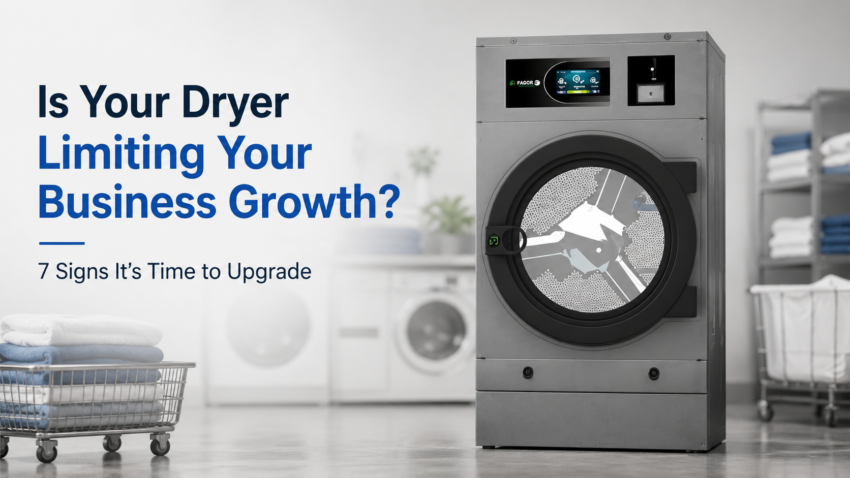
As a laundry business grows, attention often goes first to washing capacity. More orders arrive, additional washers are installed, and production increases. But one part of the operation can quietly begin holding everything back: the dryer.
A dryer that was sufficient when the business started may struggle as daily volumes increase. Wet laundry begins waiting, turnaround times become longer, energy consumption rises, and staff spend more time managing production queues.
At that point, upgrading to the right industrial tumble dryer is not simply an equipment purchase. It can become a capacity investment that helps the entire laundry process more efficiently.
Here are seven signs that your current dryer may be limiting your business growth.
Can Your Dryer Become a Bottleneck in a Growing Laundry Room?
Yes. Every commercial laundry has a maximum processing capacity, and that capacity is often determined by its slowest production stage.
Imagine your washers can process 100 kg per hour, but your drying section effectively handles only 70 kg. Even though washing capacity is available, the overall operation cannot maintain the same throughput because wet laundry starts accumulating.
This is why laundry productivity should be measured across the complete process:
Sorting → Washing → Extraction → Drying → Finishing → Packing
If drying consistently operates slower than the surrounding stages, increasing washing capacity alone will not solve the problem.
Sign 1: Wet Laundry Is Regularly Waiting for Dryer Availability
One of the clearest warning signs is a queue of wet linen waiting for the dryer.
Occasional waiting during an unusually busy period is normal. Regular queues throughout the working week indicate a capacity imbalance.
The problem becomes more serious when operators begin changing production schedules simply to work around dryer availability.
A properly planned commercial tumble dryer section should allow loads to move smoothly from extraction into drying without unnecessary waiting.
Track how long washed loads remain idle before drying. Consistent waiting time provides useful evidence that additional drying capacity should be considered.
Sign 2: Drying Takes Longer Than Your Washing Cycles
Washers and dryers do not necessarily need identical cycle times, but their hourly production should work together.
Suppose a washer completes a load every 40 minutes while the corresponding laundry dryer requires 60 minutes. Over multiple cycles, the washer gradually produces loads faster than the dryer can process them.
The gap becomes increasingly noticeable during long operating shifts.
Drying performance can also be affected by residual moisture after extraction, fabric type, airflow, heating efficiency, loading practices, and equipment condition.
Before assuming you need a larger dryer, identify whether the problem is capacity, maintenance, extraction performance, or operating practice.
Sign 3: You Are Turning Away Orders During Peak Periods
A growing laundry should be able to benefit from peak demand rather than fear it.
If your team regularly declines orders because the drying section cannot keep up, the equipment is placing a ceiling on potential revenue.
This is especially important for laundries serving hotels, hospitals, restaurants, hostels, gyms, and institutional customers, where order volumes can be substantial.
A high-capacity tumble dryer can provide additional processing capability, but capacity should be selected according to real demand rather than occasional maximum loads.
Review how many kilograms of profitable work you are declining each month. That lost contribution can become part of the financial justification for an upgrade.
Sign 4: Energy Cost Per Load Keeps Increasing
Dryers are significant energy consumers in many commercial laundry operations.
An older or inefficient industrial dryer may require longer operating periods to achieve the required moisture level. Poor airflow, damaged seals, heating problems, clogged filters or incorrect loading can further increase energy consumption.
Instead of tracking only the monthly electricity or gas bill, calculate approximate energy cost per kilogram.
If energy consumption rises while processed volume remains relatively stable, investigate the cause.
An energy-efficient tumble dryer with appropriate controls and correctly matched capacity may help improve operating efficiency, but savings depend on machine technology, utilities, loading patterns, and actual operating conditions.
Sign 5: Your Dryer Requires Frequent Repairs
Every machine requires maintenance. Frequent breakdowns are different.
If your industrial dryer machine repeatedly needs repairs, the business pays for more than spare parts.
Downtime can cause:
- Delayed customer orders
- Overtime
- Reduced daily capacity
- Emergency outsourcing
- Staff idle time
- Lost orders
- Customer complaints
Maintenance records can help determine whether continued repair is economically sensible.
Compare annual maintenance expenditure and downtime against the expected cost and productivity benefits of replacement. Sometimes keeping an aging machine operating becomes more expensive than upgrading it.
Sign 6: Your Current Tumble Dryer Capacity No Longer Matches Your Washer
Laundry businesses frequently expand their washing section without reviewing dryer capacity.
For example, a business might replace a smaller washer with a higher-capacity washer extractor while continuing to operate its existing dryer.
The result is an imbalance.
The correct tumble dryer capacity cannot be determined solely by copying the washer’s stated kilogram rating. High-spin extraction may significantly reduce residual moisture, while heavy towels and similar textiles may require different drying conditions from lightweight garments.
Instead, compare actual kilograms processed per hour at both stages.
Your objective is balanced production capacity rather than matching numbers on equipment specification sheets.
Sign 7: Slow Drying Is Affecting Customer Turnaround Time
Customers do not care which stage caused a delay. They care whether their laundry is ready when promised.
If slow drying regularly pushes orders beyond their expected completion times, the problem has moved beyond equipment productivity and started affecting customer experience.
Delayed drying can also compress the finishing and packing schedule. Staff may suddenly receive large batches late in the shift, creating overtime and increasing the possibility of mistakes.
For businesses competing on fast turnaround, an appropriate commercial laundry dryer can therefore support both production and service quality.
What Industrial Tumble Dryer Capacity Does Your Business Need?
Start with actual production data.
Measure:
- Kilograms washed per day
- Kilograms requiring tumble drying
- Average load size
- Number of dryer cycles
- Average drying time
- Operating hours
- Peak-period volumes
- Fabric categories
- Residual moisture after extraction
Suppose your laundry needs to dry 600 kg during a 10-hour production window. Your drying section must practically support an average of approximately 60 kg per hour, with additional capacity desirable for peaks, changeovers and operational variation.
Avoid choosing commercial laundry equipment solely around today’s average volume. Consider realistic growth over the next several years while avoiding excessive unused capacity.
Gas vs Electric Tumble Dryer: Which Is Better When Upgrading?
Both configurations can be appropriate depending on site conditions.
A gas tumble dryer may be attractive where suitable gas infrastructure is available and operating economics make sense. An electric tumble dryer may be easier to implement at locations where sufficient electrical infrastructure already exists.
The decision should consider:
- Local utility costs
- Available electrical load
- Gas availability
- Installation requirements
- Ventilation
- Expected operating hours
- Dryer capacity
- Maintenance requirements
- Long-term operating costs
Do not compare only equipment purchase prices. Compare the total operating economics of both options for your facility.
Should You Buy a Larger Dryer or Add Another Dryer?
There is no universal answer.
A larger commercial dryer machine can simplify high-volume production and may be appropriate when most loads are large and relatively standardized.
Adding another dryer provides greater flexibility. Different fabric categories can be processed simultaneously, and the business gains some production redundancy if one machine requires maintenance.
Multiple dryers can also be useful when customer orders vary considerably in size.
Evaluate your load distribution before deciding. The largest machine is not automatically the most productive solution.
How to Calculate the ROI of an Industrial Tumble Dryer Upgrade
Do not evaluate an upgrade only through the industrial tumble dryer price.
Calculate the financial effect of the equipment on the entire business.
Start with potential improvements in additional kilograms processed, orders accepted, energy consumption, labour utilization, turnaround time, maintenance costs and downtime.
For example, suppose additional drying capacity allows your business to process another 150 kg per day. Multiply that capacity by the contribution earned per kilogram and expected operating days.
Then compare the additional annual contribution and potential operating savings against the total installed investment.
This gives a more meaningful view of ROI than simply choosing the lowest-priced dryer.
How Orgaearth Can Help
Orgaearth helps commercial laundries evaluate drying requirements based on actual processing volumes, washer capacity, fabric mix, available utilities, operating hours and future growth plans.
Our approach considers the complete laundry workflow rather than treating the dryer as an isolated machine.
Orgaearth can support businesses with industrial laundry equipment, including washer-extractors, tumble dryers, finishing systems, dry cleaning equipment, professional laundry chemicals, and other solutions required for commercial operations.
Support can also include equipment selection, capacity planning, layout guidance, installation and commissioning, operator training, preventive maintenance, spare-parts support, and annual maintenance contracts.
The objective is to build a balanced operation where washing, drying and finishing capacity work together efficiently.
Contact Us:
Orgaearth Laundry Solutions
Plot no. 714, Udyog Vihar, Phase 5, Gurugram, Haryana, India-122016
Email: marketing@orgaearth.com
Contact No.: +91 7042912777
FAQs
How do I know if my commercial dryer is too small?
If wet laundry regularly waits for dryer availability, drying limits daily production or you cannot accept additional orders despite available washing capacity, your existing dryer may be undersized for current demand.
What tumble dryer capacity does my laundry need?
Capacity should be based on kilograms requiring drying per hour, fabric mix, extraction performance, cycle duration, operating hours, and peak demand rather than daily volume alone.
Should dryer capacity match washer capacity?
Not necessarily by stated kilogram rating. What matters is whether washing and drying have compatible hourly throughput under your actual operating conditions.
When should I replace an industrial tumble dryer?
Replacement should be considered when frequent repairs, excessive downtime, poor drying performance, high operating costs, or inadequate capacity make continued operation economically inefficient.
Is it better to add another dryer or buy a larger one?
A larger dryer can suit consistently high-volume loads, while multiple dryers provide flexibility, simultaneous processing, and production redundancy. The better choice depends on your load profile and workflow.
Can a faster dryer increase laundry production?
Yes, if drying is currently the production bottleneck. Improving drying throughput can allow more loads to move through finishing and dispatch within the same operating hours.
How much does an industrial tumble dryer cost?
Prices vary according to capacity, heating method, technology, controls, construction and installation requirements. Businesses should compare total installed cost and long-term operating expenses rather than purchase price alone.