
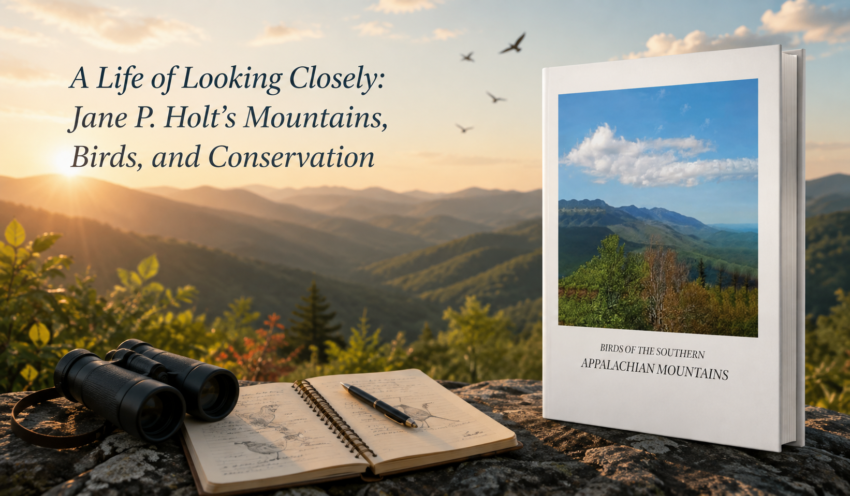
At the end of Birds of the Southern Appalachian Mountains, after warblers, ducks, herons, swallows, owls, woodpeckers, hawks, and dozens of quieter neighbors have crossed the page, the book finally turns the camera toward its maker. Jane P. Holt is identified as a lifelong bird photographer, a professor of biology at Presbyterian College, a director connected with the Montreat Conference Center Wilderness, and someone who helped place the Montreat Wilderness in a conservation easement for future generations.
That short biography explains more about the preceding pages than a long introduction could.
A Scientist’s Eye, a Photographer’s Patience
The book does not read like a conventional field guide. There are no dense identification entries, distribution maps, or technical keys. Instead, Holt teaches by juxtaposition.
A male appears beside a female. An adult appears beside an immature bird. Breeding plumage is compared with fall plumage. Similar ducks are grouped together. A bill is enlarged to show feeding structures. A woodpecker’s tail markings become a clue. A nesting sequence continues across multiple frames.
This is the work of someone who values observation before explanation.
The biology background is visible in what Holt chooses to point out. She notes habitat, elevation, migration timing, feeding behavior, breeding status, sexual differences, nesting methods, and plumage changes. Those details are concise, often only a sentence or two, but they give each photograph ecological context.
The Camera Does Not Rush
Holt’s strongest photographs are not necessarily the ones with the cleanest backgrounds. Some are compelling because they preserve time.
A pied-billed grebe works for twenty minutes to swallow a fish. A black-throated blue warbler maneuvers a sticky worm from a wing feather toward its beak. Tree swallows feed young. Pileated woodpecker parents attend nestlings shortly before fledging. Belted Kingfishers move in and out of a clay-bank nest. A great blue heron approaches an awkward landing.
These sequences reveal a photographer who stays after the first usable frame.
That matters. Wildlife photography often rewards immediacy, but natural history rewards duration. The decisive photograph may not be the first one. The story may exist in the interval between photographs.
Holt seems interested in that interval.
The Mountains Are More Than Scenery
Scenic pages appear throughout the book: ridges beneath clouds, a spring climbing the slopes, a lake at dusk, and water tucked among mountains. Yet the landscapes are not inserted merely for atmosphere.
They explain the birds.
The opening pages connect rising spring vegetation with migrating warblers. Later, elevation helps distinguish where different species breed. Lower forests, second growth, mid-elevation woods, high country, slow-moving water, lakes, flooded areas, tree cavities, clay banks, and young forests all become part of the avian story.
For a biology professor and wilderness advocate, that relationship is fundamental. A bird cannot be separated from the conditions that allow it to feed, nest, hide, migrate, and return.
The book keeps making that connection visually, even when the captions remain brief.
Conservation Without a Lecture
The closing biography gives special weight to the book’s treatment of habitat. Holt helped place the Montreat Wilderness in a conservation easement, preserving it for future generations. That fact makes the photographic record feel less like a hobby album and more like an extension of stewardship.
Importantly, the book does not turn every page into an environmental warning.
Instead, conservation enters through specificity. The golden-winged warbler is described as near threatened because the young forests it prefers for nesting, along with comparable wintering habitat farther south, are increasingly rare. The Cerulean Warbler is presented as one of the rarer Southern Appalachian breeding warblers. Other pages show the dependence of birds on particular waters, elevations, nesting cavities, forest stages, and migration corridors.
The message emerges naturally: protect a landscape, and you protect relationships, not just scenery.
A Book Built From Encounters
The most human quality of Birds of the Southern Appalachian Mountains is that it feels accumulated rather than manufactured.
There are polished portraits, but there are also distant birds, unexpected migrants, awkward moments, comparison grids, feeding sequences, nest activity, unusual visitors, and photographs whose value lies in what they document. A Kirtland’s warbler remains near Mount Mitchell during bad weather. A black-bellied whistling duck joins mallards at a local lake. Roseate spoonbills and white pelicans appear as unexpected mountain migrants. An immature Black-crowned night heron spends part of the summer on a tiny island.
These are the kinds of records that grow from returning to places repeatedly.
The book carries the feeling of years spent watching the same region change.
Teaching People to Notice
Because Holt’s captions are short, the reader is given room to look first.
That choice is especially effective for beginners. A reader can compare the male and female Belted Kingfisher before reading why the female is more colorful. One can inspect the downy woodpecker’s outer tail feathers after being told to look for ladder marks. One can compare a fall migrant with its brighter breeding appearance. One can see the unusual filtering structure of a Northern Shoveler’s bill.
Each page offers a small act of visual learning.
This kind of teaching is gentle but durable. The reader is not asked to memorize a lecture. The reader is invited to find the feature in the photograph.
Once found, it becomes harder to forget.
The Value of a Regional Book
A global bird encyclopedia can be comprehensive, but it cannot replace the intimacy of a regional record.
Holt’s book belongs to a particular landscape. The Southern Appalachians are not treated as one undifferentiated wilderness. They are shown through seasons, elevations, lakes, forest types, migrants, residents, breeders, and occasional surprises.
That local focus gives the collection emotional weight. Readers who know the region can recognize its weather, vegetation, ridgelines, and small waters. Readers who do not know it can begin to understand why the mountains support such varied birdlife.
The book becomes a form of place knowledge.
That progression also explains why the book can appeal beyond committed birders. It offers a model for paying attention to any familiar place. Repetition does not make a landscape boring; repetition creates the baseline that lets change become visible. The returning migrant, the missing species, the new nest, the altered plumage, or the unexpected visitor only becomes meaningful because someone has watched before. Holt’s work suggests that care begins with that kind of accumulated noticing across many seasons together.
A Closing Thought About Continuity
The final pages pair a quotation about the power that makes grass grow, fruits ripen, and guides birds in flight with Holt’s brief biography and conservation work.
It is a fitting ending because the book has spent more than one hundred pages showing continuity in motion.
Birds arrive and leave. Adults feed the young. Immatures become adults. Plumage changes. Forests support different species at different stages. Water attracts travelers. Weather redirects migration. A photographer watches, records, and returns.
Then conservation enters the frame and asks whether those places will remain available for the next cycle.
Holt’s answer, expressed through both photography and action, appears to be that attention should lead somewhere.
First, notice the bird.
Then notice what the bird needs.
Finally, understand that keeping a wild place intact is one way of ensuring that future observers will still have something worth waiting for.