
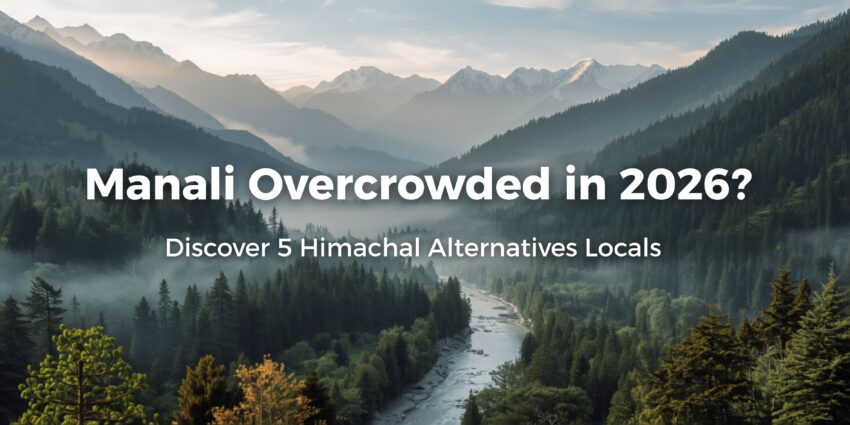
If your Manali trip planning has involved scrolling through fully-booked hotels and traffic-jam reels from Mall Road, you’re not imagining the crowding – it’s real, and it’s part of a wider pattern across India’s most Instagrammed destinations. Travel analysts have flagged this directly: over-tourism at India’s most famous spots is a genuine problem, and Manali in July is called out as one of the clearest examples, alongside Rishikesh in March and Agra year-round, where experience quality has dropped significantly under sheer volume. The good news is that Himachal itself offers the fix. Here are five real alternatives – not generic “hidden gem” filler, but places locals and offbeat travel operators actually send people to instead.
1. Tirthan Valley – For the Traveler Who Wants Manali’s Beauty Without the Crowds
Tirthan Valley has become the most commonly recommended swap for Manali, and the reasoning is specific, not vague: recent travel-trend coverage explicitly lists Tirthan Valley as the direct alternative for travelers who’d normally default to Manali. It has the same pine forests, the same river-valley setting, and similar access to trekking and trout fishing – but without the traffic. The Tirthan River runs clean and cold through the valley, and the nearby Great Himalayan National Park (a UNESCO World Heritage Site) offers genuine wildlife and birdwatching that Manali’s more developed zones no longer really support.
2. Jibhi – Cozy Cottages Instead of Crowded Hotels
Jibhi sits in the Banjar valley, a short drive from Tirthan, and has built its reputation on exactly what Manali has lost – quiet, characterful stays instead of stacked hotel blocks. Jibhi Waterfall, the short trek to “Mini Thailand,” and the ancient Chehni Kothi tower are all easy, low-effort outings that don’t require fighting crowds to enjoy. It’s also become a genuine hub for cafe culture and slow mornings, appealing to exactly the kind of traveler who used to head to Old Manali for that vibe before it got saturated.
3. Barot Valley – Trout Fishing, Forest Trails & Real Quiet
Barot, tucked in Mandi district and framed by the Dhauladhar and Pir Panjal ranges, remains one of Himachal’s least commercialized valleys despite being easily reachable. The Uhl River running through it is known for trout farming and fishing, and the surrounding Nargu Wildlife Sanctuary offers genuine forest trekking through deodar and pine without another tour group in sight. If Manali’s appeal for you was always about the river and the pine forests rather than the markets, Barot delivers that more purely.
4. Sangla & Chitkul – For Travelers Who Want Manali’s Mountain Views, Amplified
If you loved Manali for the mountain backdrop, Sangla Valley and Chitkul in Kinnaur district take that further. Sangla is flanked by the Baspa River and ringed with apple and cherry orchards against snow-clad peaks, while Chitkul – the last inhabited village before the Indo-Tibet border – offers an genuine end-of-the-road feeling most travelers never get to experience closer to Manali anymore. This route asks a bit more of you in travel time, but rewards it with scenery that’s arguably more dramatic than anything left in Manali’s more developed pockets.
5. Bir Billing – Adventure Without the Bottleneck
For travelers who chose Manali specifically for adventure activities like paragliding, Bir Billing is a genuinely stronger alternative, not just a quieter one – it’s recognized as one of the world’s best paragliding sites, with the Billing takeoff point offering some of the most reliable thermals in the Himalayas. Bir itself carries a distinct Tibetan-monastery culture, cafes, and a much calmer market scene than Solang Valley’s increasingly commercial paragliding setup. Pair it with a stop in Barot for a complete offbeat adventure circuit.
Why This Shift Is Happening Now
This isn’t just a matter of personal preference – it reflects a broader, well-documented shift in Himalayan tourism. Himachal Pradesh is seeing rising interest in offbeat travel alongside its traditional hotspots, with hoteliers reporting growing bookings across the state, not just in Manali, and industry data shows most Indian destinations now have a genuine shoulder season, 2-3 weeks either side of peak dates, where crowds thin out substantially without sacrificing much of the core experience. If your dates are flexible, timing a Manali-adjacent trip around April or late September rather than peak June-July often solves the crowding problem on its own, even without switching destinations entirely.
How to Choose Between Them
- Want river valleys and forest trekking closest to Manali’s original charm: Tirthan Valley or Jibhi.
- Want total quiet and real remoteness: Barot Valley or Chitkul.
- Want dramatic mountain views with orchards and rivers: Sangla Valley.
- Want adventure sports without Solang’s crowds: Bir Billing.
The Bottom Line
Manali’s crowding problem isn’t a reason to give up on a Himachal trip – it’s a reason to look one valley over. Tirthan, Jibhi, Barot, Sangla-Chitkul, and Bir Billing each capture a different part of what originally made Manali special, minus the traffic jams and sold-out hotels. Many of these can even be combined into a single offbeat circuit if you have 6-8 days to spare, giving you a richer trip than a crowded Manali weekend ever could.
At Royal Rover Holiday, our offbeat Shangarh-Jibhi-Tirthan Valley package and our Kullu-Manali-Kasol with Jibhi combination tour are both built specifically for travelers who want to experience the region’s beauty without the peak-season chaos. Get in touch and we’ll help you plan a Himachal trip that feels like an escape, not a queue.