
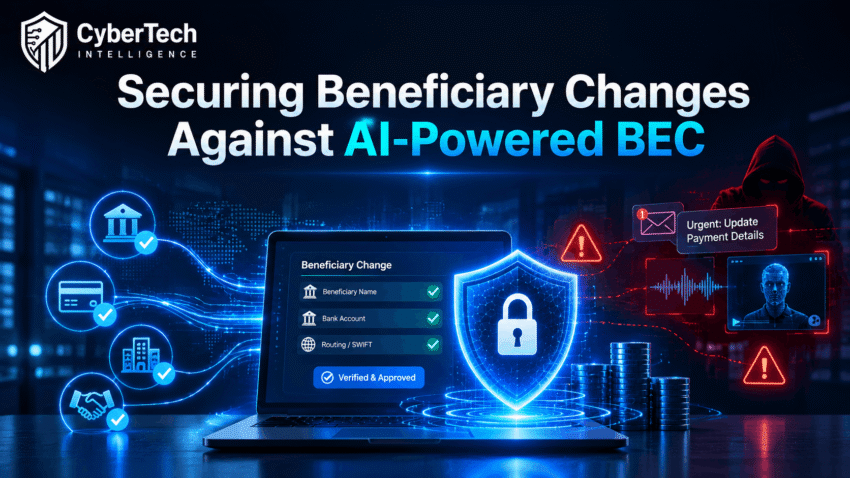
Business Email Compromise (BEC) has long been one of the most financially damaging forms of cybercrime. The rise of generative AI is making these attacks more convincing. Criminals can now create highly personalized emails, imitate executive communication styles, generate realistic voice recordings, and even produce synthetic video. For finance and treasury teams, beneficiary changes have therefore become a particularly important area of risk.
Read More: https://tinyurl.com/24bpesu6
A beneficiary change occurs when payment details associated with a supplier, partner, employee, or other recipient are modified. In legitimate business operations, these changes happen regularly. A supplier may move to a new bank, restructure its accounts, or update payment instructions. Attackers exploit this routine process by impersonating trusted individuals and convincing employees to redirect future payments to fraudulent accounts.
AI makes these schemes harder to recognize through communication quality alone. Traditional phishing attacks often contained spelling mistakes, unusual language, or obvious formatting problems. AI-generated messages can closely reproduce professional writing styles and incorporate contextual information collected from compromised accounts, social media, previous email conversations, or public business information.
Deepfake voice and video add another layer of credibility. An employee receiving suspicious payment instructions might attempt to verify the request through a phone or video conversation. If attackers can imitate the voice or appearance of a trusted executive or supplier representative, recognition alone may no longer provide sufficient assurance.
Organizations should therefore treat beneficiary changes as controlled business transactions rather than communication requests. An email, phone call, messaging application, or video meeting can initiate a request, but it should not independently authorize the modification.
The first critical control is independent verification. Finance teams should confirm beneficiary changes using trusted contact information already maintained within approved enterprise records. Employees should not use phone numbers, links, or contact details contained in the change request itself because those channels may be controlled by the attacker.
For example, if a supplier requests new banking information through email, the finance team should contact an established supplier representative using previously verified contact details. This creates separation between the communication requesting the change and the channel used to validate it.
Dual authorization provides another important safeguard. One employee should not be able to receive, verify, approve, and activate a sensitive beneficiary change independently. Separating these responsibilities reduces the likelihood that social engineering, compromised credentials, or human error can result in fraudulent payments.
Organizations can strengthen this approach through maker-checker controls. One authorized employee enters the requested beneficiary modification, while another independently reviews and approves it. Higher-risk changes can require additional authorization depending on payment value, supplier importance, destination, or other risk factors.
Temporary activation holds can provide another layer of protection. Instead of allowing new banking details to become immediately available for payments, organizations can introduce a defined waiting period. During this period, teams can perform additional validation and investigate inconsistencies before funds are transferred.
Historical comparison can also reveal suspicious activity. Finance teams should examine whether the requested banking information differs significantly from established supplier behavior. A sudden change in banking country, account ownership, payment destination, or transaction pattern may justify enhanced verification.
The first payment following a beneficiary change deserves particular scrutiny. Even when a modification has passed the normal approval process, organizations can apply additional monitoring to the initial transaction. High-value transfers to newly changed accounts may require another confirmation before release.
Identity security should support these financial controls. Attackers may compromise legitimate employee or supplier accounts and use authentic communication channels to request fraudulent changes. Multi-factor authentication, conditional access, session monitoring, and detection of unusual login behavior can help identify compromised identities before they are used for BEC.
However, authentication alone cannot eliminate the threat. A message sent from a legitimate but compromised account can still contain fraudulent instructions. This is why transaction verification must remain independent of the communication channel.
Organizations should also monitor for behavioral indicators surrounding beneficiary changes. Unusual urgency, requests for secrecy, pressure to bypass normal procedures, unexpected changes immediately before large payments, or repeated attempts to contact different employees may indicate social engineering. These indicators should increase verification requirements rather than accelerate processing.
Artificial intelligence can also strengthen defensive capabilities. Behavioral analytics can identify unusual payment destinations, abnormal transaction amounts, changes inconsistent with supplier history, or deviations from established approval patterns. Risk scoring can help organizations apply additional verification to transactions presenting the greatest potential impact.
Employee authority is equally important. Finance personnel should be explicitly empowered to delay transactions when verification cannot be completed. Seniority or urgency should never override established controls. Attackers frequently exploit organizational hierarchy by impersonating executives and demanding immediate action.
Read More: https://tinyurl.com/24bpesu6
Incident response procedures should address fraudulent beneficiary changes before an attack occurs. Organizations need clear processes for freezing transactions, contacting financial institutions, preserving communications, disabling compromised accounts, investigating related activity, and notifying relevant stakeholders.
Evidence retention also matters. Approval records, verification actions, communication history, identity telemetry, and transaction details should be preserved so investigators can reconstruct how a beneficiary change was requested and authorized.
Ultimately, AI-powered BEC is changing what organizations can safely trust. A professional email, familiar voice, convincing video call, or recognized identity can no longer serve as sufficient evidence for a high-risk financial action. Securing beneficiary changes requires organizations to shift trust from communication to controlled processes.
By combining independent verification, trusted contact records, dual approval, activation holds, behavioral monitoring, identity security, transaction controls, and employee authority to stop suspicious requests, enterprises can significantly reduce their exposure to AI-powered BEC while keeping legitimate financial operations moving.