
Water is one of the most valuable resources for homes, businesses, industries, and communities. As water demand continues to increase, simply measuring consumption is no longer enough. Organizations need better visibility into how water is being used, where losses are happening, and how consumption can be controlled.
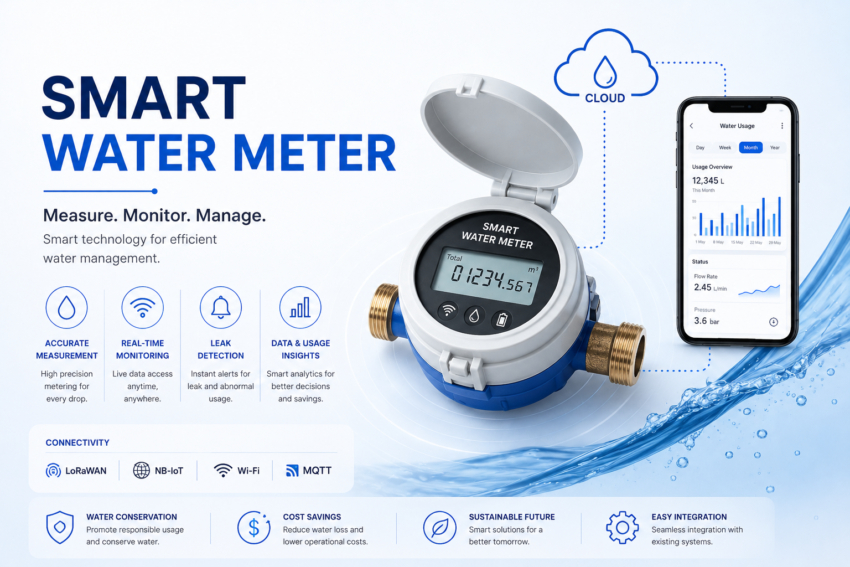
This is where a smart water meter can make a major difference. Unlike a traditional water meter, which mainly records the amount of water passing through a pipeline, a smart meter can collect and communicate consumption data automatically. This creates opportunities for real-time monitoring, leak detection, automated reporting, and better water management.
Traditional meters still have an important role, especially in simple residential applications. However, businesses, industries, commercial buildings, and large communities often need more detailed information than a manual meter can provide.
Understanding the difference between these two technologies can help organizations choose the right approach for their water monitoring needs.
What Is a Traditional Water Meter?
A traditional water meter is a mechanical or conventional measuring device installed in a water pipeline.
Its primary purpose is simple: measure the volume of water passing through the system.
In many cases, the meter has a physical display that needs to be inspected manually. A person reads the meter and records the value for billing, monitoring, or reporting.
Traditional meters are widely used because they are:
- Simple to install
- Easy to understand
- Relatively affordable
- Suitable for basic measurement
- Proven over many years
However, they have limitations when organizations need continuous monitoring.
For example, if a business reads a meter only once a month, it may not know exactly when unusual consumption occurred. A leak could continue for days before someone notices it.
What Is a Smart Water Meter?
A smart water meter combines water measurement with digital communication.
Instead of simply displaying a reading, the meter can collect consumption information and transmit it to a centralized system.
Depending on the technology used, the information may be sent through wireless or wired communication networks.
A typical smart metering setup can include:
Water Meter → Sensor/Communication Module → IoT Gateway → Cloud Platform → Dashboard
The result is a more connected water monitoring system that can provide information about water consumption and operating conditions.
Smart meters can support applications such as:
- Real-time consumption monitoring
- Automated meter reading
- Leak detection
- Usage analysis
- Consumption alerts
- Remote monitoring
- Automated reporting
- Digital billing
Smart Water Meter vs Traditional Water Meter
The biggest difference is not simply how the water is measured. Both technologies can measure water flow. The major difference is how the information is collected, communicated, and used.
| Feature | Traditional Water Meter | Smart Water Meter |
|---|---|---|
| Water measurement | Yes | Yes |
| Manual reading | Usually required | Can be automated |
| Remote monitoring | Limited/No | Yes |
| Real-time data | Generally unavailable | Available depending on setup |
| Automated alerts | No | Yes |
| Leak detection | Limited | Supported with suitable analytics |
| Data history | Usually manual | Digital |
| Automated reporting | No | Yes |
| Consumption analysis | Limited | Advanced |
| Integration with IoT | Limited | Designed for connectivity |
| Suitable for large-scale monitoring | Less convenient | More suitable |
| Operational visibility | Basic | High |
The exact features of a smart meter depend on the meter, communication technology, software platform, and overall system design.
1. Data Collection
Traditional meters generally require a person to visit the location and record the reading.
This creates a gap between the time water is consumed and the time the information becomes available.
Smart meters can automatically send readings to a central platform.
This allows organizations to collect data more frequently and understand consumption patterns in greater detail.
For businesses with multiple buildings, factories, or facilities, automated data collection can save significant time.
2. Real-Time Water Monitoring
Real-time information is one of the biggest advantages of smart metering.
A traditional meter may tell you that a building consumed a certain amount of water over a period.
A connected meter can provide more detailed information about when consumption occurred.
This can help answer questions such as:
- When is water consumption highest?
- Is consumption increasing unexpectedly?
- Is water flowing when the facility is closed?
- Which building uses the most water?
- Has consumption changed compared with previous periods?
This information can support faster and more informed decisions.
3. Leak Detection
Water leakage is a major concern for businesses and infrastructure operators.
A traditional meter can measure the water passing through the pipeline, but identifying a leak usually requires additional investigation.
A smart water monitoring system can analyze consumption patterns and identify unusual activity.
For example, suppose a commercial building normally has very low water usage overnight. If the meter detects continuous flow throughout the night, the system can generate an alert for investigation.
This does not mean every unusual reading is automatically a leak. It means the data provides an early warning that something may need attention.
Early detection can help reduce unnecessary water loss and prevent a small issue from becoming a larger problem.
4. Automated Meter Reading
Manual meter reading can become difficult when an organization has hundreds or thousands of meters.
Employees may need to travel to different locations, record readings, verify information, and enter the data into spreadsheets or billing systems.
Smart metering can automate much of this process.
The data can be transmitted to a central platform, reducing the need for repeated physical inspections.
This can be particularly useful for:
- Apartment communities
- Hotels
- Factories
- Shopping centers
- Hospitals
- Universities
- Municipal water networks
- Large commercial properties
5. Better Consumption Analysis
Traditional meters provide readings, but the analysis often depends on manual data collection.
Smart meters can create a digital history of consumption.
This allows businesses to compare:
- Daily consumption
- Weekly consumption
- Monthly consumption
- Peak usage
- Off-peak usage
- Building-level consumption
- Production-related usage
Historical data can help organizations identify trends and understand whether water-saving initiatives are working.
How IoT Makes Smart Water Metering More Powerful
The real power of smart metering comes when meters are connected to an IoT platform.
IoT allows physical devices to communicate with software systems.
An iot device management platform can help organizations monitor connected meters, check device status, manage configurations, and identify communication problems.
An iot gateway can act as a communication bridge between field devices and the cloud platform.
The overall process can look like this:
Smart Meter → IoT Gateway → Cloud → Data Analytics → Dashboard → Alerts
This architecture can support large-scale water monitoring across multiple locations.
Role of AI in Smart Water Metering
Smart meters generate data, but AI can help organizations understand that data.
AI-based analytics can identify unusual consumption patterns and detect anomalies.
For example, the system may learn that a factory normally uses a particular amount of water during production hours.
If consumption suddenly increases without a corresponding increase in production, the system can flag the situation for investigation.
AI can support:
- Anomaly detection
- Consumption forecasting
- Leak identification
- Usage pattern analysis
- Predictive maintenance
- Operational optimization
This changes smart water management from simply measuring consumption to understanding consumption.
Smart Water Meters in Industrial Applications
Industries often consume large amounts of water for production, cooling, cleaning, processing, and treatment.
For these businesses, knowing the total water consumption may not be enough.
They may need to understand consumption at different points in the facility.
For example, separate meters can monitor:
- Raw water
- Production water
- Cooling systems
- Boiler systems
- Treatment plants
- Process water
- Wastewater
- Recycled water
This provides better visibility into where water is being consumed.
Industrial IoT can connect these meters and sensors to a centralized platform.
This allows management teams to monitor multiple systems from a single dashboard.
Smart Water Meters and Water Billing
Billing is another important application.
Traditional meter reading can involve manual data collection and data-entry errors.
Connected meters can provide digital consumption information that can support automated billing processes.
For commercial buildings and residential communities, this can help create a more transparent billing system.
For example, property managers can monitor individual units or buildings and use actual consumption information for usage-based billing where appropriate.
Statistics That Show the Value of Smart Metering
Smart water metering is receiving increasing attention because of its potential to reduce water waste and improve consumption awareness.
A review of advanced metering studies reported water-use reductions ranging from approximately 7% to 15% in several applications. A Chennai smart water meter trial also reported a 15% reduction in overall consumption after smart meters were introduced.
Some important points include:
- Advanced metering can provide more frequent consumption information.
- Digital data can improve visibility into water usage.
- Automated readings can reduce manual meter-reading work.
- Usage information can encourage more responsible consumption.
- Continuous monitoring can support earlier identification of abnormal usage.
Actual savings vary depending on infrastructure, consumer behavior, technology, pricing, and implementation.
Smart Water Meter vs Traditional Meter: Which One Should You Choose?
There is no single answer for every situation.
A traditional meter may be suitable when:
- The application is simple.
- Water consumption is relatively low.
- Manual reading is practical.
- Real-time information is not required.
- The organization has a small number of meters.
A smart meter may be more suitable when:
- There are many meters.
- Remote monitoring is required.
- Water consumption needs to be tracked frequently.
- Leakage detection is important.
- Automated reporting is required.
- Multiple locations need centralized monitoring.
- Data-based decision-making is a priority.
For growing businesses, the ability to collect and analyze data can make smart metering a more useful long-term investment.
Key Benefits at a Glance
| Smart Meter Benefit | Business Value |
| Automated readings | Reduces manual work |
| Remote monitoring | Reduces unnecessary site visits |
| Consumption analytics | Improves water-use understanding |
| Leak alerts | Supports faster investigation |
| Digital records | Simplifies reporting |
| Historical data | Helps identify trends |
| Centralized dashboard | Improves visibility |
| IoT connectivity | Enables connected operations |
| AI analytics | Supports anomaly detection |
| Automated billing support | Improves billing efficiency |
Challenges of Smart Water Meter Implementation
Smart water meters offer many advantages, but organizations should consider several factors before implementation.
Initial Investment
Smart meters and supporting infrastructure can cost more than traditional meters.
However, the investment should be evaluated against potential savings from reduced water loss, automated readings, improved monitoring, and operational efficiency.
Connectivity
The system needs reliable communication between meters and the central platform.
The right connectivity option depends on location, distance, infrastructure, and the number of devices.
Data Security
Connected meters create digital data that needs appropriate security measures.
Businesses should work with technology providers that follow suitable security practices.
Maintenance
Meters, sensors, gateways, and communication systems require ongoing maintenance.
A proper device management process can help identify problems and keep the network operating reliably.
How KarIoT Can Help
KarIoT provides connected monitoring solutions designed to help organizations improve water visibility and operational efficiency.
Its platform supports real-time monitoring of water consumption, flow, level, pressure, water quality, and energy consumption. The system can also provide automated alerts and data analytics to help organizations identify unusual conditions and respond faster.
KarIoT supports different types of flow meters and sensors, including electromagnetic and ultrasonic flow meters and water-quality sensors. Its solutions can be applied across government, industrial, commercial, and residential environments.
For industrial applications, KarIoT can help organizations monitor STP, WTP, and ETP operations, along with water quality, flow, equipment performance, and energy-related parameters.
The company’s approach combines connected field devices, gateways, cloud monitoring, dashboards, alerts, and analytics to provide a centralized view of water-related operations.
Final Thoughts: Is a Smart Water Meter Worth It?
The difference between a traditional water meter and a smart meter goes beyond the meter itself.
A traditional meter mainly answers one question:
“How much water was consumed?”
A smart metering solution can help answer much more:
“When was the water consumed, where was it consumed, is the usage normal, and is there a possible problem?”
That additional information can be valuable for businesses, industries, communities, and organizations looking to control water consumption and reduce unnecessary losses.
As smart water management system becomes increasingly data-driven, smart metering can provide the foundation for better monitoring, faster response, and more informed decisions.