
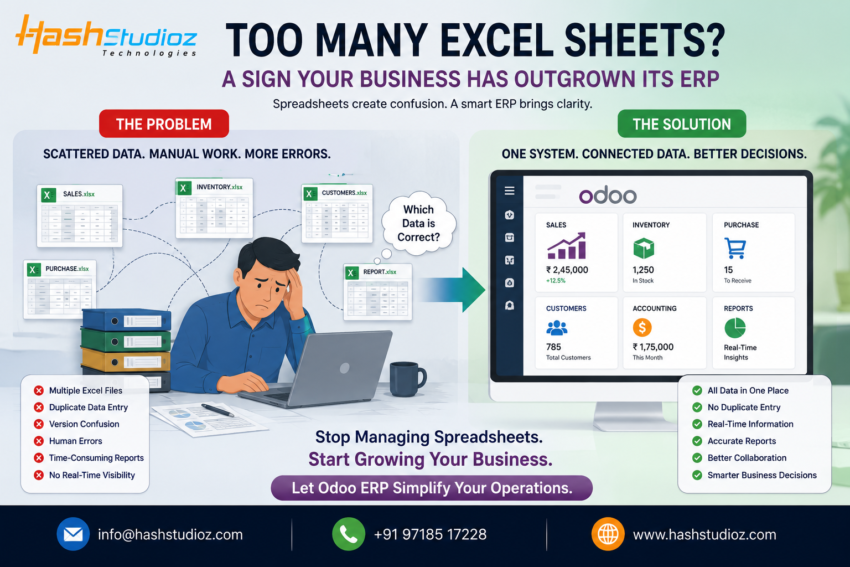
When a business is small, managing daily work is usually simple. A basic ERP system may be enough to handle sales, inventory, accounting, and customer information.
But as the business grows, things start to change.
There are more customers, more orders, more employees, more products, and more data. The ERP system that worked well before may now feel slow, difficult, or limited.
This raises an important question:
Has your business outgrown its current ERP system?
If you’re not sure, don’t worry. In this blog, we’ll look at some common signs that can help you find the answer.
1. Your Employees Still Depend on Excel
One of the first signs is heavy use of spreadsheets.
Your company may already have an ERP, but employees still use Excel to manage:
- Sales information
- Inventory
- Customer data
- Expenses
- Reports
- Purchase orders
- Production planning
Using Excel isn’t always a problem. The problem starts when important business information is stored in different places.
For example, your sales team may have one spreadsheet while the warehouse has another. This can lead to different numbers and outdated information.
2. Your Departments Are Not Connected
A growing business has many departments.
Sales needs information from inventory. Finance needs sales information. Purchasing needs to know what inventory is required.
If every department uses a different system, employees may have to send information manually.
For example:
Sales → Excel → Warehouse → Email → Finance
This takes time and can easily create mistakes.
A good ERP should help different departments work with the same business information.
Quick check:
Can your sales, inventory, purchasing, and accounting teams easily access the information they need?
If not, your current ERP may not be keeping up with your business.
3. Employees Are Entering the Same Information Again and Again
Think about how many times your employees enter the same customer or order information.
For example, a customer places an order.
Someone enters the order into the sales system.
Another employee enters the information into inventory.
The finance team enters it again for billing.
This is unnecessary work.
It also increases the chance of typing mistakes.
An ERP with better automation and integration can reduce this repeated work.
Ask your team:
“How much time do we spend entering or copying the same information?”
If the answer is “a lot,” your current system may need improvement.
4. Your Business Processes Have Changed
Your business today may be very different from the business you had three or five years ago.
Maybe you have:
- Added new products
- Opened another warehouse
- Started selling online
- Added new employees
- Started manufacturing
- Expanded into new markets
- Added new business locations
But your ERP may still be working in the same old way.
When employees constantly say:
“We need a workaround for this.”
it may be a sign that your ERP is no longer a good fit.
5. Connecting Other Software Has Become Difficult
Most businesses use more than one software system.
You may use separate tools for:
- E-commerce
- CRM
- Payments
- Shipping
- Accounting
- Customer support
- Marketing
These tools need to share information.
If they don’t connect properly, employees have to move information from one system to another manually.
This can become frustrating as the business grows.
Ask yourself:
“If we add another business tool, can our ERP connect with it easily?”
If the answer is usually no, your current system may be limiting your growth.
6. Getting a Simple Report Takes Too Long
Management needs information to make good decisions.
For example:
- How much did we sell this month?
- Which products are selling the most?
- How much stock do we have?
- Which invoices are still unpaid?
- How are our sales teams performing?
If your employees need several hours to collect information from different systems before creating a report, there may be a problem.
A useful ERP should make business information easier to find.
Try this simple test:
Ask your team for an important business report.
How long does it take to get it?
If the answer is “a few minutes,” that’s good.
If it takes hours or days, it’s worth looking into.
7. Your Business Is Growing Faster Than Your ERP
Growth is good.
But growth also creates more work for your ERP.
More customers mean more orders.
More orders mean more inventory movements.
More inventory means more purchasing and accounting work.
If your ERP starts becoming slow or difficult to manage as your business grows, it may not be able to support your future needs.
Don’t only ask:
“Does our ERP work today?”
Also ask:
“Will it still work if our business becomes twice as big?”
That’s a much better way to judge your system.
8. Employees Don’t Like Using the ERP
Your employees use the system every day, so their experience matters.
Ask them simple questions:
- Is the ERP easy to use?
- Is it difficult to find information?
- Do you have to enter information more than once?
- Do you use other tools because the ERP doesn’t have what you need?
- What would you change?
If many employees have the same complaints, don’t ignore them.
Sometimes the problem can be fixed with better training or configuration.
But if the same problems keep coming back, your ERP may not be meeting your business needs.
9. Your ERP Has Too Many Custom Changes
Businesses often customize their ERP to meet specific requirements.
Some customization is completely normal.
The problem starts when there are too many custom changes.
For example:
- Every small change needs a developer
- Updates become difficult
- Fixing one issue creates another
- Maintenance costs keep increasing
- Employees depend on a particular developer
At this point, you should ask:
“Are we improving our ERP, or are we spending too much time fixing it?”
A review of your current setup can help answer this question.
10. Your ERP Is Making Growth Difficult
This is perhaps the biggest warning sign.
Imagine your business wants to:
- Open a new warehouse
- Start selling online
- Add a new product line
- Enter a new market
- Connect a new payment system
- Automate a manual process
Instead of thinking about how quickly you can do it, your team starts worrying about whether the ERP can support it.
That’s a problem.
Your ERP should support your business plans.
It shouldn’t stop you from growing.
Does This Mean You Need a New ERP?
Not always.
This is important.
Sometimes the ERP isn’t the real problem.
The problem could be:
- Poor setup
- Old workflows
- Lack of training
- Missing integrations
- Too much manual work
- Poor data management
For example, you may think you need a completely new system because employees are entering sales information twice.
But the actual solution might be a better integration or workflow.
That’s why it’s better to understand the problem before replacing your ERP.
A Simple Way to Check Your ERP
Take a few minutes and answer these questions:
Question 1
Do we use spreadsheets for important business processes?
Yes / No
Question 2
Do employees enter the same information into multiple systems?
Yes / No
Question 3
Is it difficult to connect our ERP with other software?
Yes / No
Question 4
Does creating a report take too much time?
Yes / No
Question 5
Do employees regularly complain about the ERP?
Yes / No
Question 6
Has our business changed significantly since we implemented the ERP?
Yes / No
Question 7
Does our ERP make it difficult to add new processes or locations?
Yes / No
Question 8
Have ERP maintenance and customization costs increased?
Yes / No
Your Result
0–2 Yes answers:
Your ERP may still be working well. Keep monitoring it as your business grows.
3–5 Yes answers:
It’s a good time to review your ERP and identify what can be improved.
6–8 Yes answers:
Your business may have outgrown its current ERP. A detailed ERP assessment could help you decide what to do next.
What Can You Do If Your ERP Is No Longer Enough?
You have several options.
Option 1: Improve Your Current ERP
If the system is still capable, you may only need better configuration, training, or workflows.
Option 2: Add Integrations
If your main problem is disconnected software, integrating your existing tools may solve the issue.
Option 3: Automate Manual Work
Look for repetitive tasks that employees perform every day and see which ones can be automated.
Option 4: Move to a More Flexible ERP
If your current system cannot support your business requirements, moving to another ERP may make more sense.
The important thing is to choose the option based on your actual business needs.
How Odoo Can Help Growing Businesses
Odoo is an ERP platform that brings different business activities together.
Depending on the company’s requirements, businesses can connect areas such as:
CRM → Sales → Inventory → Purchasing → Manufacturing → Accounting
This can make it easier for departments to share information and work together.
For example, when a customer places an order, the information can move through the relevant sales, inventory, delivery, and accounting processes instead of being entered separately by different teams.
This can help reduce manual work and improve visibility across the business.
Where Odoo Consulting Services Can Help
Moving to a new ERP is a big decision.
Before making that decision, it’s useful to understand what is actually causing your current problems.
Odoo Consulting Services can help businesses review their existing processes and identify areas that need improvement.
This may include:
- Reviewing current ERP processes
- Finding manual tasks
- Identifying integration requirements
- Understanding reporting problems
- Planning data migration
- Reviewing customization needs
- Planning new workflows
- Preparing an ERP implementation roadmap
The goal shouldn’t simply be to install new software.
The goal should be to create a system that fits the way your business actually works.
Final Thoughts
Outgrowing an ERP doesn’t happen overnight.
It usually happens slowly.
First, employees start using more spreadsheets.
Then they create manual workarounds.
Then departments start using different tools.
Reports take longer.
Integrations become difficult.
And eventually, the ERP becomes more of a problem than a solution.
If you are seeing several of these signs, don’t wait until the problems become bigger.
Start by reviewing your current processes and identifying what is slowing your business down.
And remember:
The right ERP should grow with your business—not hold it back.
If you’re considering improving or replacing your current ERP, Odoo Consulting Services can help you understand your requirements and plan a practical path forward.
Frequently Asked Questions
- How can I tell if my business has outgrown its ERP system?
Common signs include heavy dependence on spreadsheets, duplicate data entry, disconnected departments, slow reporting, difficult integrations, frequent ERP complaints, and problems supporting new locations or business processes. - Should I replace my ERP if employees are having problems with it?
Not necessarily. The problem may be caused by poor configuration, outdated workflows, lack of training, or missing integrations. An ERP assessment can help determine whether the system needs optimization or replacement. - Can Odoo help a growing business replace an outdated ERP?
Yes. Odoo can bring areas such as CRM, sales, inventory, purchasing, manufacturing, and accounting into a connected platform. This can help businesses reduce manual work and improve information sharing between departments. - How can Odoo Consulting Services help with an ERP transition?
Odoo Consulting Services can help businesses understand their current ERP problems, review workflows, identify automation and integration needs, plan data migration, and create an implementation roadmap based on their business requirements. - What should I consider before moving to a new ERP system?
Start by identifying your current problems and future business needs. Consider scalability, integrations, automation, reporting, data migration, customization, employee requirements, implementation costs, and how well the new ERP can support your future growth.