
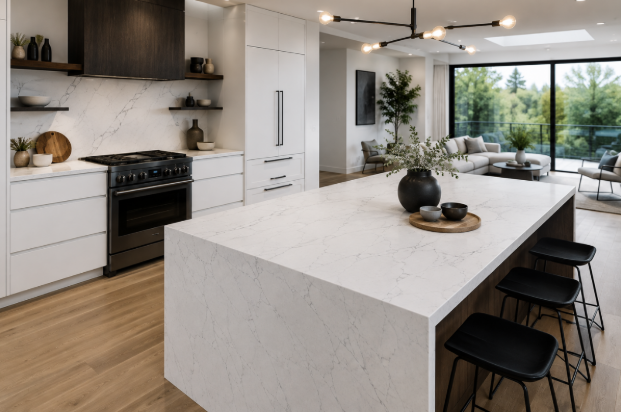
Choosing a countertop material involves considering durability, appearance, maintenance, hygiene, and how the surface will be used every day. Quartz countertops have become a popular option for kitchens because engineered quartz combines natural mineral content with resins and pigments to create a consistent, non-porous surface. Unlike natural stone slabs, engineered quartz is manufactured under controlled conditions, allowing manufacturers to produce a broad selection of colours, patterns, and finishes.
For homeowners planning a kitchen renovation, understanding how quartz countertops are made and maintained can make the selection process more straightforward. Their combination of practical performance and design flexibility makes quartz suitable for a wide range of contemporary and traditional kitchen layouts.
What Are Quartz Countertops Made Of?
Engineered quartz is produced using natural quartz crystals combined with polymer resins, pigments, and other mineral materials. Many engineered quartz surfaces contain roughly 90% or more natural quartz, although the precise composition varies between products and manufacturers. The mixture is processed under controlled pressure to form dense slabs.
Natural quartz is a hard mineral, measuring around 7 on the Mohs hardness scale. When incorporated into an engineered surface, it contributes to the material’s resistance to everyday wear. The resin component binds the mineral particles together while allowing manufacturers to create different colours and visual effects.
This manufacturing process also contributes to the consistent appearance associated with quartz countertops.
Why Are Quartz Countertops Popular for Kitchens?
One of the main attractions of quartz countertops is their combination of practical performance and relatively simple care. Quartz is non-porous, meaning liquids do not readily penetrate the surface. This characteristic makes it useful in areas where food, beverages, oils, and water are regularly present.
Quartz also offers considerable design flexibility. Engineered slabs are available in neutral colours, bold shades, subtle textures, and patterns that can resemble natural stone. The controlled manufacturing process makes it possible to produce designs with a relatively consistent visual appearance across slabs.
For kitchens, this combination of surface performance and design choice allows quartz to work with many cabinet styles, splashbacks, flooring materials, and interior colour schemes.
What Are the Main Benefits of Quartz?
Several characteristics explain why quartz is widely used for kitchen work surfaces.
Non-Porous Surface
The dense, non-porous structure of engineered quartz provides strong resistance to liquid absorption. This makes routine cleaning straightforward and helps the surface maintain its appearance when properly cared for.
Scratch Resistance
Quartz is based largely on one of the harder naturally occurring minerals. Consequently, engineered quartz surfaces have good resistance to everyday scratching and abrasion. Using appropriate cutting boards and routine kitchen practices remains advisable, particularly for preserving the finish over many years.
Low Maintenance
Unlike many natural stone surfaces, engineered quartz generally does not require routine sealing. Daily cleaning can usually be handled with warm water, mild soap, and a soft cloth. Quartz Supply’s guidance similarly recommends mild soap and water for routine care.
Design Variety
Because quartz is manufactured rather than simply cut from a naturally occurring slab, manufacturers can produce numerous colours and patterns. Options can range from plain surfaces to designs inspired by marble, concrete, or other natural materials.
How Should Quartz Countertops Be Cleaned?
Regular cleaning is one of the simplest aspects of maintaining quartz. For everyday cleaning, warm water and mild soap can be used with a soft cloth. After cleaning, wiping the surface dry can help maintain an even finish.
For more persistent marks, a suitable pH-neutral surface cleaner can be considered. Abrasive pads and aggressive cleaning products should generally be avoided because they can affect the surface finish or resin component over time.
The best approach is to follow the care instructions supplied for the particular quartz surface because formulations and finishes can differ.
Can Quartz Be Used Around Kitchen Appliances?
Quartz is well suited to kitchen environments, including areas surrounding sinks, preparation spaces, and cooking zones. However, engineered quartz should not be treated as completely heat-proof.
The natural quartz mineral itself has excellent heat resistance, but engineered slabs also contain resin. Sudden, intense, or prolonged direct heat can affect that resin. Using trivets or heat-resistant pads underneath cookware taken directly from a hob or oven is therefore a sensible practice.
This simple habit allows homeowners to make practical use of quartz countertops while protecting the surface from unnecessary thermal stress.
How Do Quartz Countertops Compare With Other Materials?
Quartz occupies an interesting position between natural stone and other engineered surfaces. Granite is a natural stone with strong heat resistance and distinctive geological patterns, while marble is valued for its characteristic veining and traditional appearance.
Quartz offers a more controlled appearance because its colours and patterns are manufactured. It is also non-porous and generally does not require sealing, which can simplify routine care compared with some natural stones.
The right material ultimately depends on the kitchen’s design, cooking habits, maintenance preferences, and desired appearance.
What Should You Consider Before Choosing Quartz?
When selecting quartz countertops, homeowners should consider slab colour, pattern, thickness, edge profile, surface finish, installation requirements, and the overall dimensions of the kitchen.
It is also useful to view physical samples because lighting can influence how colours appear. A sample viewed in a showroom may look different under natural daylight or artificial kitchen lighting.
The layout should also be considered carefully. Areas around sinks, hobs, islands, and breakfast bars may require specific fabrication details, so accurate measurements and professional installation are important parts of the planning process.
Conclusion
Quartz countertops combine natural mineral content with engineered manufacturing to create a dense, non-porous surface available in a wide range of colours and patterns. Their resistance to everyday wear, straightforward cleaning requirements, and design flexibility make them a practical choice for many contemporary kitchens. Regular care is simple: clean spills promptly, use appropriate non-abrasive cleaning products, and protect the surface from direct extreme heat. Selecting the appropriate colour, finish, thickness, and edge treatment can also help integrate the countertop successfully into the wider kitchen design. For homeowners researching kitchen countertops quartz, understanding the material’s composition, maintenance requirements, heat considerations, and design possibilities provides a useful foundation for making an informed countertop decision.