
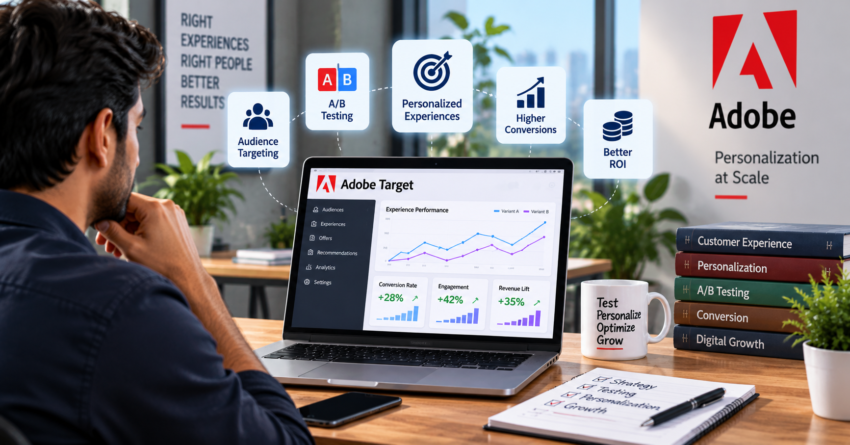
Businesses investing in personalization and experimentation often ask one question before starting: How much does Adobe Target cost?
Understanding Adobe Target pricing is not as simple as finding a fixed monthly subscription. Adobe positions Target as an enterprise solution and provides customized pricing based on an organization’s requirements. Its current pricing information identifies factors such as product options, the volume of digital properties, and omnichannel delivery as considerations when determining the price.
For companies evaluating Adobe Target, the software license is only one part of the overall budget. Implementation, integrations, development resources, consulting, training, and ongoing optimization can also influence the total investment.
This guide explains how Adobe Target licensing works, what affects the cost, and what businesses should consider before requesting a quote.
What Is Adobe Target?
Adobe Target is Adobe’s platform for experimentation, personalization, and optimization. It helps businesses test different digital experiences and deliver personalized content, offers, and interactions based on customer behavior and audience characteristics.
Organizations can use Adobe Target for activities such as:
-
A/B testing
-
Multivariate testing
-
Personalized website experiences
-
Mobile app personalization
-
Audience-based targeting
-
Recommendations
-
Automated personalization
-
Conversion optimization
-
Cross-channel experimentation
Adobe also provides AI-powered capabilities and integrations with Adobe Experience Platform to support personalization and experimentation at scale.
How Does Adobe Target Pricing Work?
Adobe does not currently publish one universal price for every Target customer.
Instead, Adobe states that it offers flexible licensing and configuration options tailored to individual organizations. The pricing conversation can depend on the organization’s product requirements, digital property volume, and omnichannel delivery needs.
This means the Adobe Target cost for one enterprise may differ significantly from another company’s cost.
For example, a business testing one website has a different implementation and usage profile from a global organization running experiments across websites, mobile applications, and other digital channels.
Adobe Target Licensing: What Businesses Need to Know
Adobe Target licensing is designed around enterprise requirements rather than a simple one-size-fits-all subscription.
When discussing licensing, organizations should consider:
-
Number of digital properties
-
Website traffic and usage requirements
-
Mobile application requirements
-
Testing volume
-
Personalization use cases
-
Number of teams using the platform
-
Required integrations
-
Deployment architecture
-
Support and professional services
-
Contract requirements
Adobe specifically identifies the volume of digital properties where Target is implemented as a pricing consideration. It also highlights omnichannel delivery across web, mobile app, email, IoT, and other environments.
Adobe Target Pricing Plans: Is There a Fixed Package?
Unlike consumer software products that display simple monthly plans, Adobe Target is sold using a customized enterprise model.
Therefore, businesses should not assume that there is one fixed Adobe Target pricing plan that applies to every organization.
Instead, Adobe evaluates the requirements and configuration needed for a particular customer.
The most useful way to approach the pricing discussion is to define the intended use cases first.
For example:
Basic Experimentation
A company may primarily need A/B testing for website landing pages, product pages, calls to action, or navigation.
Advanced Personalization
Another organization may need audience-based experiences, recommendations, automated personalization, and real-time decisioning.
Omnichannel Optimization
Large enterprises may want to use Target across websites, mobile applications, and other customer touchpoints.
The broader and more complex the deployment, the more important it becomes to scope the complete solution before discussing price.
What Factors Affect Adobe Target Enterprise Pricing?
Several factors can influence Adobe Target enterprise pricing.
1. Number of Digital Properties
Adobe explicitly identifies the volume of digital properties as a pricing consideration.
A company managing one primary website may have a very different requirement from an organization operating dozens of regional websites and applications.
2. Omnichannel Delivery
Adobe Target supports personalization across multiple channels, including web, mobile applications, email, IoT, and more.
If an organization wants to expand beyond website testing, its implementation requirements may become more complex.
3. Testing Requirements
The type and scale of experimentation can also affect the overall solution requirements.
Businesses may use Target for:
-
A/B tests
-
Multivariate tests
-
Personalization
-
Automated optimization
-
Recommendations
-
Audience targeting
Adobe describes Target as supporting both rules-based and AI-powered personalization alongside A/B and multivariate testing.
4. Integrations
Integrations can affect both implementation complexity and ongoing resource requirements.
Organizations may need Target to work with Adobe Experience Platform and other components of their digital technology stack.
Adobe highlights its integrations with Adobe Experience Platform as part of Target’s personalization capabilities.
5. Implementation Complexity
The Adobe Target implementation cost depends heavily on how the organization plans to deploy the platform.
Implementation may involve:
-
Tag management
-
Data layer configuration
-
Audience setup
-
Experience creation
-
Testing configuration
-
Analytics integration
-
API or server-side implementation
-
Quality assurance
-
Reporting
Adobe Target supports client-side, server-side, and hybrid implementation approaches, giving technical teams flexibility but also creating different implementation considerations.
Adobe Target Implementation Cost
The license should not be confused with the total implementation investment.
An enterprise implementation may require developers, analytics specialists, marketers, product managers, QA teams, and solution architects.
The actual Adobe Target implementation cost can depend on:
-
Number of properties
-
Number of experiences
-
Existing data infrastructure
-
Technical architecture
-
Integration requirements
-
Migration requirements
-
Testing complexity
-
Internal technical expertise
For companies with a mature analytics and development team, some implementation work may be handled internally.
Others may use Adobe Professional Services or external implementation partners.
Adobe Target Consulting Services
Organizations may also budget for Adobe Target consulting services.
Consulting support can potentially cover areas such as:
-
Implementation strategy
-
Technical architecture
-
Experimentation strategy
-
Personalization planning
-
Audience configuration
-
Integration
-
Migration
-
Testing governance
-
Training
-
Ongoing optimization
The need for consulting depends on internal expertise and the complexity of the deployment.
For large enterprise implementations, professional services can become an important part of the total project budget.
Adobe Target Cost vs Total Cost of Ownership
Looking only at the software subscription can give an incomplete picture.
A better approach is to calculate the total cost of ownership.
| Cost Area | Potential Expense |
|---|---|
| Adobe Target License | Software subscription |
| Implementation | Technical setup and configuration |
| Development | Data layer, APIs and integrations |
| Consulting | Strategy and implementation expertise |
| Training | Team onboarding and enablement |
| Testing | Experiment creation and QA |
| Analytics | Measurement and reporting |
| Maintenance | Ongoing optimization and technical support |
An older Adobe-commissioned Forrester Total Economic Impact study of Adobe Experience Cloud illustrates this broader concept by separating software licensing, professional and managed services, internal resources, and training. The study covered the broader Experience Cloud rather than Adobe Target alone, so its figures should not be treated as a current Target price.
How to Estimate Your Adobe Target Budget
Before requesting an Adobe Target quote, create a basic requirements document.
Step 1: Define Your Digital Properties
List the websites, mobile applications, and other digital experiences where Target will be used.
Step 2: Identify Your Use Cases
Decide whether your primary goals are:
-
A/B testing
-
Conversion optimization
-
Personalization
-
Recommendations
-
Automated testing
-
Cross-channel experiences
Step 3: Map Your Technology Stack
Document the analytics, customer data, CMS, commerce, CRM, and other platforms that need to connect with Target.
Step 4: Estimate Internal Resources
Identify the developers, analysts, marketers, product teams, and administrators who will operate the platform.
Step 5: Decide on Implementation Support
Determine whether your organization will manage implementation internally or require external consulting.
Step 6: Request a Customized Quote
Once these requirements are documented, Adobe can scope a configuration that matches the organization’s needs. Adobe currently directs businesses toward customized pricing rather than publishing a universal Target price.
Ways to Manage Adobe Target Costs
Enterprise personalization programs can become complex quickly. A structured rollout can help control unnecessary costs.
Start With High-Value Use Cases
Begin with experiments connected to measurable business objectives rather than launching dozens of tests without a clear measurement framework.
Create a Testing Roadmap
Prioritize experiments based on business impact, available traffic, technical complexity, and expected learning.
Build Reusable Components
Reusable audiences, templates, experiences, and measurement frameworks can reduce repetitive work.
Use Existing Data Infrastructure
Where possible, connect Target with the organization’s existing analytics and customer data architecture instead of creating disconnected measurement systems.
Train Internal Teams
Developing internal expertise can reduce reliance on external consulting for routine activities.
Is Adobe Target Worth the Investment?
The answer depends on the organization’s goals, scale, traffic, experimentation maturity, and personalization requirements.
Adobe Target is designed for businesses that need advanced testing and personalization capabilities across digital experiences. Its capabilities include experimentation, AI-powered personalization, recommendations, and integrations with Adobe Experience Platform.
A company evaluating the platform should therefore consider both the financial investment and the business problems it wants to solve.
The key questions are:
-
How much traffic can we test?
-
How many digital properties do we manage?
-
How many experiments do we expect to run?
-
Do we need personalization?
-
Which channels need optimization?
-
What integrations are required?
-
Do we have the internal expertise to manage the platform?
Frequently Asked Questions
How much does Adobe Target cost?
Adobe does not publish one universal public price for Adobe Target. Pricing is customized according to organizational requirements, including product configuration, digital property volume, and omnichannel delivery.
What affects Adobe Target pricing?
Key considerations include product options, the number of digital properties, omnichannel requirements, implementation scope, integrations, and the organization’s experimentation and personalization needs.
Does Adobe Target have a free plan?
Adobe’s current business pricing page does not present a permanent free plan for Adobe Target. Organizations are directed toward customized enterprise pricing.
What is included in Adobe Target licensing?
The exact licensing configuration depends on the organization’s requirements and selected solution. Adobe describes flexible licensing and configuration options rather than one universal package.
Does Adobe Target require implementation services?
Not necessarily. The implementation approach depends on the organization’s technical capabilities and deployment requirements. Businesses can use internal resources or seek professional and consulting support.
What should be included when calculating Adobe Target cost?
Consider the software license, implementation, development, integrations, consulting, training, analytics, testing, and ongoing maintenance. Looking at these components provides a more complete view of the total investment.
Conclusion
Adobe Target pricing is based on a customized enterprise model rather than a single public subscription price.
The final Adobe Target cost can be influenced by the number of digital properties, omnichannel requirements, product configuration, implementation complexity, integrations, internal resources, and professional services.
For organizations evaluating Adobe Target, the most practical approach is to define the required testing and personalization use cases first, map the technical environment, estimate implementation resources, and then request a customized quote.
That gives businesses a clearer picture of both the Adobe Target licensing investment and the wider cost of building an enterprise experimentation and personalization program.