

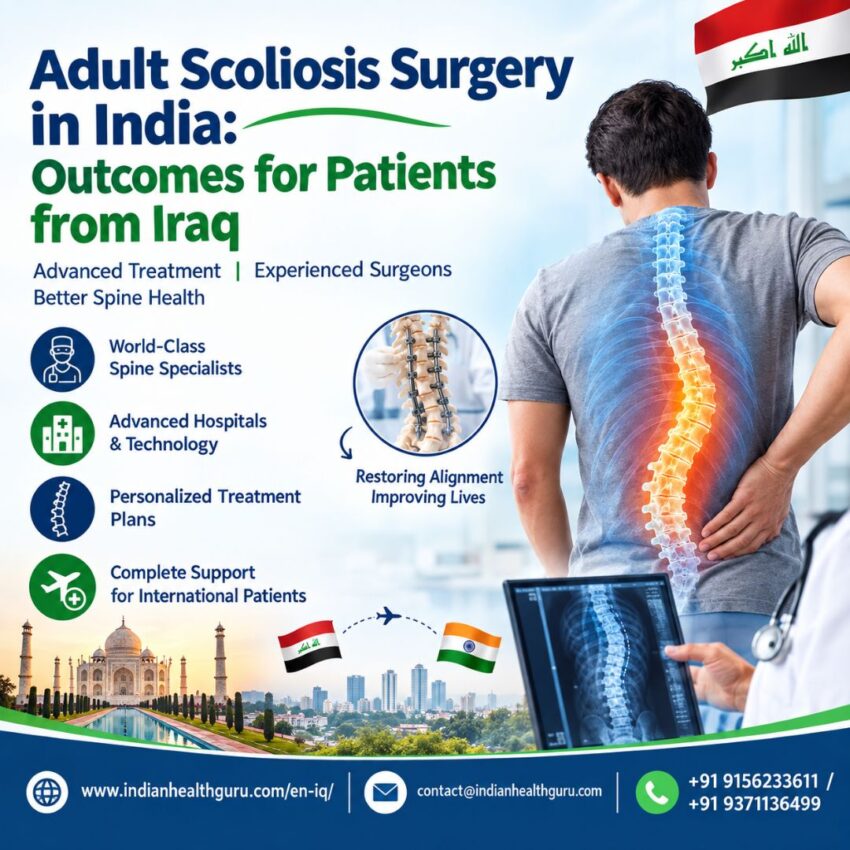
Adult scoliosis can become increasingly difficult to manage when spinal curvature is accompanied by persistent back pain, nerve compression, difficulty standing upright or reduced mobility. For some Iraqi patients, conservative treatment may no longer provide sufficient relief, leading them to consider corrective spine surgery in India. Adult scoliosis surgery is complex and the objective is not simply to make the spine look straighter; surgeons also consider pain, neurological function, spinal balance, mobility and the patient’s ability to perform daily activities. Research involving adults with symptomatic spinal deformity has shown that carefully selected patients can experience meaningful improvements in pain, disability and quality of life after surgery, although complications and the need for long-term follow-up must also be considered.
What Is Adult Scoliosis?
Adult scoliosis refers to an abnormal sideways curvature of the spine that is present or develops during adulthood. Some patients have a curve that began during adolescence, while others develop degenerative scoliosis as discs, joints and other spinal structures change with age. The condition may remain relatively stable in some people, while others develop increasing pain, spinal imbalance, nerve compression or difficulty walking.
For Iraqi patients considering treatment in India, understanding the cause and severity of the deformity is essential. A specialist normally evaluates standing X-rays and, when indicated, MRI or CT imaging to understand the curvature, spinal alignment, nerve compression and condition of the vertebrae and discs before recommending surgery.
When Is Surgery Considered?
Surgery is generally considered when symptoms are significant, conservative treatment has not provided adequate improvement, or the spinal deformity is associated with problems such as progressive imbalance or nerve compression. Not every adult with scoliosis requires an operation. Physiotherapy, medication, activity modification and other non-surgical approaches may remain appropriate when symptoms are manageable and there is no compelling reason for surgical correction.
When surgery is recommended, the objective is usually to improve function and quality of life while achieving an appropriate and sustainable spinal alignment. Studies comparing operative and non-operative treatment in symptomatic adult lumbar scoliosis have found greater long-term improvements in disability and patient-reported outcomes among appropriately selected surgical patients.
Read More About:- Adult Scoliosis Surgery In India For Iraq Patients
What Does Adult Scoliosis Surgery Involve?
The operation varies considerably from one patient to another. Depending on the deformity, treatment may involve decompression of compressed nerves, spinal fusion, correction of spinal alignment or a combination of techniques. Some complex deformities require fusion across several vertebral levels, while less extensive problems may be treated with a more limited procedure.
The surgeon must balance the degree of correction against the patient’s age, bone quality, general health and surgical risk. Complex adult spinal deformity surgery can involve substantial blood loss, lengthy operating time and a prolonged recovery, so the proposed procedure should be clearly explained before an Iraqi patient commits to treatment.
Expected Outcomes for Iraq Patients
Outcomes should be assessed using several measures rather than looking only at the degree of curve correction. Important outcomes include reduction in back or leg pain, improved walking ability, better spinal balance, improved daily function and quality of life. The Scoliosis Research Society has recommended standardized measures that include pain, neurological function, disability, return to work, complications, revision procedures and long-term sustainability of treatment.
Long-term studies have reported meaningful improvements in disability and patient-reported quality of life after adult spinal deformity surgery. However, outcomes vary substantially according to the patient’s age, deformity, surgical complexity, general health and whether the operation is a primary or revision procedure. Therefore, an Iraqi patient should ask the treating surgeon about expected outcomes for their specific spinal condition, rather than relying on a general success percentage.
|
Outcome area |
What Iraqi patients may expect |
|
Pain |
Reduction may occur gradually during recovery |
|
Spinal alignment |
The surgical goal is improved and sustainable balance |
|
Mobility |
Walking and daily activities may improve as recovery progresses |
|
Nerve symptoms |
Improvement depends on the cause and duration of compression |
|
Quality of life |
Can improve when pain and functional limitations are reduced |
|
Long-term monitoring |
Important to identify implant, fusion or alignment-related problems |
What Are the Risks?
Adult scoliosis surgery can be considerably more complex than routine spine surgery. Potential complications include infection, blood loss, neurological injury, blood clots, problems with wound healing, implant-related problems, failure of fusion and the possibility of additional surgery. The risk profile depends heavily on the patient’s medical condition and the complexity of the correction.
Published research demonstrates why these risks should be discussed honestly. Earlier systematic evidence reported substantial complication rates in adult scoliosis surgery, while more recent outcome studies continue to identify complications, revision procedures and implant or fusion problems as important long-term outcome measures. This does not mean that every patient will experience complications, but it highlights the importance of careful patient selection and experienced surgical teams.
Preparing for Surgery in India
Iraqi patients should ideally send their previous spine records before travelling. These may include standing X-rays, MRI or CT scans, previous operative reports, medication lists and information about previous physiotherapy or injections. A detailed pre-travel review can help determine whether additional imaging or specialist assessment will be required after arrival in India.
Patients should also discuss existing medical conditions such as diabetes, heart disease, osteoporosis or respiratory problems because these can affect surgical planning and recovery. Bone health is particularly important in older adults undergoing extensive spinal fusion, as poor bone quality can influence fixation and fusion.
Recovery After Adult Scoliosis Surgery
Recovery is gradual and can extend over several months. Hospital care initially focuses on pain control, neurological monitoring, wound care and safe mobilisation. Physiotherapy then becomes important for improving strength, walking ability and confidence with everyday movements. Patients should not expect the final result immediately after surgery.
For Iraqi patients, the timing of return travel should be decided by the treating team rather than according to a fixed number of days. The patient needs to be sufficiently stable for travel and should have a clear medication, wound-care and rehabilitation plan. Follow-up can then continue in Iraq, with the Indian surgical team reviewing progress through appropriate reports and imaging when necessary.
Choosing a Spine Centre in India
For complex adult scoliosis, the experience of the spinal deformity surgeon and multidisciplinary team is more important than choosing a hospital based only on its general reputation. Iraqi patients should ask how frequently the centre manages adult spinal deformity, whether complex revision cases are treated, what imaging facilities are available and how postoperative rehabilitation is organised.
It is also useful to ask for a written explanation of the proposed operation, including the number of spinal levels expected to be treated, whether decompression or osteotomy may be required, the expected hospital stay, possible complications and the anticipated rehabilitation pathway.
Read More About:- Best Hospitals For Scoliosis Surgery In India For Iraqi Patients
Final Thoughts
Adult scoliosis surgery can provide meaningful improvements in pain, disability, mobility and quality of life for appropriately selected patients, but it is a major procedure that requires careful planning. For Iraqi patients considering treatment in India, the most important step is obtaining a detailed assessment of the spinal deformity and understanding what the surgeon is trying to achieve through the operation.
India can provide access to experienced spine and deformity teams, advanced imaging and comprehensive postoperative care. However, outcomes should always be discussed in the context of the individual patient, because age, bone health, spinal anatomy, neurological symptoms and surgical complexity can all influence recovery.
Official Indian Government References
- Ministry of Health & Family Welfare, Government of India — The Ministry provides official information on India’s healthcare system, national health programmes and broader healthcare policies. It is a useful government reference for international patients seeking to understand the country’s healthcare framework. Official MoHFW Website
- National Medical Commission, Government of India — NMC is India’s statutory medical regulator and establishes standards related to medical education and professional practice. Its official resources can help patients understand the regulatory framework governing medical professionals in India. Official NMC Website
Our Commitment to Patients
Our mission is to place patients at the centre of every healthcare decision by providing trustworthy, evidence-based, and unbiased medical information. We believe that informed patients make better decisions. Backed by personalised guidance from our experienced advisory team, we help patients understand their treatment options, compare them objectively, and confidently choose the path that best aligns with their medical needs, personal preferences, and long-term health goals.
Disclaimer
This article is intended for educational and informational purposes only and should not be considered medical, legal, or visa advice. Medical recommendations, treatment plans, and procedures may vary from one patient to another based on individual health conditions and circumstances. Readers are strongly advised to consult qualified healthcare professionals before making any medical-related decisions.
Dr. Dheeraj Bojwani
Medical Travel Advisor for International Patients Seeking Treatment in India
New Delhi, India
24+ Years of Experience | Assisted 5,000+ International Patients
Website: www.indianhealthguru.com/en-iq/
Email: contact@indianhealthguru.com
Phone: +91 9156233611 |
Alternate Phone: +91 9371136499