

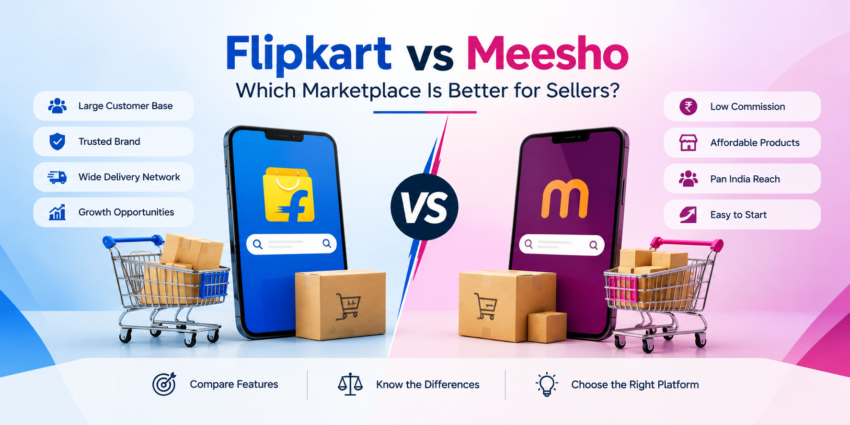
Starting an online business can be exciting, but choosing the right marketplace is an important decision for a new seller. Two popular options in India are Flipkart and Meesho. Both platforms provide opportunities to list products, reach online shoppers, manage orders, and build an e-commerce business. However, their seller ecosystems, fee structures, customer segments, product categories, and selling processes can differ.
If you are searching for Flipkart vs Meesho: Which Is Better for E-commerce, the answer depends on your products, pricing strategy, target customers, profit margins, and long-term business goals. A marketplace that works well for one seller may not provide the same results for another.
In this detailed comparison, we will look at Flipkart vs Meesho across important areas such as seller registration, marketplace reach, commission and fees, product listing, shipping, advertising, competition, customer base, and business growth. Understanding these factors can help you decide how to start selling online and whether one marketplace or a multi-channel strategy is more suitable for your business.
Flipkart vs Meesho: An Overview
Flipkart is one of India’s major e-commerce marketplaces and provides sellers with access to a large customer base across India. Its seller ecosystem includes product listings, fulfilment options, advertising tools, seller support, pricing tools, and business insights. Flipkart currently states that its marketplace reaches more than 45 crore customers and more than 19,000 pincodes.
Meesho is another major marketplace option for Indian sellers, particularly across categories such as fashion, home products, beauty, accessories, and other consumer goods. Meesho promotes a 0% commission model for suppliers in its seller information, although sellers should review the current commercial terms and other applicable charges before calculating profitability.
The Flipkart vs Meesho decision should therefore be based on your individual business model rather than simply choosing the platform with the lowest advertised fee.
Flipkart vs Meesho: Which Is Better for E-commerce?
There is no single answer that applies to every seller.
For a business looking for a broad marketplace ecosystem with established fulfilment, advertising, seller tools, and access to a large customer base, Flipkart offers several seller-oriented features. Flipkart provides both Fulfilment by Flipkart and Non-Fulfilment by Flipkart options, along with advertising and seller growth tools.
Meesho may be attractive to sellers who are particularly focused on price-sensitive products and categories where competitive pricing and affordable online shopping are important factors.
Therefore, when evaluating Flipkart vs Meesho: Which Is Better for E-commerce, consider the complete cost of selling rather than only the commission percentage.
Seller Registration and Getting Started
The registration process is one of the first things new online sellers consider.
Starting on Flipkart
Flipkart provides a dedicated seller platform where businesses can create seller accounts, list products, manage inventory, process orders, and access seller tools. Flipkart states that sellers can create an account with a valid GSTIN and begin listing products.
The basic process generally involves:
-
Creating a seller account.
-
Providing required business and tax information.
-
Adding product details.
-
Uploading product images.
-
Setting prices and inventory.
-
Processing customer orders.
-
Managing returns and payments.
Starting on Meesho
Meesho also provides an online supplier registration process. Its supplier pages describe a process involving registration, catalogue creation, order processing, shipping, and payment.
Before registration, sellers should check the latest documentation and eligibility requirements applicable to their business and product category.
Comparing Marketplace Fees
Fees are an important part of the Flipkart vs Meesho comparison because they directly affect your profit margin.
Flipkart’s official fee information shows that seller costs can include fixed fees, category-based commission fees, collection fees, and shipping fees. The exact amount can depend on factors such as category, selling price, fulfilment method, shipping distance, and package weight.
Meesho promotes 0% commission for suppliers on its seller platform, but sellers should still consider applicable shipping, return-related, tax, and other commercial costs when calculating actual profitability.
What Should Sellers Calculate?
Instead of comparing only commission rates, calculate:
-
Product purchase cost
-
Packaging cost
-
Marketplace fees
-
Shipping cost
-
Taxes
-
Advertising expenses
-
Return-related costs
-
Discount costs
-
Net profit per order
This gives you a more realistic understanding of which marketplace suits your business.
Product Listing and Catalogue Management
A strong product listing is essential on any marketplace.
Your catalogue should include:
-
A clear product title
-
High-quality product images
-
Accurate product specifications
-
Relevant search keywords
-
Detailed product descriptions
-
Correct category selection
-
Available variations
-
Accurate pricing
-
Inventory information
Poor product information can affect customer understanding and conversions.
For both platforms, sellers should regularly review listings and update titles, descriptions, images, prices, stock, and other catalogue information.
Flipkart vs Meesho for Product Categories
The ideal marketplace can also depend on what you sell.
Products That May Suit Flipkart
Flipkart has a broad marketplace covering categories such as:
-
Electronics
-
Mobile accessories
-
Home products
-
Appliances
-
Fashion
-
Beauty products
-
Furniture
-
Books
-
Toys
-
Personal accessories
Flipkart itself promotes numerous product categories for sellers.
Products That May Suit Meesho
Meesho is widely associated with categories such as:
-
Women’s fashion
-
Sarees
-
Kurtis
-
Jewellery
-
Home décor
-
Beauty products
-
Accessories
-
Footwear
-
Kitchen products
-
Lifestyle products
The right platform ultimately depends on product demand, competition, selling price, margins, and customer expectations.
Shipping and Order Fulfilment
Logistics can have a major effect on an online seller’s customer experience.
Flipkart offers different fulfilment options. With Fulfilment by Flipkart, Flipkart can handle storage, packaging, shipping, and returns, while Non-Fulfilment by Flipkart allows sellers to manage packaging from their own location while using Flipkart’s logistics network.
Meesho also provides shipping support for suppliers, allowing sellers to process orders through its supplier ecosystem.
Before choosing a platform, sellers should understand:
-
Shipping charges
-
Pickup process
-
Delivery timelines
-
Return process
-
Packaging requirements
-
Weight-based charges
-
Customer service responsibilities
Advertising and Product Visibility
Getting products listed is only the beginning. Sellers also need visibility.
Flipkart provides advertising solutions that include CPC and Smart ROI campaign types. These tools are designed to help sellers increase product visibility and reach potential customers.
Advertising can be useful when a product has strong margins and sufficient conversion potential. However, sellers should monitor advertising costs carefully.
Important metrics include:
-
Advertising spend
-
Clicks
-
Orders
-
Conversion rate
-
Advertising cost
-
Return on advertising spend
-
Profit after advertising
Competition on Flipkart and Meesho
Both marketplaces have significant seller competition.
To compete effectively, sellers should focus on:
-
Competitive pricing
-
Better product images
-
Accurate product information
-
Strong customer reviews
-
Consistent inventory
-
Fast order processing
-
Competitive shipping
-
Effective advertising
Simply lowering the price is not always the best strategy. Sellers should understand their margins before offering discounts.
Flipkart vs Meesho for New Sellers
New sellers often want to know which marketplace is easier to start with.
A practical approach is to begin with a limited product range and monitor performance. Instead of uploading hundreds of products immediately, sellers can test selected products and evaluate:
-
Product views
-
Click-through rate
-
Orders
-
Conversion rate
-
Returns
-
Customer feedback
-
Net profit
-
Repeat demand
This approach helps identify products that have commercial potential before investing heavily in inventory.
Can You Sell on Both Flipkart and Meesho?
Yes, sellers can consider a multi-marketplace strategy where appropriate.
Selling across multiple marketplaces can provide access to different customer groups and reduce dependence on one sales channel. However, managing multiple platforms also requires accurate inventory synchronization, catalogue management, pricing updates, order processing, and customer service.
A multi-channel approach can become particularly useful as an online business grows.
How Avisha Digital Services Can Help Marketplace Sellers
Managing an e-commerce marketplace requires regular attention to product listings, catalogue information, inventory, orders, advertising, pricing, and account performance.
Avisha Digital Services can support businesses with marketplace-related activities such as account management, catalogue optimization, product listing management, marketplace SEO, advertising support, and e-commerce growth strategies.
For sellers comparing Flipkart vs Meesho, professional marketplace management can help organize day-to-day operations and improve the consistency of your online presence.
Businesses can also consider professional Flipkart account management services or Meesho account management services when managing marketplace operations internally becomes time-consuming.
Important Factors Before Choosing a Marketplace
Before deciding between the two platforms, create a simple comparison based on your business.
Consider:
1. Product Category
Check where your product has relevant customer demand.
2. Profit Margin
Calculate all marketplace and operational expenses before setting your selling price.
3. Target Customer
Understand your ideal customer’s purchasing behaviour and price sensitivity.
4. Competition
Research competing products, prices, ratings, reviews, and catalogue quality.
5. Logistics
Compare shipping requirements, return handling, packaging, and fulfilment options.
6. Advertising
Determine whether your product can support paid advertising while maintaining profitability.
7. Business Goals
Consider whether you want to test products, build a long-term brand, or expand across multiple marketplaces.
Flipkart vs Meesho: A Simple Comparison
| Factor | Flipkart | Meesho |
|---|---|---|
| Marketplace reach | Large national marketplace | Large Indian online marketplace |
| Seller tools | Pricing, inventory, insights and advertising tools | Supplier and catalogue management ecosystem |
| Fulfilment | FBF and NFBF options | Marketplace-supported shipping |
| Commission | Category and other fees apply | 0% commission promoted on supplier platform |
| Advertising | Flipkart Ads available | Seller promotional options may vary |
| Product categories | Broad range | Broad range, with strong presence in several value-oriented categories |
| Best approach | Depends on product and business model | Depends on product and business model |
Fee structures, eligibility, programmes, and services can change, so sellers should verify the current seller terms before making financial decisions.
Common Mistakes New Marketplace Sellers Should Avoid
New sellers can face challenges when marketplace operations are not properly managed.
Avoid these common mistakes:
-
Uploading low-quality product images
-
Using unclear product titles
-
Ignoring search keywords
-
Incorrect category selection
-
Keeping inaccurate inventory
-
Setting prices without calculating all costs
-
Ignoring customer reviews
-
Spending on ads without tracking profitability
-
Failing to monitor returns
-
Listing products without checking marketplace guidelines
Good marketplace management requires regular monitoring rather than a one-time setup.
Which Marketplace Should You Start With?
The answer depends on your business model.
If your products require a broad marketplace presence, structured seller tools, multiple fulfilment options, and advertising capabilities, Flipkart may be relevant to your evaluation. Flipkart provides seller tools covering pricing, selection insights, inventory health, advertising, and other business-support services.
If your business model focuses strongly on competitive pricing and categories that perform well on Meesho, the Meesho marketplace may also be worth evaluating.
Rather than asking only Flipkart vs Meesho: Which Is Better for E-commerce, ask which platform fits your product, margins, customers, operational capacity, and growth plans.
Final Thoughts on Flipkart vs Meesho
The Flipkart vs Meesho comparison does not have one universal answer. Both marketplaces provide opportunities for online sellers, but their seller models, fees, tools, customer behaviour, and operational requirements can differ.
Before starting, research your product category, calculate your expected profit, study competitors, prepare high-quality listings, and understand marketplace policies.
For businesses planning to sell across multiple marketplaces, professional account and catalogue management can also simplify daily operations. Avisha Digital Services can assist sellers with marketplace management, listing optimization, catalogue management, marketplace SEO, advertising support, and e-commerce growth services.
Start with clear goals, test your products, track actual performance, and make decisions based on your own sales and profitability data.