

A manufacturing plant may sign an Annual Maintenance Contract (AMC) expecting predictable maintenance costs and faster equipment support. The problems often appear only after a breakdown. A critical spare is excluded, the vendor’s response time is undefined, or the contract covers preventive visits but says little about restoring production after a failure.
A well-designed AMC contract for manufacturing equipment should therefore do more than define the number of maintenance visits. It should establish exactly which equipment is covered, what maintenance is included, how breakdowns will be handled, which costs are included, and how vendor performance will be measured. The Government of India’s procurement guidance similarly recommends defining service requirements, payment terms, spare and consumable costs, and measurable service levels for complex maintenance contracts.
Why AMC Contracts Need More Than a Maintenance Schedule
A statement such as “preventive maintenance will be carried out quarterly” describes an activity, not the result expected from the maintenance provider.
For production equipment, the contract should also answer:
-
How quickly must the vendor acknowledge a breakdown?
-
When must a technician reach the plant?
-
What is the expected restoration time?
-
Which spare parts are included?
-
Who pays for consumables?
-
What happens when a critical spare is unavailable?
-
How are repeated failures escalated?
-
What evidence is required after a service visit?
-
How is vendor performance assessed at renewal?
This distinction matters because maintenance affects asset availability, production continuity and operating cost. ISO 55001:2024 frames asset management around balancing asset performance, risk and expenditure across the asset lifecycle.
1. Define the Equipment Covered by the AMC
The contract should begin with an equipment-wise scope rather than a broad statement covering “plant machinery.”
The asset register should ideally identify:
-
Equipment name and type
-
Manufacturer and model
-
Serial number
-
Internal asset ID
-
Plant location
-
Installation date
-
Current condition
-
Criticality to production
-
Existing warranty status
Classifying equipment by criticality is particularly useful. A failure of a main compressor, production-line PLC or critical filling machine may have a very different business impact from a non-critical utility or auxiliary asset.
The equipment list should be attached to the contract and updated through a controlled process whenever assets are added, removed or replaced.
2. Clearly Define Preventive Maintenance
The AMC should state what the vendor will actually perform during preventive maintenance.
Depending on the equipment, this may include:
-
Inspection and functional checks
-
Lubrication
-
Cleaning
-
Tightening and alignment checks
-
Electrical and control-system inspection
-
Vibration or temperature monitoring
-
Calibration
-
Safety checks
-
Replacement of scheduled wear components
-
Performance testing
-
Condition assessment
Avoid wording such as “regular maintenance” without an accompanying schedule. The contract should specify the frequency, activities, acceptance criteria and documentation for each major equipment category.
This also gives the plant a way to verify whether a scheduled visit was genuinely completed rather than treating technician attendance as proof of maintenance.
3. Separate Preventive and Breakdown Maintenance
An AMC should explain what happens when equipment fails between scheduled visits.
The breakdown process should define:
Complaint registration → acknowledgement → technician deployment → diagnosis → repair → testing → restoration → closure
The contract should distinguish response time from resolution time.
For example, a vendor may acknowledge a breakdown within two hours but take two days to restore the equipment. Measuring only response time would hide the actual production impact.
For critical equipment, the contract can establish different service levels based on operational importance rather than applying one response target to every machine.
4. Specify SLA and Uptime Requirements
A strong AMC converts vague promises into measurable obligations.
Possible SLA parameters include:
| Parameter | What the Contract Should Define |
|---|---|
| Response time | Maximum time to acknowledge and respond |
| Diagnosis time | Time to identify the failure |
| Restoration time | Target for returning equipment to service |
| Uptime | Required equipment availability |
| PM completion | Percentage of scheduled maintenance completed |
| Escalation | Who handles unresolved breakdowns |
| Repeat failures | How recurring problems are reviewed |
| Reporting | Required service and performance records |
The Government of India’s procurement manual specifically identifies uptime, equipment performance, service-request channels, response time, escalation and service-level monitoring as suitable elements of SLAs for complex maintenance contracts. It also notes that contracts may include consequences for unacceptable delays or performance degradation.
The targets should be realistic and equipment-specific. An SLA should not promise an arbitrary restoration time when the required spare has a long OEM lead time.
5. Define Comprehensive and Non-Comprehensive Coverage
The word “comprehensive” should never be accepted as a substitute for an inclusion list.
The contract should clearly state whether the AMC covers:
-
Labour
-
Breakdown visits
-
Preventive maintenance
-
Major spare parts
-
Wear parts
-
Electrical components
-
Control components
-
Lubricants
-
Filters
-
Batteries
-
Travel and accommodation
-
Emergency visits
-
Calibration
-
Software or control-system support
For a non-comprehensive AMC, the plant should obtain a defined spare-part mechanism, including applicable prices, discounts, lead times and approval requirements.
The procurement manual also recommends clarifying whether maintenance charges include visiting charges, spares and consumables and, where the purchaser bears spare costs, obtaining an appropriate price list.
6. Control Spare-Part Availability and Cost
Spare parts can determine the real cost of an AMC.
A contract should identify:
-
Included spare categories
-
Excluded spare categories
-
OEM versus approved equivalent parts
-
Critical spare inventory
-
Expected procurement lead time
-
Imported spare requirements
-
Obsolete-component handling
-
Emergency procurement procedure
-
Spare pricing mechanism
The important question is not simply “Are spares included?”
It is:
“What happens when a critical spare is required during an unplanned breakdown?”
For important production equipment, the vendor may also be required to recommend minimum critical-spare levels.
7. Establish Technician and Escalation Requirements
The contract should identify who will provide technical support and how unresolved issues will move upward.
Depending on the equipment, requirements may include:
-
Qualified service technicians
-
OEM-authorized support where necessary
-
Specialist engineers
-
Remote technical support
-
Emergency support
-
Named escalation contacts
-
After-hours support
-
Regional service availability
Where an independent service provider is used, the plant should verify its technical capability and any required OEM authorization. Government procurement guidance recognizes both OEMs and authorized service providers as possible AMC providers, subject to the applicable technical and support requirements.
8. Make Service Documentation Part of the Contract
Every maintenance intervention should create a usable record.
A service report should capture:
-
Equipment identification
-
Complaint date and time
-
Technician arrival time
-
Failure description
-
Diagnosis
-
Root cause, where established
-
Work performed
-
Parts replaced
-
Testing performed
-
Equipment status
-
Downtime
-
Pending actions
-
Next maintenance requirement
This information is valuable beyond invoice approval. ISO 14224 identifies equipment, failure and maintenance data, including maintenance actions and downtime, as important reliability and maintenance information. Although the standard is developed for petroleum, petrochemical and natural gas industries, its data principles provide a useful framework for structured maintenance records.
9. Define Performance Review and Payment Terms
AMC payments should be connected to documented service delivery and contract performance.
The agreement should state:
-
Contract value
-
Payment frequency
-
Applicable taxes
-
Payment milestones
-
Service-report requirements
-
Performance certification
-
Spare-part billing procedure
-
Additional-charge approval process
-
SLA-related deductions or credits, where applicable
Government procurement guidance notes that maintenance payments are generally structured periodically and that complex contracts can incorporate performance security and SLA provisions.
A quarterly performance review can examine downtime, PM completion, response performance, repeat failures and unresolved complaints before the next payment or renewal decision.
10. Include Exclusions and Failure Responsibility
Exclusions are as important as inclusions.
The contract should address situations such as:
-
Operator misuse
-
Unauthorized modification
-
External electrical faults
-
Accident damage
-
Fire or flooding
-
Non-approved parts
-
Civil or utility-related failures
-
Consumables
-
Obsolete equipment
-
Force majeure
However, exclusions should be specific. A broad clause such as “electrical faults are excluded” could create disputes if electrical controls are integral to the equipment.
The plant should examine every major exclusion against the actual failure modes of the machine.
11. Track Repeat Failures, Not Just Service Visits
A machine that receives six service visits is not necessarily being well maintained.
If the same bearing, sensor, drive or control module repeatedly fails, the plant needs to know why.
Useful indicators include:
-
Mean time to repair
-
Repeat failure rate
-
Equipment downtime
-
Availability
-
First-time fix rate
-
PM completion
-
Open service calls
-
Critical-spare availability
This changes AMC management from “Did the vendor visit?” to “Did the equipment become more reliable?”
12. Plan the Warranty-to-AMC Transition
The best time to review an AMC is before the equipment warranty expires.
The plant should review:
-
Pending warranty claims
-
Repeated failures
-
Replaced components
-
Maintenance history
-
Equipment condition
-
Critical spares
-
OEM recommendations
-
Recurring technical problems
-
Expected post-warranty maintenance cost
This prevents the plant from entering an AMC immediately after warranty expiry without understanding the equipment’s actual maintenance history.
AMC Red Flags to Check Before Signing
Before approving an AMC, watch for clauses such as:
-
“As and when required”
-
“Reasonable response time”
-
“Major spares extra”
-
“Consumables as applicable”
-
“Subject to availability”
-
No equipment-wise scope
-
No breakdown SLA
-
No escalation process
-
No defined exclusions
-
No service-report requirement
-
No mechanism for repeat failures
These phrases are not automatically unacceptable, but they require clarification before the contract is signed.
A Practical AMC Contract Checklist
Before finalizing an AMC, the manufacturing team should be able to answer yes to these questions:
-
Is every covered asset clearly identified?
-
Are preventive maintenance activities defined?
-
Are breakdown procedures documented?
-
Are response and restoration targets separate?
-
Are spare parts and consumables clearly categorized?
-
Are critical spares and lead times addressed?
-
Are technician and escalation responsibilities defined?
-
Are service reports mandatory?
-
Are performance KPIs measurable?
-
Are payment and additional-cost approvals clear?
-
Are exclusions specific?
-
Is there a process for repeated failures?
-
Is vendor performance reviewed before renewal?
A contract that answers these questions gives the plant considerably more control than an AMC defined only by an annual fee and a fixed number of service visits.
How IMARC Engineering Can Help
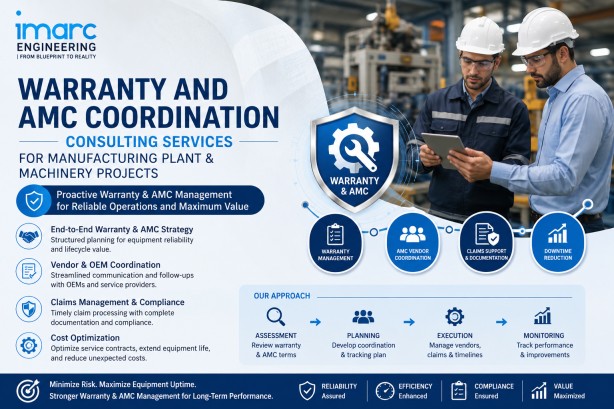
IMARC Engineering can support manufacturing companies in reviewing warranty and AMC requirements across equipment, vendors and service obligations. The support can include equipment-wise scope review, identification of coverage gaps, AMC evaluation, vendor coordination, warranty-claim follow-up, service escalation, documentation review and performance tracking. The objective is to help plant teams establish clearer responsibilities, control avoidable maintenance costs and coordinate vendors against practical operational requirements rather than relying only on routine service visits.
Consult With An Expert: https://www.imarcengineering.com/contact?service=warranty-and-amc-coordination
Conclusion
An effective AMC contract should protect more than the equipment. It should protect production continuity, maintenance budgets and accountability. The strongest agreements clearly define asset scope, preventive and breakdown work, spare coverage, response and restoration SLAs, documentation, KPIs, exclusions and escalation. When these elements are linked to equipment criticality and actual plant requirements, an AMC becomes a measurable maintenance arrangement rather than a yearly service invoice.
Contact Us:
IMARC Engineering
Phone: +91-120-433-0800
Email: sales@imarcengineering.com
India: C-130, Sector 2, Noida, Uttar Pradesh 201301
LinkedIn: https://www.linkedin.com/showcase/imarc-engineering/