

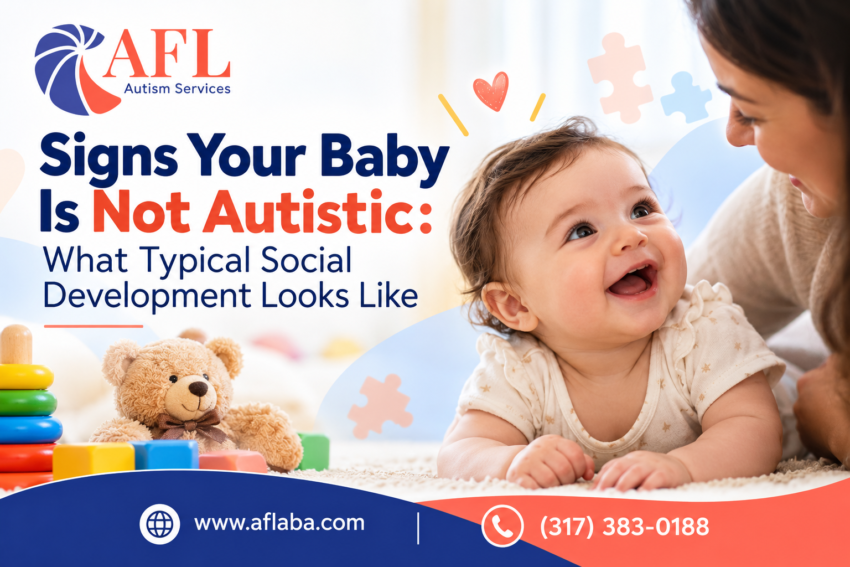
If you are reading this late at night with your baby asleep on your chest, you are not alone. Searches like this spike whenever a new milestone checklist starts circulating online. Before you spiral, it helps to know what typical social development looks like, and what families usually do when a concern turns out to be real. Many parents also learn more about clinic-based ABA therapy during this stage, so they know what support is available if it is ever needed.
Why Parents Search for This
Most parents who look this up are not seeking a diagnosis. They are seeking reassurance, usually after reading a checklist that made them anxious about something ordinary their baby does.
That anxiety deserves a straight answer rather than either dismissal or alarm. Here is what typical early social development generally looks like, and what genuinely warrants a closer look.
Signs Development Is Broadly On Track
By around two months, most babies smile in response to a familiar face. By four to six months, they engage in back-and-forth vocal exchanges you make a sound, they answer.
By nine months, most respond to their name, follow a caregiver with their eyes across a room, and show clear preference for familiar people. By twelve months, most point at things to share interest rather than only to request, wave, and imitate simple gestures.
Development is not a checklist that children pass or fail on a fixed schedule. Each child moves at their own pace, and the age ranges above are averages, not deadlines. A baby who smiles a little later than the chart suggests may still be well within the normal range. What professionals look for is a steady pattern of growth in social interest, communication, and play, and whether that pattern is moving forward over time.
Play Is Part of the Picture
Play offers some of the clearest windows into social growth. Typically developing babies tend to hand objects to adults, bring toys over to show a caregiver, and copy simple actions like clapping or waving bye-bye. They also enjoy peekaboo and games that depend on taking turns.
These moments of shared attention matter more than whether a child plays with a particular toy or in a particular way. A child who plays quietly alone for a while but still returns to you, checks your face, and shares delight is usually showing exactly the kind of connection that signals typical development.
Behaviours That Worry Parents but Are Usually Typical
Lining up toys occasionally. Enjoying spinning objects. Strong preferences about food or clothing. Flapping when excited. Playing alone contentedly. Being slow to speak while clearly understanding everything.
In isolation, none of these indicates autism. Many typically developing children do all of them. What matters is whether a pattern exists across multiple areas, particularly social communication.
Signs That Do Warrant an Evaluation
No babbling by twelve months. No pointing or waving by twelve months. No single words by sixteen months. No two-word phrases by twenty-four months. Consistent failure to respond to their name. Very limited eye contact. And at any age, loss of skills a child previously had.
Loss of previously acquired language or social skills always warrants prompt evaluation.
If a few of these signs apply to your child, the next step is a professional opinion rather than waiting and hoping. Families who want a thorough look at their child’s development can explore autism diagnostic services, which assess communication, social skills, and play in a structured way.
What to Do With Your Concern
If a checklist has worried you, take the concern to your paediatrician rather than to the internet. Standardised developmental screening is recommended routinely in the second year, and you can ask for it.
If concerns persist after screening, a full diagnostic evaluation gives you a detailed developmental picture regardless of whether autism is identified.
The Value of Being Wrong
Parents sometimes hesitate because they fear over-reacting. But an evaluation that finds no autism is not a wasted appointment it produces a developmental profile, addresses your concern properly, and often identifies other things worth supporting.
Parental instinct is one of the more reliable early signals in the research. It is worth acting on.
Whatever you decide, you do not need to carry the question alone. You can find the clinic location nearest you or call (317) 383-0188 or email aflinfo@adaptforlifeaba.com to talk through your child’s development with a team that works with families every day.
Frequently Asked Questions
My baby avoids eye contact sometimes. Should I worry?
Occasional avoidance is typical. Consistently limited eye contact across situations, alongside other social communication differences, is what prompts evaluation.
At what age can autism be reliably identified?
Reliable identification is often possible from around 18 to 24 months, and routine screening is recommended earlier.
Does hand flapping mean autism?
Not on its own. Many typically developing children flap when excited. Context and the presence of other signs matter.
Where can I get an evaluation?
Adapt For Life provides autism diagnostic services at locations across Indiana, Kentucky, North Carolina and Illinois.
About the Provider
Adapt For Life AFL Autism Services
Adapt For Life provides applied behavior analysis therapy, autism diagnostic services and speech therapy for children and families across Indiana, Kentucky, North Carolina and Illinois. Programmes are designed and supervised by Board Certified Behavior Analysts and built around each child’s individual assessment.
Address: Clinic locations across Indiana, Kentucky, North Carolina and Illinois
Phone: (317) 383-0188
Email: aflinfo@adaptforlifeaba.com
Hours: Monday Friday, 8:00 AM 5:00 PM
Services: Clinic-Based ABA Therapy, Autism Diagnostic Services, Speech Therapy
Website: https://aflaba.com/locations/
To book an assessment, call (317) 383-0188, email aflinfo@adaptforlifeaba.com, or visit Adapt For Life Autism Services locations.