

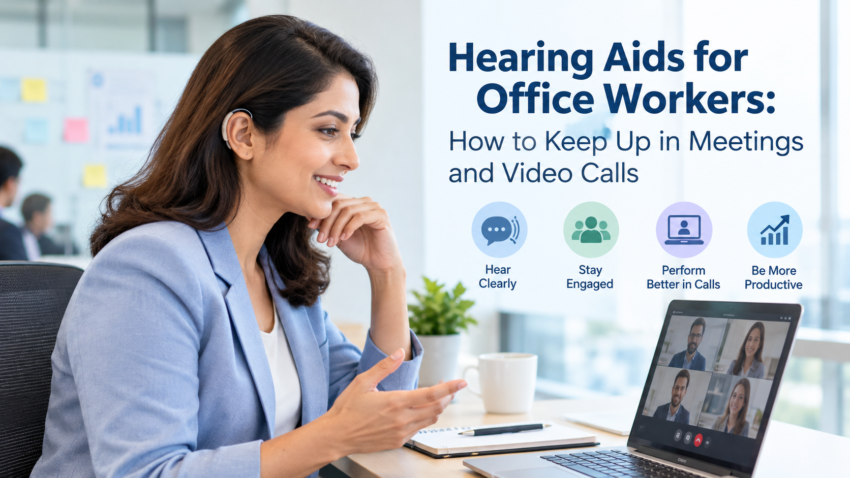
You’re in the Monday meeting. Six people sit around the table, the air conditioner hums, someone speaks from the far end, and a colleague is dialled in through a laptop speaker. The discussion moves quickly, and you realize you’ve missed the last two points.
If this scenario is familiar, you’re in good company. Office environments look quiet, but for a person with hearing loss, they are some of the most demanding listening situations of the day.
Why offices are harder than they look
A typical workplace has overlapping challenges:
- Multiple speakers who talk from different directions and distances.
- Constant low-level noise from air conditioning, keyboards, corridor conversations and printers.
- Reverberation in glass-walled meeting rooms where voices bounce around.
- Compressed audio on video calls, where voices are already stripped of detail.
- Fast turn-taking, which leaves no time to puzzle out what was said.
You don’t just need to hear. You need to follow, respond and contribute in real time, and missing a detail can have professional consequences.
The hidden cost: listening fatigue
Many professionals with untreated hearing loss describe the same afternoon crash. By 3 p.m. they’re drained, not from the work itself, but from the effort of decoding speech all day. Over time these symptoms can lead to withdrawing from discussions, avoiding client calls, or declining opportunities that involve lots of conversation.
Features that actually matter at work
When you’re choosing a hearing aid for a professional lifestyle, here is what to focus on:
1. Directional microphones and adaptive noise management. These help the hearing aid focus on speech coming from the front or from the active speaker while reducing steady background noise.
2. Speech-enhancement processing. Modern devices, including AI and DNN-based models, are designed to analyze the acoustic scene and adapt as you move between a quiet desk, a busy canteen, and a conference room.
3. Bluetooth connectivity. Streaming a call or video meeting directly to your hearing aids can be much clearer than listening through a laptop speaker, since the audio arrives without room echo.
4. Rechargeable batteries. Nobody wants to fumble with tiny batteries before a presentation. A device that charges overnight and lasts the full day removes one thing from your mental checklist.
5. Discreet design. Many professionals prefer slim, low-profile styles that don’t draw attention. Just remember the smallest device is not always the best fit for your hearing loss.
Match the tool to the task
Not every professional needs the same thing. Consider these examples:
- The client-facing consultant who talks one-to-one all day may benefit most from clarity in quiet-to-moderate noise, plus easy phone streaming.
- The manager in back-to-back meetings probably needs strong multi-speaker handling and reliable all-day battery.
- The teacher or trainer who stands in front of a room needs adequate performance with soft voices from the audience.
- The factory supervisor who moves between a quiet office and a loud floor needs robust noise management and durability.
This is why generic advice such as “buy the top model” is unreliable. The right choice depends on what your working day actually asks of your ears. A good starting point is to read about choosing a hearing aid that fits your lifestyle, which covers office, family, and social scenarios side by side.
Practical tips for meetings, with or without hearing aids
- Choose your seat deliberately. Sit where you can see most faces, ideally near the main speaker.
- Ask for an agenda in advance. Knowing the topics helps your brain predict words.
- Use captions on video calls. Live captions are a valuable backup, not a sign of failure.
- Use a headset or direct streaming rather than a speaker for important calls.
- Be upfront. A short sentence like “I have a hearing difficulty, so please face me when you speak” works well and usually earns respect rather than pity.
The stigma question
Many professionals worry that hearing aids will make them seem older or less capable. In practice, the opposite is often true. Constantly asking people to repeat themselves, or responding to the wrong question, creates a far stronger impression than a discreet device behind the ear. Today’s devices look more like earbuds than the bulky aids of the past.
Get it fitted for your real day.
A device chosen in a quiet showroom can behave very differently in a noisy open-plan office. Ask your audiologist to program and fine-tune the aids based on your actual work environments, and book a follow-up after a couple of weeks of real use. Ask about trial options so you can test in your meetings rather than relying on a demonstration.
The takeaway
Your career relies on communication, so make sure your hearing solution supports it. Think about your meetings, your calls, and your commute. Then pick technology that supports those moments, and get it properly fitted. The aim isn’t just to hear better. It’s to walk out of every meeting knowing you caught everything that mattered.