
Introduction
Search engines have evolved far beyond simple keyword matching. Modern search algorithms powered by artificial intelligence now understand people, places, organizations, products, and concepts as entities rather than just words. This transformation has made Entity SEO one of the most effective strategies for improving search visibility, topical authority, and long-term rankings.
Businesses that invest in entity-focused optimization gain better opportunities to appear in rich results, AI-generated search experiences, and knowledge panels. Combining structured data with Semantic SEO allows search engines to understand relationships between different pieces of content, strengthening overall website authority.
Whether you operate a local business or a global enterprise, building entity authority ensures that your website becomes a trusted source of information across Google’s evolving ecosystem. This guide explains how structured data, semantic relationships, and entity-based optimization work together to improve search performance while supporting AI-driven search experiences.
What is Entity SEO?
Entity SEO is the process of optimizing content around identifiable entities instead of relying solely on keywords.
An entity can be:
- A company
- A person
- A location
- A service
- A product
- An event
- A concept
Google uses entities within its Knowledge Graph to understand how information connects across the web.
Instead of asking:
Which keyword appears most often?
Google now asks:
Which entity best answers this search?
This shift makes entity-based optimization one of the strongest long-term SEO strategies.
Why Entity Authority Matters
Entity authority measures how confidently search engines recognize your business as an expert on a specific topic.
A strong entity profile helps:
- Improve topical authority
- Increase trust signals
- Enhance content relevance
- Support AI-generated search results
- Improve Featured Snippets
- Increase Knowledge Panel opportunities
- Build long-term organic visibility
Google’s AI systems increasingly rely on trusted entities instead of isolated pages.
According to Google Search documentation, structured information and consistent entity signals help search engines better understand website content and relationships.
How Structured Data Supports Entity Optimization
Structured data provides machine-readable information that helps search engines understand website content.
It acts as a translator between your website and search engines.
Common schema types include:
- Organization
- Local Business
- Product
- Article
- FAQ
- Service
- Person
- Breadcrumb
- Review
Benefits of Structured Data
- Better indexing
- Rich snippets
- Enhanced search appearance
- Improved crawl efficiency
- Better understanding of business relationships
Example:
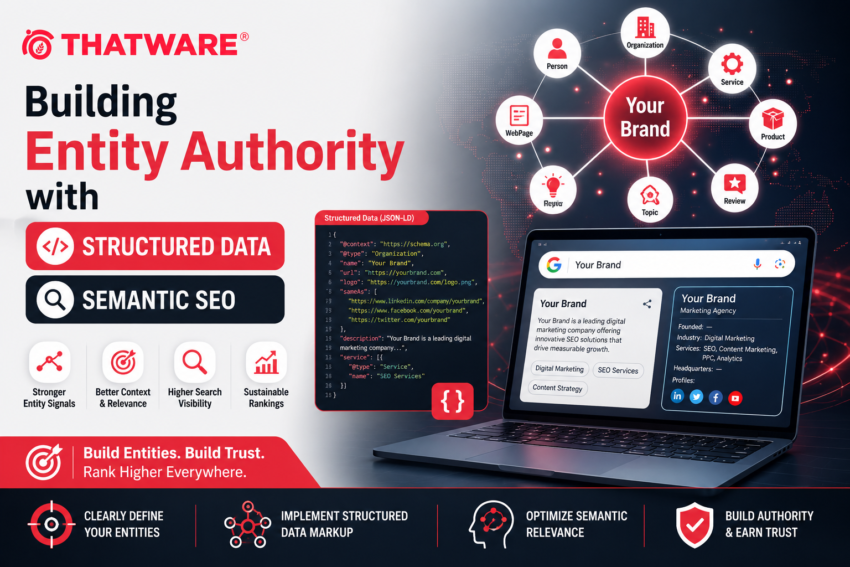
Instead of simply mentioning “ThatWare LLP,” Organization Schema tells Google:
- Official business name
- Website
- Logo
- Contact details
- Social profiles
- Services
- Business location
These signals strengthen Entity Optimization while improving entity consistency across the web.
The Role of Semantic SEO
While keywords remain important, Semantic SEO focuses on topic relationships.
Instead of optimizing one keyword repeatedly, semantic optimization covers related concepts naturally.
For example, content about Entity SEO may also discuss:
- Structured Data
- Schema Markup
- Knowledge Graph
- NLP
- Google Entities
- Topic Clusters
- Search Intent
- AI Search
- Rich Results
Semantic optimization helps search engines understand the complete topic rather than individual phrases.
Benefits of Semantic SEO
- Improved topical authority
- Better user experience
- Increased keyword coverage
- Higher search relevance
- Better ranking stability
Semantic optimization also improves AI-generated answers because language models understand connected concepts more effectively.
Understanding Knowledge Graph SEO
Google’s Knowledge Graph contains billions of entities and their relationships.
Knowledge Graph SEO focuses on improving how your business is represented within this ecosystem.
Strong entity signals include:
- Consistent business information
- Structured data
- Brand mentions
- High-authority backlinks
- Industry citations
- Wikipedia (where applicable)
- Trusted business profiles
Knowledge Graph optimization helps Google confidently associate your website with your business entity.
The stronger these associations become, the greater your chances of appearing in:
- Knowledge Panels
- AI Overviews
- Rich Results
- Local Search
- Featured Snippets
Best Practices for Building Entity Authority
1. Implement Comprehensive Schema Markup
Every important page should contain relevant structured data.
Examples include:
- Organization Schema
- Service Schema
- FAQ Schema
- Article Schema
- Breadcrumb Schema
2. Build Topic Clusters
Instead of isolated blogs, create interconnected content around one primary entity.
For example:
Entity SEO
↓
Structured Data
↓
Schema Markup
↓
Knowledge Graph
↓
Semantic Content
↓
Entity Authority
This internal relationship strengthens topic understanding.
3. Maintain Consistent Brand Signals
Ensure consistency across:
- Website
- Google Business Profile
- Social media
- Business directories
- Press releases
- Industry listings
Consistency improves Entity Authority.
4. Optimize Internal Linking
Internal links help search engines understand relationships between pages.
Example:
Service Page
↓
Blog
↓
Case Study
↓
FAQ
↓
Industry Guide
This creates semantic relevance across your website.
5. Publish High-Quality Topical Content
Search engines reward websites that consistently publish valuable information.
Focus on:
- Industry insights
- Expert guides
- Research articles
- Case studies
- Educational resources
High-quality content naturally strengthens entity recognition.
How ThatWare LLP Builds Entity Authority
ThatWare LLP combines AI-driven SEO strategies with semantic optimization to help businesses establish stronger digital authority.
Its approach includes:
- Advanced Entity Optimization
- Structured Data implementation
- Semantic content architecture
- Knowledge Graph optimization
- AI-powered SEO strategies
- Topical authority development
- Technical SEO improvements
- Internal linking optimization
Rather than focusing only on keyword rankings, ThatWare LLP helps businesses create sustainable entity-based search visibility aligned with modern search engine algorithms.
Conclusion
Search engines continue to shift toward understanding meaning instead of simply matching keywords. Businesses that embrace Entity SEO, structured data, semantic content, and Knowledge Graph optimization are better positioned for long-term organic success and AI-driven search visibility.
Building entity authority requires more than publishing content—it involves creating meaningful relationships between your brand, services, topics, and audience. By implementing structured data, strengthening semantic connections, and maintaining consistent brand signals, organizations can improve trust, relevance, and discoverability across modern search platforms.
If you’re ready to future-proof your SEO strategy, ThatWare LLP offers advanced entity optimization solutions designed to enhance search performance, improve topical authority, and support sustainable growth.
Frequently Asked Questions
1. What is Entity SEO?
Entity SEO is an optimization strategy that helps search engines understand people, businesses, products, and concepts as entities rather than just keywords.
2. Why is Entity Authority important?
Entity authority increases search engine trust, improves topical relevance, and enhances visibility in AI-powered search results, rich snippets, and Knowledge Panels.
3. How does structured data improve SEO?
Structured data provides machine-readable information that helps search engines interpret website content accurately, leading to better indexing and enhanced search features.
4. What is the difference between Semantic SEO and traditional SEO?
Traditional SEO primarily targets keywords, while Semantic SEO focuses on the relationships between topics, entities, and user intent to create comprehensive, context-rich content.
5. What is Knowledge Graph SEO?
Knowledge Graph SEO involves optimizing your brand and content so search engines can accurately recognize and connect your business within Google’s Knowledge Graph.
6. How can businesses improve Entity Optimization?
Businesses can strengthen Entity Optimization by implementing structured data, maintaining consistent brand information, building topical authority, earning quality backlinks, and creating semantically related content.
7. Does Entity SEO help AI-powered search?
Yes. Entity-based optimization helps AI systems better understand your content, increasing the likelihood of appearing in AI-generated search summaries, rich results, and conversational search experiences.