

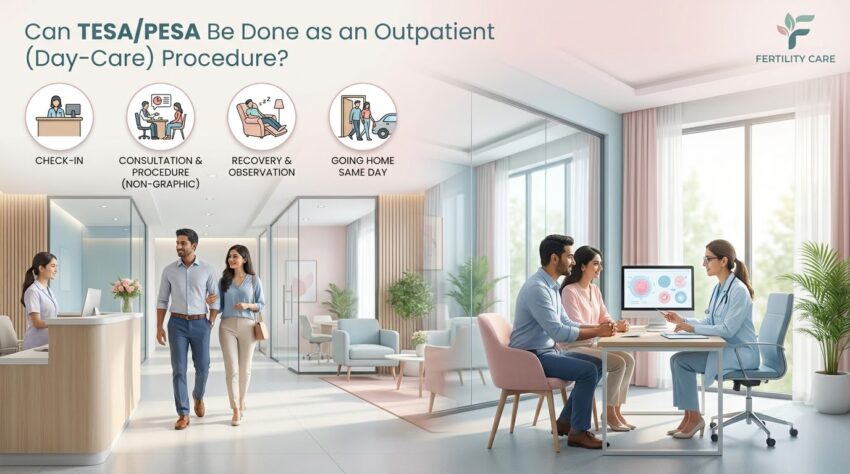
Is TESA/PESA a Day-Care Procedure?
When a doctor recommends sperm retrieval, many men wonder whether they will need to stay in the hospital overnight. TESA and PESA are generally short procedures, and in suitable cases they may be performed as outpatient or day-care procedures. This means the patient can usually return home after a period of observation rather than staying overnight.
During a consultation at an IVF Centre in Mayiladuthurai, the fertility specialist can explain where the sperm will be retrieved from, what type of anaesthesia may be used, and how long observation is likely to be needed. The exact arrangement depends on the patient’s health, the planned procedure, and the clinic or hospital’s protocol.
Understanding what a day-care procedure involves can make the experience less stressful.
What Are TESA and PESA?
TESA stands for Testicular Sperm Aspiration. A fine needle is used to collect sperm-containing material directly from the testicle.
PESA stands for Percutaneous Epididymal Sperm Aspiration. A fine needle is used to retrieve sperm from the epididymis, where mature sperm are stored.
Both procedures may be considered when sperm cannot be obtained through ejaculation, including certain cases of azoospermia.
The choice between them depends on the suspected cause of the fertility problem and the findings from the patient’s evaluation.
What Does “Day-Care” Mean?
A day-care procedure means that you come to the medical facility, undergo the procedure, spend some time recovering afterward, and are discharged on the same day when the medical team considers it safe.
It does not necessarily mean you will be in and out immediately.
The total visit can include:
- Registration and preparation
- Medical assessment
- Anaesthesia or local numbing
- The sperm-retrieval procedure
- Laboratory assessment of the sample
- Recovery and observation
- Discharge instructions
The procedure itself may be relatively brief, but the complete visit can take longer.
Is Anaesthesia Used During TESA/PESA?
The type of anaesthesia or local numbing depends on the procedure, patient, and clinical setting.
Some procedures may be performed with local anaesthesia, while sedation or another form of anaesthesia may be considered in certain circumstances.
Your doctor and anaesthesia team should explain what will be used before the procedure. If sedation or general anaesthesia is planned, you may receive specific instructions about eating, drinking, medicines, and arranging transportation home.
Do not assume that you can drive yourself home simply because the procedure is classified as day-care.
How Long Does the Procedure Take?
TESA and PESA are usually performed within a relatively short period, but the exact duration varies.
The actual sperm retrieval may take less time than the entire hospital or clinic visit. Preparation, anaesthesia, laboratory examination, and post-procedure monitoring all contribute to the total time.
Your specialist can give you a more realistic estimate based on the particular procedure planned for you.
What Happens After Sperm Retrieval?
Once the sample is obtained, it is usually sent to the embryology laboratory for assessment.
The laboratory team checks whether sperm are present and evaluates whether suitable sperm are available for treatment. If viable sperm are obtained, they may be used for ICSI or, when appropriate, cryopreserved for future use.
If no suitable sperm are identified, the fertility team may discuss what this means and whether another approach should be considered.
The laboratory assessment is therefore an important part of the day-care visit.
Can You Go Home Immediately?
Usually, patients are observed for a period after the procedure before discharge.
The medical team may check for problems such as excessive bleeding, significant pain, dizziness, or other effects related to the procedure or anaesthesia.
Once you are considered stable, you may be allowed to go home with aftercare instructions.
If sedation or general anaesthesia has been used, you may need someone to accompany you home and stay with you for a period, depending on the medical team’s advice.
What Should You Do After Going Home?
Mild tenderness, soreness, bruising, or swelling may occur after sperm retrieval.
You should:
- Rest as advised
- Take prescribed or recommended medication correctly
- Keep the procedure area clean according to instructions
- Avoid strenuous exercise until cleared
- Avoid heavy lifting for the period recommended by your doctor
- Follow instructions about sexual activity
- Attend follow-up appointments if advised
Recovery instructions can differ between patients, so your own medical team’s advice should take priority.
When Should You Contact Your Doctor?
Most patients receive specific instructions about symptoms that require attention.
Contact your healthcare team if you experience:
- Severe or worsening pain
- Significant or rapidly increasing swelling
- Heavy bleeding
- Fever or chills
- Increasing redness
- Pus or unusual discharge
- Feeling increasingly unwell
These symptoms should not simply be ignored because the procedure was performed as a day-care treatment.
Is Tesa Pesa Suitable for Everyone?
No. The decision to perform TESA or PESA depends on the individual’s fertility diagnosis.
The doctor may consider semen analysis, hormone levels, physical examination, previous surgeries, suspected obstruction, and other medical findings before recommending sperm retrieval.
In some cases, another technique may be more appropriate. For example, selected men with non-obstructive azoospermia may be considered for micro-TESE rather than routine needle aspiration.
What Should You Arrange Before a Day-Care Procedure?
Before the appointment, ask your clinic about:
- Fasting requirements
- Regular medicines
- Anaesthesia instructions
- Arrival time
- Transportation home
- Expected recovery period
- Activity restrictions
- When the laboratory result will be available
- Whether sperm will be frozen or used immediately
Having these details ready can make the day much easier to manage.
A Short Procedure Can Still Require Proper Planning
TESA/PESA can often be performed as a day-care or outpatient procedure, meaning an overnight hospital stay may not be necessary for suitable patients. However, the exact process depends on the procedure, anaesthesia, medical condition, and clinic protocol.
A fertility specialist at an IVF Centre in Mayiladuthurai can explain what your particular day-care visit will involve, from preparation and sperm retrieval to recovery and discharge. Knowing what to expect can help you prepare comfortably and approach the procedure with greater confidence.