

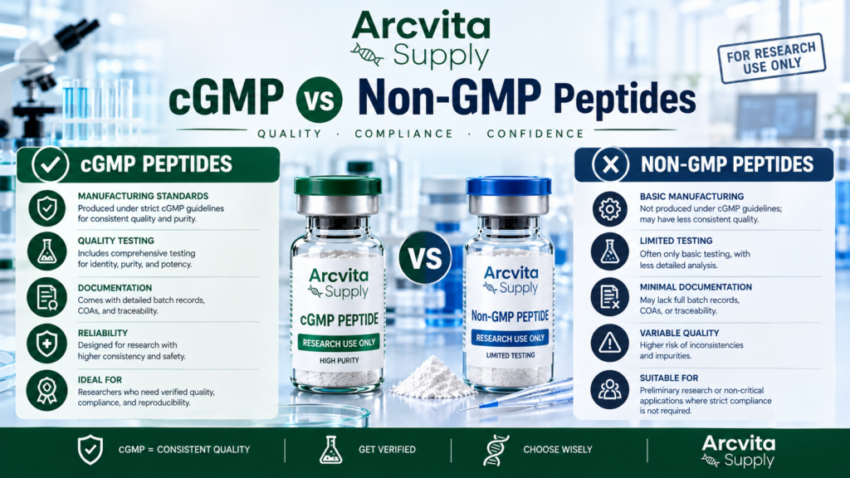
Understanding the difference between cGMP vs Non-GMP Peptides is important for researchers who need to evaluate laboratory materials based on manufacturing standards, quality documentation, analytical testing, and traceability. While both categories may be encountered in research environments, they are not interchangeable descriptions of manufacturing quality. Researchers should understand what each designation means and evaluate supporting documentation rather than relying solely on product labels or marketing statements.
What Does cGMP Mean?
cGMP stands for Current Good Manufacturing Practice. It refers to a system of manufacturing and quality-control requirements designed to help ensure that products are consistently produced and controlled according to established standards.
A cGMP-oriented manufacturing environment generally emphasizes documented procedures, controlled processes, equipment management, personnel responsibilities, quality systems, record keeping, and appropriate testing. These controls are intended to improve consistency and reduce the risk of manufacturing errors or contamination.
However, the term cGMP should not automatically be interpreted as meaning that every individual research material is suitable for every purpose. Researchers should still review product-specific documentation, analytical results, intended-use information, and applicable requirements.
What Are Non-GMP Peptides?
Non-GMP peptides are materials manufactured outside a cGMP manufacturing framework. This does not necessarily mean that a material has no quality controls or analytical testing. Instead, it means the manufacturing process is not being represented as operating under the same cGMP framework.
For research purposes, non-GMP materials may be accompanied by analytical information such as purity results, identity testing, batch information, or Certificates of Analysis. The level and quality of documentation can vary between suppliers, so researchers should evaluate the evidence provided for each specific batch.
The important point is that non-GMP does not automatically mean poor quality, just as a cGMP designation alone does not replace the need for product-specific quality verification.
cGMP vs Non-GMP Peptides: Key Differences
The primary distinction between cGMP and non-GMP materials relates to the manufacturing and quality-management framework used during production.
cGMP systems generally place greater emphasis on controlled manufacturing processes, documented procedures, quality assurance, traceability, equipment controls, and standardized records. Non-GMP manufacturing may operate under different quality systems and requirements.
When evaluating research materials, researchers can consider several factors:
- Manufacturing controls
- Quality-management procedures
- Batch traceability
- Analytical testing
- Identity verification
- Purity results
- Certificates of Analysis
- Storage and handling information
- Supplier documentation
- Intended research use
A comprehensive evaluation considers these factors together rather than depending on one label.
Why Research Peptide Quality Testing Matters
Research peptide quality testing helps researchers understand the characteristics of a particular material. Testing can provide information about identity, purity, composition, and other measurable characteristics depending on the analytical methods used.
Common analytical techniques may include high-performance liquid chromatography (HPLC) for purity assessment and mass spectrometry for molecular identity or mass confirmation. Different testing methods answer different questions, so researchers should consider whether the testing approach is appropriate for the material and research objective.
A reported purity percentage should also be interpreted carefully. Purity is only one aspect of material characterization. It does not necessarily provide complete information about identity, residual substances, manufacturing consistency, stability, or other quality attributes.
Understanding Certificates of Analysis
A Certificate of Analysis, commonly called a CoA, can be an important document when evaluating research materials.
A useful batch-specific CoA may include information such as:
- Product or material identification
- Batch or lot number
- Testing date
- Analytical method
- Reported purity
- Identity or characterization results
- Laboratory information
- Acceptance criteria, where applicable
Researchers should compare the CoA with the product information and verify that the document corresponds to the specific batch being considered.
Generic or incomplete documentation can provide less useful evidence than a clear, batch-specific report. Researchers should also consider whether the testing laboratory and analytical methodology are adequately identified.
Manufacturing Standards and Purity Are Different
One of the most important concepts when comparing cGMP and non-GMP materials is that manufacturing standards and analytical purity are not the same thing.
A manufacturing framework describes how production and quality processes are controlled. Analytical testing provides measurable information about a particular sample or batch.
For example, a material may have a high reported purity result, but that result alone does not establish that the manufacturing process followed a particular quality-management framework. Conversely, a manufacturing framework does not mean researchers should ignore batch-specific analytical evidence.
For this reason, evaluating both manufacturing information and analytical documentation can provide a more complete picture.
What About USA-Made Research Peptides?
The phrase USA-made research peptides describes geographic manufacturing or production claims rather than automatically defining a specific quality standard.
Researchers should avoid assuming that country of origin alone establishes quality. Instead, they can review manufacturing information, batch documentation, analytical testing, storage requirements, and supplier quality procedures.
A responsible evaluation should focus on verifiable evidence rather than geographic claims or promotional language.
Storage and Handling Considerations
Appropriate storage is another important part of research material quality. Researchers should follow the supplier’s documented storage recommendations and applicable laboratory procedures.
Factors that may be relevant include temperature, moisture, light exposure, container integrity, and handling frequency. Lyophilized materials and prepared solutions may have different storage considerations, so researchers should consult the applicable documentation rather than assuming identical conditions.
Maintaining appropriate storage records can also support laboratory traceability and help researchers identify potential deviations.
Legal and Responsible Research Use
Researchers should understand the legal and institutional requirements applicable to their work. Research-use labeling does not automatically authorize clinical, diagnostic, therapeutic, or other regulated applications.
Before acquiring or using research materials, laboratories should consider applicable laws, institutional policies, safety procedures, import or export requirements, and research protocols.
Materials should be used only for their properly documented and lawful research purposes. Researchers should also maintain appropriate records regarding procurement, storage, testing, and handling.
How to Evaluate a Research Peptide Supplier
When comparing suppliers, researchers can use a consistent evaluation process. Instead of focusing only on price or product claims, consider whether the supplier provides meaningful quality documentation.
Useful questions include:
- Is the material clearly identified?
- Is batch or lot information available?
- Is a batch-specific CoA provided?
- Are analytical methods identified?
- Are purity and identity results documented?
- Is storage information available?
- Are manufacturing and quality procedures clearly described?
- Does the supplier provide transparent information about intended research use?
These questions can help laboratories make more objective comparisons.
Final Takeaway
Understanding cGMP vs Non-GMP Peptides requires more than comparing two labels. cGMP describes a manufacturing and quality-management framework, while non-GMP identifies materials produced outside that framework. Neither designation should replace careful evaluation of product-specific evidence.
Researchers should consider manufacturing controls, analytical testing, batch traceability, Certificates of Analysis, storage requirements, supplier documentation, and applicable legal requirements. By evaluating multiple sources of quality information together, laboratories can make better-informed decisions and maintain responsible research practices.