
The failures of materials in the manufacturing process are not instant phenomena; they are normally a result of poor assessment of mechanical properties in the production stage. Inadequate tensile strength may lead to product flaws of ripping film, bursting packaging, weak joints, or failure of these products to withstand loading in the packaging and also in the textile and construction material industries.
In the growing industrial sector in Kenya, it is important that the performance of materials used by the manufacturers remains constant to ensure a high quality of the products, meet its export demands, and minimize losses incurred due to production. Nevertheless, the goals would be impossible to fulfill without proper tensile testing devices that would help to measure the way materials respond to forces that stretch them.
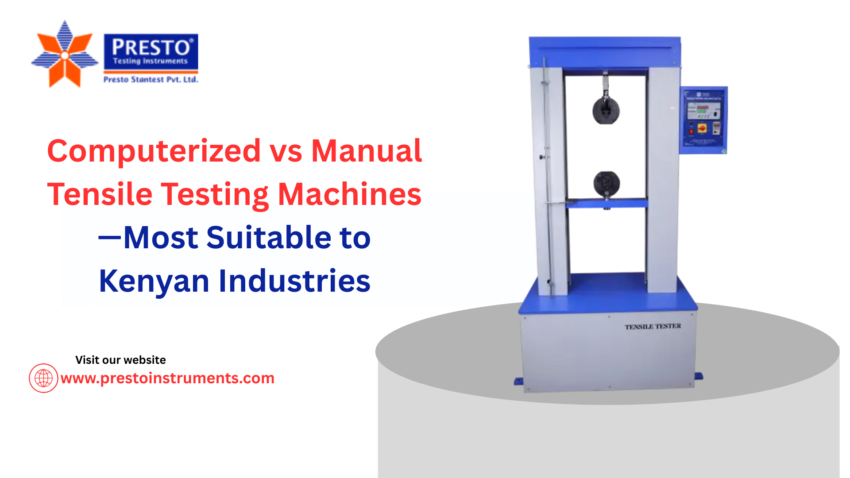
The tensile strength testing machine is used to measure the behavior of a material to a continuously increasing tensile force until the specimen breaks. The test determines several critical mechanical properties, including
- Ultimate tensile strength
- Yield strength
- Elongation at break
- Young’s modulus
- Energy absorption before fracture
These properties assist engineers in forecasting the behaviour of materials in real operating conditions.
Manual Tensile Testing Machines
Manual systems rely primarily on mechanical components and operator observation to measure tensile properties.
Advantages
- Lower equipment cost
- Simple operation and maintenance
- Suitable for basic strength measurement
Limitations
- Limited data recording and analysis
- Reduced measurement precision
- Dependence on operator interpretation
- Difficulty detecting subtle material variations
Manual machines can perform basic testing, but their limitations may restrict detailed material analysis in modern manufacturing environments.
Tensile testing machines, which are operated by computers
Computerized tensile strength tester systems are systems that combine digital load cells, motion controllers, and specialized software to automate the testing.
Advantages
- High-precision load measurement
- Real-time stress–strain curve generation
- Automated data recording and reporting
- Reduced operator variability
- Improved repeatability and traceability
For laboratories conducting frequent testing or supplying international markets, computerized systems provide a significant advantage in accuracy and efficiency.
The importance of Tensile Strength testing
One of the most common types of tests in material quality control is tensile testing since the basic mechanical behavior is displayed.
Material Performance Evaluation
The test identifies how much a material can take before the material breaks down.
Processing Defects Identification
Manufacturing errors, like poor polymer orientation, poor bonding, or degradation of the materials, can decrease tensile strength.
Process Optimization
Routine testing enables the engineers to track the impacts of the production parameters, including extrusion temperature, the composition of the resin, and the cooling rate.
Product Reliability
Proper tensile strength machines guarantee the structural integrity of materials when they are used in the real world.
In the absence of quality testing, manufacturers can end up with products that will fail during transportation or service.
The Principle of Operation of a Tensile Strength Testing Machine
A tensile strength testing machine is used to measure mechanical properties; this is done by using controlled tensile force on a specimen until it fractures.
1. Specimen Preparation
Samples are prepared according to standardized dimensions defined in ASTM or ISO testing methods.
2. Specimen Mounting
The material sample is secured between the upper and lower grips of the tensile strength tester.
3. Controlled Load Application
A crosshead that is driven by a motor moves slowly, extending the specimen.
4. Force and Elongation Measurement
A calibrated load cell measures applied force, while displacement sensors record elongation.
5. Failure Mode Analysis
The stress-strain curve generated enables the engineers to determine material behavior and fracture mechanisms such as
- Brittle fracture—sudden fracture with no deformation
- Ductile failure—major deformation prior to breakage
- Necking—localized reduction in cross-section before break
- Yielding—change of elastic to plastic deformation
These insights help engineers refine material formulations and manufacturing processes.
The Major Characteristics of Advanced Tensile Testing Equipment in Kenya
The design of tensile testing machines in the modern world focuses on extra features of the machine that enhance the accuracy of the tests and the efficiency of the machine.
High-Precision Load Cells
Provide accurate force measurement across the testing range.
Digital Motion Control
Ensures precise crosshead speed regulation.
Automated Data Acquisition
Computerized systems generate detailed stress–strain curves in real time.
Versatile Grip Systems
Permission to test plastic films, paper, rubber, textiles, and polymer materials.
Overload Protection
Integrated safety systems prevent damage to the instrument.
These capabilities make computerized systems the preferred industrial testing machines for modern laboratories.
Applications Across Industries
Tensile testing machine Kenya laboratories use these systems across multiple manufacturing sectors.
Packaging Industry – Testing plastic films, laminates, and flexible packaging materials.
Paper Industry – The tensile strength of paper, tissue, and board materials.
Plastics Manufacturing – Evaluating polymer sheets and molded components.
Automotive Sector – Testing rubber seals and plastic parts.
Textile Industry – Evaluation of the strength of the yarn and fabric.
Compliance with International Standards
Quality tensile testing shall be done according to the internationally accepted testing methods to guarantee accuracy and comparison.
Common standards include:
- ASTM International
- ISO material testing standards
- TAPPI standards for paper testing
- IEC guidelines
- ISTA packaging performance standards
Why Choose Presto Instruments
Presto Instruments is a trusted tensile testing machine manufacturer supplying precision-engineered material testing instruments for global industries.
Key advantages include
- Advanced tensile strength testing machine technology
- Compliance with international testing standards
- Competitive tensile testing machine price options
- Reliable supply for tensile tester machines in Kenyan markets
- Professional calibration and technical support services
These features guarantee repeatability and precision of testing in the challenging industrial environment.
The decisions on whether to use a computerized or manual tensile testing machine hinge on the needs of the tests, the magnitude with which it will be used, and its accuracy of data. Although manual systems are very simple, computerized tensile strength tester solutions are more precise with automated analysis as well as efficiency in testing.
Investment in high-quality tensile testing machinery is required by the Kenyan industries that want to ensure they have a uniform product quality, as well as adhere to the international standards.
Call Presto Instruments today and receive a technical consultation of their products, product specifications, and even a live demonstration, depending on the demands of your laboratory.
FAQs
1. Q.What is the distinction between Computerized and manual tensile testing machines?
Ans: Computerized machines have automated data analysis, digital measurement, and increased accuracy, whilst manual machine systems depend on observation by operators.
2 Q. Why is tensile testing of value in quality control?
Ans: It helps to work the materials to the required standards of strength and prevents the material failure in manufactured products.
3 Q. What influences the price of a tensile testing machine in Kenya?
Ans: The price of a UTM tensile testing machine in Kenya depends on load capacity, degree of automation, capability of running software, range of testing speed, and construction design.