

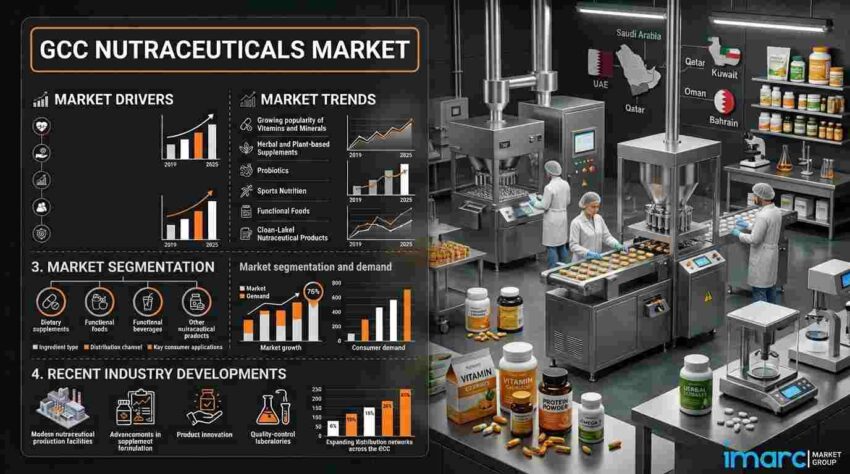
IMARC Group, a leading global market research and management consulting firm, has published its latest market intelligence report on the GCC Nutraceuticals Market. The GCC nutraceuticals market grew from USD 7.5 Billion in 2025 to USD 8.3 Billion in 2026. Looking forward, IMARC Group estimates the market to reach USD 16.1 Billion by 2034, exhibiting a CAGR of 8.61% from 2026 to 2034. Rising health awareness, increasing disposable income, government initiatives targeting lifestyle diseases, rapid urbanization, and expanding retail and e-commerce channels are the leading factors boosting the market.
Across the GCC, consumers are moving from treating illness to preventing it, and nutraceuticals sit at the center of that shift. Lifestyle conditions such as diabetes, obesity and cardiovascular disease, linked to sedentary routines and processed food consumption, are pushing households toward dietary supplements, functional foods and functional beverages. Governments are reinforcing the change through national health campaigns, sugar tariffs and fortification programs that keep nutrition on the public agenda. Social media and easy access to global health information are amplifying awareness of probiotics, omega-3 and superfoods, while pharmacies, hypermarkets and online platforms are widening availability. Together, these forces are building durable, structural momentum for the market through the forecast period.
GCC Nutraceuticals Market at a Glance:
- Market Size (2025): USD 7.5 Billion
- Market Size (2026): USD 8.3 Billion
- Market Forecast (2034): USD 16.1 Billion
- Market Growth Rate (CAGR, 2026-2034): 8.61%
- Largest Product Type (2025): Functional Foods, with a 47.2% share
- Largest Country (2025): Saudi Arabia, with a 37.5% share
How AI is Reshaping the Future of the GCC Nutraceuticals Market
- Digital Health Data as the Foundation for Personalization: Saudi Arabia’s Health Sector Transformation Program reported in June 2026 that its “My Health” application has passed 31 million beneficiaries, giving the Kingdom one of the region’s largest digital health footprints. As prevention becomes a national priority, this kind of connected health data creates the base on which AI-driven nutrition guidance and supplement recommendations can be built for a population facing high rates of diabetes and obesity.
- AI-Enabled Personalized Nutrition Platforms Are Arriving: In April 2026, Google and Singapore microbiome firm AMILI were reported to be launching a personalized nutrition app that uses Gemini to tailor recommendations from gut microbiome data, dietary intake and blood glucose response. Models of this kind give GCC brands, pharmacies and distributors a ready template for localized, halal-compliant and condition-specific supplement programs, particularly for metabolic health.
- Data-Driven Digital Commerce and Direct-to-Consumer Models: Companies in the region are investing in digital marketing, subscription models and direct-to-consumer channels, and first-party purchase data from these channels feeds recommendation engines and demand forecasting. This matters as portfolios widen, with NutraONE and Nutrifactor Laboratories announcing in February 2026 an initial rollout of more than 100 SKUs across the UAE and Saudi Arabia.
Grab a sample PDF of this report: https://www.imarcgroup.com/gcc-nutraceuticals-market/requestsample
GCC Nutraceuticals Market Trends and Drivers:
The core demand driver is a region-wide shift toward proactive health management. Increasing cases of diabetes, obesity and cardiovascular conditions, with approximately 73 million people in the Middle East and North Africa living with diabetes, are prompting consumers to prevent illness rather than only treat it. Social media is accelerating the trend, with the UAE alone recording 10.73 million social media users in January 2024, equal to 112% of its population, as influencers and health experts promote probiotics, omega-3 supplements and superfoods.
The structural differentiator is the pace of urban life and the way retail has adapted to it. Rapid urbanization and long working hours, with more than one in ten Gulf workers reportedly working over 11 hours a day, are creating demand for convenient nutrition such as meal replacement shakes, fortified snacks and ready-to-drink supplements. Availability is expanding across supermarkets, hypermarkets, specialty health stores and online platforms, and the Dubai Chamber of Commerce and Industry had projected e-commerce sales of around USD 8 billion by 2025, which is especially helpful for niche products such as vegan protein powders and organic supplements.
The third driver is government policy that favors healthier consumption and local supply. Saudi Arabia, the UAE and Qatar have introduced sugar tariffs and tighter restrictions on junk food advertising, while Saudi Vision 2030 sets objectives to lower obesity rates and raise dietary awareness. Government endorsement of products such as vitamin D-fortified milk and iodine-enriched salt further supports adoption, and manufacturers are prioritizing local production and halal-certified formulations. These programs are covered in more detail below.
Government Schemes and Vision 2030 Initiatives Driving Demand:
- Saudi Health Sector Transformation Program under Vision 2030: The program restructures the health system around prevention and healthier lifestyles. Its 2025 annual report, published in June 2026, recorded life expectancy of 79.7 years against the Vision target of 80 years, primary healthcare coverage of 97.5% of population clusters, and more than 31 million beneficiaries on the “My Health” application.
- Saudi Quality of Life Program: Launched in 2018, the program aims to improve the quality of life of individuals and families by creating an environment that supports healthier lifestyle options, which reinforces demand for supplements, fortified foods and functional beverages.
- Sugar Tariffs and Junk Food Advertising Restrictions: Saudi Arabia, the UAE and Qatar have introduced sugar tariffs and tighter restrictions on junk food advertising, alongside national campaigns on balanced diets, nudging consumers toward fortified and functional alternatives.
- SFDA Regulation of Dietary Supplements: The Saudi Food and Drug Authority regulates the import, manufacture and distribution of dietary supplements and requires pre-market approval and labeling compliance, which raises quality standards and favors credible, well-documented brands.
- UAE Ministry of Health and Prevention 2023-2026 Strategy and Healthcare Investment: National transformation programs in Saudi Arabia and the UAE are catalyzing capital flows, with JLL recording almost 400 healthcare transactions across the GCC between 2021 and April 2025, nearly 92 percent of them in the two countries, and expecting investment to shift toward preventive care and personalized health.
GCC Nutraceuticals Market Industry Segmentation:
The report has segmented the market into the following categories:
Breakup By Product Type:
- Dietary Supplements: Proteins and Peptides, Vitamins and Minerals, Herbals, Others
- Functional Foods: Probiotics Fortified Food, Omega Fatty Acid Fortified Food, Branded Ionized Salt, Branded Wheat Flour, Others
- Functional Beverages: Fruit and Vegetable Juices and Drinks, Dairy and Dairy Alternative Drinks, Others
Functional foods account for the largest share at 47.2% in 2025. Growth is driven by consumer demand for fortified products that deliver benefits beyond essential nutrition, such as omega-3 enriched dairy, protein-fortified snacks and probiotic yogurts, which cater to the region’s focus on immunity, digestion and overall wellness. Strategic marketing around convenience and government initiatives promoting healthier dietary habits are further accelerating the segment.
Breakup By Source:
- Plant
- Animal
- Microbial
Plant-based sources represent the largest share in 2025. Rising awareness of sustainable, natural-origin and herbal products, together with plant-derived proteins and botanical extracts that many consumers view as safer and more environmentally friendly, supports the segment. Shifting regional diets, greater understanding of vegan and vegetarian lifestyles, clean-label preferences and innovations such as fortified plant milks and meat alternatives are broadening its appeal.
Breakup By Form:
- Tablets and Capsules
- Gummies and Soft Gels
- Powder and Liquid
Tablets and capsules lead the market in 2025. Their strengths are precise dosing and extended shelf life, and they are the preferred format for vitamins and minerals and herbal extracts aimed at immunity, bone health and energy. Advances in encapsulation technology that enable controlled release and better bioavailability, along with their compact and portable nature, make them well suited to busy professionals and frequent travelers.
Breakup By Sales Channel:
- Offline: Supermarkets and Hypermarkets, Specialty Stores, Others
- Online
Offline channels hold the majority of the market share in 2025. The GCC’s preference for conventional retail, including pharmacies, supermarkets and specialized health shops, gives consumers in-person consultations, trusted pharmacist advice and the ability to examine products before buying. Pharmacies in particular are often the first point of contact for people seeking supplements, and the region’s trust in established retail networks keeps the channel firmly in the lead.
Breakup By Country:
- Saudi Arabia
- UAE
- Qatar
- Kuwait
- Oman
- Bahrain
Saudi Arabia accounts for the largest share at 37.5% in 2025. Its sizable population, growing health consciousness and government wellness programs under Vision 2030, which target obesity and vitamin deficiencies, are the main causes. A growing middle class and rising disposable income lift demand for premium health products, while the expansion of retail pharmacies and supermarkets across urban and rural areas improves accessibility and cements the Kingdom’s leadership in the regional market.
Competitive Landscape:
Key industry players are focusing on product innovation, strategic partnerships and expanding their market presence. Businesses are launching halal-certified nutraceuticals, vitamin D-enriched supplements and functional meals aimed at local health issues such as diabetes and obesity, using advanced technology to improve bioavailability and nutrient delivery, and prioritizing local production to reduce reliance on imports. Investment in digital marketing, subscription models and direct-to-consumer sales is making e-commerce a key area of attention, while cooperation with fitness facilities and medical professionals is supporting adoption and brand credibility. The report provides detailed profiles of all major companies. Companies active in the regional nutraceuticals landscape include:
- Nutrifactor Laboratories
- NutraONE
- iNova Pharmaceuticals
- GE Services & Trading (Global Edge)
- Agthia Group
What Does The Full Report Cover?
- Historical trends and market outlook for the GCC nutraceuticals market from 2020 to 2034, in USD Billion
- Segment-wise historical and future market assessment by product type, source, form, sales channel and country
- Product type coverage across dietary supplements, functional foods and functional beverages, including all sub-categories
- Country-level analysis covering Saudi Arabia, UAE, Qatar, Kuwait, Oman and Bahrain
- Industry catalysts and challenges shaping demand across the region
- Porter’s five forces analysis assessing new entrants, competitive rivalry, supplier power, buyer power and the threat of substitution
- Competitive landscape with detailed profiles of all major companies, plus 10% free customization and 10-12 weeks of post-sale analyst support
Recent News and Developments in the GCC Nutraceuticals Market
- January 2025: GE Services & Trading (Global Edge) took part in Arab Health 2025 to showcase three global brands aimed at bringing natural healthcare products to the UAE and wider Middle East. The brands specialize in healthy aging, plant-based nutrition and dietary supplements, addressing rising demand for health-conscious solutions.
- January 2025: iNova Pharmaceuticals, the newest player in the GCC market, launched an expanded range aimed at common winter ailments such as sore throats and colds. The launch includes Betadine Cold Defense, a new formulation developed to treat viral colds, reduce symptoms and speed recovery.
- February 2026: NutraONE and Nutrifactor Laboratories signed an exclusive distribution partnership on February 11 at World Health Expo 2026 in Dubai, covering the UAE, Saudi Arabia, Turkey, the UK and Canada. The initial rollout prioritizes the UAE and Saudi Arabia with more than 100 SKUs across wellness categories.
- June 2026: Saudi Arabia’s Health Sector Transformation Program published its 2025 annual report, citing life expectancy of 79.7 years, primary healthcare coverage of 97.5% of population clusters and more than 31 million beneficiaries of the “My Health” application, underlining the national shift toward prevention and healthier lifestyles.
Note: If you require specific details, data, or insights that are not currently included in the scope of this report, we are happy to accommodate your request. As part of our customization service, we will gather and provide the additional information you need, tailored to your specific requirements. Please let us know your exact needs, and we will ensure the report is updated accordingly to meet your expectations.
Key Questions This Report Answers
- How has the GCC nutraceuticals market performed so far and how will it perform in the coming years?
- What is the breakup of the GCC nutraceuticals market on the basis of product type?
- What is the breakup of the market on the basis of source, including plant, animal and microbial?
- What is the breakup of the market on the basis of form, such as tablets and capsules, gummies and soft gels, and powder and liquid?
- What is the breakup of the market on the basis of sales channel, offline versus online?
- Which countries lead the GCC nutraceuticals market and what is driving their share?
- What are the key driving factors and challenges, who are the key players, and what is the degree of competition?
About Us
IMARC Group is a global management consulting firm that helps the world’s most ambitious changemakers to create a lasting impact. The company provides a comprehensive suite of market entry and expansion services. IMARC offerings include thorough market assessment, feasibility studies, company incorporation assistance, factory setup support, regulatory approvals and licensing navigation, branding, marketing and sales strategies, competitive landscape and benchmarking analyses, pricing and cost research, and procurement research.
Media and Sales Contact
IMARC Group
Email: sales@imarcgroup.com
United States: +1-201-971-6302
India: +91-120-433-0800
United Kingdom: +44-753-714-6104