
Data has become one of the most valuable assets for modern businesses. Whether you’re an AI startup, SaaS provider, healthcare organization, eCommerce platform, or enterprise software company, you’re likely collecting, processing, or storing personal information every day.
With this responsibility comes the need to comply with privacy regulations, particularly the General Data Protection Regulation (GDPR).
Since its introduction, GDPR has changed how organizations collect, process, and protect personal data. It has also raised customer expectations around transparency and accountability. Today, demonstrating strong privacy practices is not only a regulatory requirement but also an important factor in earning customer trust and winning enterprise business.
However, many organizations still view GDPR compliance as a one-time project. They update their privacy policy, implement a cookie banner, and store a few compliance documents in shared folders.
In reality, compliance is an ongoing process that evolves alongside your business.
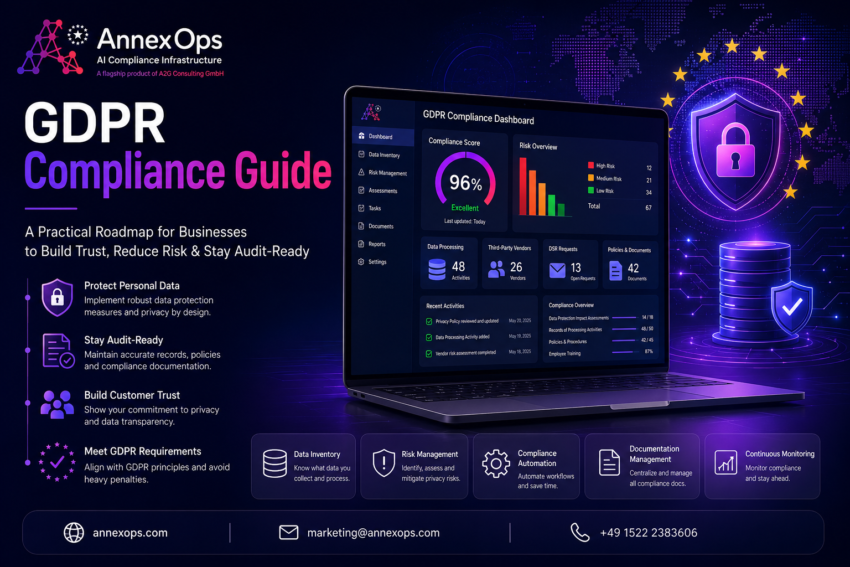
This GDPR compliance guide explains the fundamentals of GDPR, outlines the essential steps every organization should follow, and explores how businesses can simplify compliance as operations grow.
What Is GDPR?
The General Data Protection Regulation (GDPR) is the European Union’s data protection law designed to give individuals greater control over their personal information while requiring organizations to process that information responsibly.
It applies to organizations operating within the European Union and also to businesses outside the EU that offer products or services to EU residents or monitor their behavior online.
GDPR governs how organizations:
- Collect personal information
- Process personal data
- Store customer records
- Share information with third parties
- Protect sensitive data
- Respond to privacy requests
- Demonstrate accountability
The regulation is built around principles such as transparency, fairness, purpose limitation, data minimization, accuracy, storage limitation, integrity, confidentiality, and accountability.
For businesses, GDPR isn’t simply about avoiding penalties, it’s about creating responsible data governance practices that strengthen customer confidence.
Why Every Business Needs a GDPR Compliance Guide
Many companies assume GDPR only affects large enterprises or organizations headquartered in Europe.
That’s a common misconception.
If your business collects personal information from EU residents through your website, mobile application, CRM platform, marketing campaigns, or AI-powered services, GDPR obligations may apply regardless of where your company is located.
A structured GDPR compliance guide helps organizations:
- Understand their compliance responsibilities.
- Build consistent privacy processes.
- Reduce operational risk.
- Prepare for customer due diligence.
- Improve audit readiness.
- Build trust with customers and business partners.
Instead of reacting when compliance issues arise, businesses can establish repeatable governance practices that support long-term growth.
Why GDPR Compliance Has Become More Challenging
Complying with GDPR has become increasingly complex because businesses now manage significantly more personal data than they did just a few years ago.
Customer information flows through:
- Marketing automation platforms
- Customer Relationship Management (CRM) systems
- HR software
- Cloud applications
- Analytics tools
- Customer support platforms
- AI-powered applications
- Third-party integrations
Each new system creates additional responsibilities for documenting data processing activities, managing consent, securing information, and maintaining accurate compliance records.
As organizations expand, keeping track of these responsibilities manually becomes increasingly difficult.
Common Challenges Businesses Face
Many organizations begin their compliance journey using spreadsheets, emails, and shared folders.
While these methods may work initially, they often become difficult to manage as operations grow.
Some of the most common challenges include:
Scattered Documentation
Compliance documents are stored across multiple systems, making it difficult to locate policies, approvals, and audit evidence when needed.
Manual Processes
Tracking privacy requests, updating Records of Processing Activities (RoPA), and maintaining compliance documentation manually consumes valuable time and increases the likelihood of human error.
Limited Visibility
Legal, compliance, engineering, security, HR, and product teams often maintain separate records, making it difficult to gain a complete picture of organizational compliance.
Audit Preparation
Many organizations only organize compliance documentation when an audit or enterprise customer requests evidence, creating unnecessary stress and delays.
Compliance Is No Longer Just a Legal Requirement
Today, strong privacy governance also supports business growth.
Enterprise customers increasingly evaluate vendors before signing contracts.
Investors assess governance maturity during due diligence.
Business partners expect transparency regarding data handling practices.
Organizations that can demonstrate structured privacy processes are often better positioned to build trust and strengthen commercial relationships.
This is one of the reasons many businesses are moving beyond basic compliance checklists toward more structured governance programs.
Where Does a GDPR Checker Fit In?
Following a GDPR compliance guide is the first step, but businesses also need a way to measure whether their privacy practices remain effective over time.
This is where a GDPR Checker becomes valuable.
Rather than waiting for a customer questionnaire or regulatory review, a GDPR Checker helps organizations assess their current compliance posture by identifying gaps in documentation, governance, consent management, data processing records, and privacy workflows.
Think of it as a regular health check for your compliance program.
As your business evolves, periodic GDPR assessments help ensure your privacy practices continue to align with regulatory expectations and operational changes.
Step-by-Step GDPR Compliance Guide
Understanding GDPR is important, but implementing it effectively requires a structured approach. Instead of viewing compliance as a one-time checklist, organizations should build processes that can adapt as their business grows.
Whether you’re a startup handling customer registrations or an enterprise processing large volumes of personal data, these steps provide a practical framework for maintaining GDPR compliance.
Step 1: Identify the Personal Data You Collect
The first step is understanding what personal data your organization collects and why.
Personal data can include:
- Customer names
- Email addresses
- Phone numbers
- IP addresses
- Employee information
- Payment details
- Location data
- Device identifiers
It’s equally important to identify where this information is stored and which teams or systems have access to it.
Without a clear data inventory, it’s difficult to protect information or demonstrate compliance during an audit.
Step 2: Document Your Data Processing Activities
GDPR requires organizations to understand how personal data moves through the business.
This includes documenting:
- Why data is collected.
- How it is processed.
- Where it is stored.
- Who has access to it.
- Which third parties receive it.
- How long it is retained.
Maintaining accurate Records of Processing Activities (RoPA) improves transparency and makes future audits much easier.
Step 3: Review Your Privacy Notice
Your privacy policy should accurately reflect how your business collects and processes personal data.
A compliant privacy notice should clearly explain:
- What information is collected
- Why it is collected
- The legal basis for processing
- Data retention periods
- Third-party data sharing
- User rights under GDPR
- Contact information for privacy-related requests
Review your privacy notice regularly, especially after launching new products or introducing new technologies.
Step 4: Strengthen Consent Management
Consent is one of the most visible aspects of GDPR compliance.
Businesses should ensure users can:
- Give consent freely.
- Reject non-essential cookies.
- Withdraw consent easily.
- Update their preferences at any time.
Consent records should also be maintained to demonstrate accountability if required.
Step 5: Protect Personal Data
Compliance isn’t only about documentation.
Organizations should also implement appropriate technical and organizational safeguards.
Examples include:
- Multi-factor authentication
- Encryption
- Role-based access controls
- Regular backups
- Security monitoring
- Employee awareness training
Strong security practices reduce both compliance and cybersecurity risks.
Step 6: Prepare for Data Subject Requests
Individuals have the right to:
- Access their personal data.
- Correct inaccurate information.
- Request deletion.
- Restrict processing.
- Receive a copy of their data.
- Object to certain processing activities.
Organizations should establish documented procedures to handle these requests efficiently and within GDPR timelines.
Step 7: Monitor Compliance Continuously
Compliance isn’t static.
Every time your organization introduces:
- A new SaaS platform
- A third-party integration
- An AI-powered feature
- A new marketing campaign
- A cloud migration
your compliance posture may change.
Regular reviews help ensure your documentation and governance processes remain accurate as the business evolves.
Common GDPR Mistakes Businesses Make
Even organizations with strong intentions can overlook important compliance requirements.
Some of the most common mistakes include:
Treating GDPR as a One-Time Project
Privacy compliance should evolve alongside your business.
Regular reviews are essential.
Keeping Documentation in Multiple Locations
Scattered documentation makes audits more difficult and increases the risk of outdated information.
Ignoring Third-Party Vendors
Every vendor processing personal data on your behalf should be reviewed and documented appropriately.
Outdated Privacy Policies
If your business processes data differently today than it did a year ago, your privacy notice should reflect those changes.
Waiting Until an Audit
Many organizations don’t review their compliance until they’re responding to an enterprise questionnaire or regulatory request.
By then, gathering documentation often becomes a time-consuming exercise.
Why a GDPR Checker Is Important
Following a GDPR compliance guide establishes the right processes, but organizations also need a practical way to verify that those processes are working.
This is where a GDPR Checker becomes valuable.
Rather than relying on assumptions, a GDPR Checker helps businesses evaluate whether key privacy controls are in place.
It can help assess areas such as:
- Privacy notices
- Cookie consent
- Records of Processing Activities
- Data retention
- Vendor management
- Compliance documentation
- Governance processes
Think of it as a routine compliance health check.
Performing regular GDPR assessments helps organizations identify gaps early, improve operational visibility, and strengthen audit readiness before regulators, customers, or partners request evidence.
Why Businesses Are Adopting AI Compliance Software
As organizations scale, spreadsheets and manual tracking often become difficult to manage.
Compliance teams need better visibility, structured workflows, and centralized documentation.
This is where AI compliance software is transforming compliance operations.
Instead of managing multiple disconnected systems, modern compliance platforms help organizations:
- Centralize compliance documentation.
- Organize governance workflows.
- Track compliance activities.
- Improve collaboration across teams.
- Maintain audit-ready evidence.
- Monitor compliance continuously.
Automation doesn’t replace compliance professionals—it enables them to focus on strategic governance rather than repetitive administrative work.
Organizations that invest in structured compliance technology are often better prepared for customer due diligence, internal governance reviews, and evolving regulations.
GDPR Compliance Is the Foundation for Future Regulations
Privacy regulations continue to evolve, and businesses can no longer afford to treat compliance as a one-time initiative.
Organizations are increasingly adopting artificial intelligence to automate business processes, improve customer experiences, and make data-driven decisions. While these innovations create new opportunities, they also introduce additional governance responsibilities.
For companies operating in Europe or serving European customers, GDPR compliance is becoming the foundation for broader regulatory readiness.
New frameworks such as the EU AI Act place greater emphasis on accountability, transparency, documentation, and risk management throughout the AI lifecycle.
Organizations that already maintain structured GDPR processes are better prepared to meet these emerging requirements.
From GDPR Compliance to AI Governance
Traditional GDPR compliance focuses on protecting personal data and ensuring organizations process that data responsibly.
However, modern businesses need governance that extends beyond data privacy.
As AI systems become part of everyday business operations, organizations must also answer questions such as:
- How are AI systems monitored after deployment?
- Who is responsible for reviewing AI-related risks?
- How are governance decisions documented?
- Can compliance evidence be produced during customer due diligence?
- Are governance processes consistent across teams?
Building structured compliance processes today makes answering these questions significantly easier tomorrow.
How AI Compliance Software Simplifies Ongoing Compliance
Managing GDPR manually becomes increasingly difficult as businesses grow.
Every new product, employee, customer, third-party integration, or AI feature creates additional compliance responsibilities.
This is why many organizations are investing in AI compliance software to simplify governance.
Rather than replacing legal or compliance professionals, AI-powered platforms help organizations manage compliance more efficiently by providing:
- Centralized compliance documentation
- Structured governance workflows
- Compliance activity tracking
- Audit-ready evidence management
- Collaboration across legal, compliance, engineering, and product teams
- Continuous visibility into compliance activities
Instead of scrambling before an audit, organizations can maintain a proactive and organized compliance program throughout the year.
Why Businesses Are Moving Toward Compliance Automation
The conversation around compliance has shifted.
Organizations are no longer asking:
“How do we pass the next audit?”
They’re asking:
- How can we maintain compliance continuously?
- How do we reduce manual administrative work?
- How do we improve collaboration across departments?
- How do we stay prepared for future regulations?
The answer is increasingly found in automation.
By combining a practical GDPR compliance guide, regular assessments through a GDPR checker, and modern AI compliance software, businesses can build a governance framework that supports long-term growth instead of reacting to compliance issues as they arise.
How AnnexOps Helps Organizations Build Scalable Compliance
As compliance requirements become more complex, organizations need more than policies stored in shared folders.
They need an operational framework that makes governance part of everyday business processes.
AnnexOps helps organizations simplify GDPR compliance automation by providing a centralized platform for compliance operations.
With AnnexOps, organizations can:
- Centralize GDPR documentation and compliance records.
- Organize governance workflows across departments.
- Track compliance activities from a single platform.
- Strengthen AI governance and risk management.
- Improve audit readiness with structured documentation.
- Support organizations preparing for evolving regulations, including the EU AI Act.
Instead of managing compliance through disconnected spreadsheets and manual processes, businesses can create repeatable workflows that improve visibility, accountability, and operational efficiency.
Learn more about GDPR Compliance Automation:
👉 https://annexops.com/gdpr-compliance-automation/
Final Thoughts
Building a strong privacy program isn’t just about meeting regulatory requirements, it’s about creating trust.
Organizations that take a proactive approach to compliance are better equipped to protect customer data, respond confidently to audits, and strengthen relationships with enterprise customers and partners.
This GDPR compliance guide provides a practical framework for understanding the key steps involved, but maintaining compliance requires continuous attention as your business evolves.
Regular reviews with a GDPR checker, supported by AI compliance software, can help organizations identify gaps early, streamline governance processes, and stay prepared for changing regulatory expectations.
As data privacy and AI governance continue to evolve, businesses that invest in structured compliance today will be in a stronger position to scale responsibly tomorrow.