

Quick AnswerA gentle skin cleanser removes oil, sunscreen and everyday grime without leaving your face tight, hot or squeaky. Look for a mild surfactant system, a skin-friendly pH of around 5, humectants such as glycerin and hyaluronic acid, and no added fragrance or colour. The simple test: if your skin feels comfortable, soft and calm five minutes after washing, the cleanser is doing its job. If it feels tight or stings, it is too harsh for you, however “natural” the label sounds. |
Most of us were taught that clean skin should feel squeaky. That squeak is actually a sign that the cleanser has taken away more than dirt: it has stripped away some of the natural oils that keep your skin flexible and protected.
If you have ever finished washing your face and felt that tight, slightly uncomfortable pull, you already know the problem. The good news is that choosing a gentle skin cleanser is far more straightforward than the skincare aisle makes it seem. This guide explains what “gentle” really means, what to look for on an ingredients list, and how to build a simple routine, particularly if your skin is sensitive.
What Makes a Cleanser “Gentle”?
“Gentle” is not a regulated term, so any brand can print it on a bottle. In practice, a genuinely gentle formula comes down to four things: the type of cleansing agent, the pH, what has been left out, and what has been added back in.
1. A mild surfactant system
Surfactants are the ingredients that lift oil and dirt so water can rinse them away. Older, harsher ones, such as sodium lauryl sulphate, are very effective at this, but they can also strip the skin’s natural lipids and cause irritation, especially with daily use. Milder options, including amino acid-based surfactants and glucosides, clean more softly and tend to leave the skin’s surface comfortable.
2. A skin-friendly pH
Healthy skin is slightly acidic, usually sitting at around pH 4.5 to 5.5. Traditional soap bars are alkaline, which can temporarily push skin out of that range and leave it feeling dry or reactive. A cleanser formulated close to pH 5 works with the skin’s natural acidity rather than against it.
3. No added fragrance or colour
Fragrance is one of the most common causes of contact irritation, and it does nothing for how well a cleanser works. Because a cleanser sits on your face for under a minute, the scent is gone almost immediately anyway. Our guide to what to look for in fragrance free skincare products explains how to read labels properly, including the “unscented” versus “fragrance free” difference.
4. Humectants that keep skin comfortable
Ingredients like glycerin and sodium hyaluronate attract and hold water. In a rinse-off product their effect is modest, but they help offset the drying effect that washing naturally has. If you want the detail on how glycerin works, we have covered it in glycerin for hydrated skin.
Gentle vs harsh: a quick comparison
|
Feature |
Gentle cleanser |
Harsh cleanser |
|---|---|---|
|
Cleansing agents |
Amino acid-based or other mild surfactants |
Strong sulphates, high-alkaline soap bases |
|
pH |
Around 5, close to skin’s natural level |
Often 8 to 10 (soap-based) |
|
Fragrance |
None, or very low |
Added perfume or essential oils |
|
After-feel |
Soft, comfortable, clean |
Tight, squeaky, sometimes stinging |
|
Daily use |
Usually fine, twice a day |
Can lead to dryness and redness |
Why Cleansing Matters in Skin Care for Sensitive Skin
If your skin is sensitive, your cleanser is arguably the most important product in your routine. It is the one thing that touches your face twice a day, every day, so a poor choice adds up fast.
The outermost layer of your skin works like a brick wall: skin cells are the bricks, and lipids such as ceramides and fatty acids are the mortar. Over-cleansing wears away that mortar. The result is a weaker barrier that loses water more easily and lets irritants in more readily. That is why skin care for sensitive skin usually starts with removing harsh steps rather than adding clever new ones.
Signs your cleanser may be too harsh
- Your face feels tight or “squeaky” straight after rinsing
- Redness, stinging or a warm sensation when you wash
- Dry, flaky patches that appear or worsen after cleansing
- Skin that looks shiny but feels rough (a sign of dehydration, not excess moisture)
- Products that used to feel comfortable suddenly sting
If several of these sound familiar, swapping to a milder cleanser for two to four weeks is a sensible first step before changing anything else.
How to Choose a Cleanser for Sensitive Skin
Reading ingredient lists can feel like decoding a foreign language. This checklist keeps it simple when you are shopping for a cleanser for sensitive skin:
- Fragrance free, not just “unscented”, which can still contain masking agents
- Sulphate free, with a mild surfactant listed near the top of the ingredients
- Low pH, ideally stated by the brand at around 5
- Humectants such as glycerin or sodium hyaluronate
- Minimal extras: skip harsh scrubs, strong alcohols and heavy essential oil blends
- Some form of testing, such as a primary irritation test, which tells you more than a marketing claim
What to look for by skin type
|
Skin type |
Look for |
Best to avoid |
|---|---|---|
|
Sensitive |
Fragrance-free gel or cream, pH near 5, soothing extracts |
Sulphates, perfume, physical scrubs |
|
Dry |
Creamy or gel formulas with glycerin and hyaluronate |
Foaming washes with strong surfactants |
|
Oily or combination |
Light gel cleanser that rinses clean, no residue |
Over-washing, which can prompt more oil |
|
Dehydrated |
Hydrating gel with humectants, used lukewarm |
Hot water and very long massage times |
Oily skin deserves a special mention. A gentle formula does not mean a weak one. Many people with oily skin do well with a light gel cleanser because it lifts excess oil without triggering the “rebound” shine that can follow a harsh wash.
Do You Really Need a Hydrating Facial Cleanser?
A fair question, because a cleanser is rinsed off within seconds. A hydrating facial cleanser will not replace your moisturiser, and anyone who tells you otherwise is overselling it.
What it does do is reduce the damage that cleansing can cause. By pairing mild surfactants with humectants, it lets you wash without that dry, tight aftermath, which makes it easier for your moisturiser to do its job. If your skin runs dry or dehydrated, or if you simply want a routine that is easy to keep up, it is a sensible choice. Our walkthrough on how to choose the right hydrating facial cleanser for everyday use goes through this in more detail.
Which cleanser format suits you?
|
Format |
Best for |
Things to know |
|---|---|---|
|
Gel |
Most skin types, including oily and sensitive |
Light and rinses cleanly; check it is not stripping |
|
Cream or milk |
Dry, mature or very reactive skin |
Comforting, but can feel heavy on oily skin |
|
Cleansing balm or oil |
Heavy makeup and water-resistant SPF |
Needs a second, gentle wash to remove residue |
|
Foaming wash |
Oily skin, if formulated mildly |
Many are too harsh; check the pH and surfactants |
|
Micellar water |
Quick removal of light makeup |
Can leave residue if not rinsed or wiped well |
A Simple Routine for Sensitive Skin
You do not need ten steps. In fact, for reactive skin, fewer is almost always better.
- Morning: Cleanse with lukewarm water, or rinse only if your skin is very dry. Follow with moisturiser and sunscreen.
- Evening: Cleanse once to remove sunscreen, sweat and the day’s buildup. If you wear heavy makeup, use a balm first, then your gentle cleanser.
- Moisturise within a few minutes, while skin is still slightly damp.
- Introduce new actives slowly, one at a time, with a few days between each.
|
Expert tips for gentler cleansing Go lukewarm. Hot water strips oils faster and can aggravate redness. Keep it to 30 to 60 seconds. Longer massage times do not clean better; they just increase friction. Pat dry. Rubbing with a towel can irritate already sensitive skin. A clean, soft towel pressed gently does the job. Patch test. Try any new cleanser on a small area, such as the jawline, for a few days before using it on your whole face. Be patient. Give a new cleanser at least two to four weeks unless it causes obvious irritation. If it does, stop using it. |
Where 77SKIN Sea Reset Cleanser Fits In
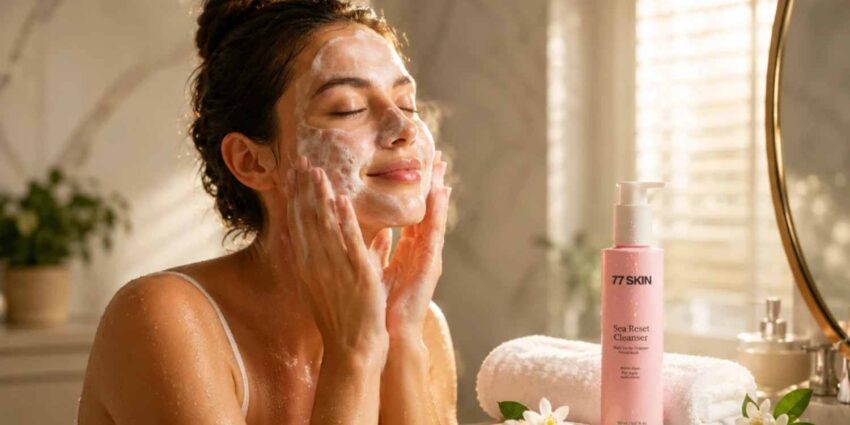
Everything above is the thinking behind the Sea Reset Cleanser from 77skin. It is a hydrating gel cleanser formulated at approximately pH 5, and it is sulphate free, fragrance free and colour free. Rather than relying on a long list of extras, it keeps things deliberately simple.
|
What it does |
How the formula supports it |
|---|---|
|
Cleanses without over-cleansing |
Lifts daily buildup, excess oil, sunscreen and light makeup with a cushiony gel texture |
|
Keeps skin comfortable |
Glycerin and sodium hyaluronate help skin feel smooth and hydrated after rinsing |
|
Works with the skin barrier |
Low-pH, mild cleansing system designed to avoid the tight, stripped feeling |
|
Suits daily use |
Fragrance free and colour free, suitable for sensitive and all skin types |
The formula also includes red algae extract and lactobacillus ferment, and it has undergone primary irritation testing with a non-irritating result. In consumer testing, every participant agreed that it felt gentle enough for sensitive skin and suitable for daily use. You can read the full figures on the consumer testing results page.
To be straightforward about it: no skincare product suits absolutely everyone, and a passed irritation test is not a guarantee against any reaction. If you have a diagnosed skin condition such as eczema, rosacea or dermatitis, it is worth checking with your dermatologist or GP before introducing a new product, and patch testing first.
If you are curious, the Sea Reset Cleanser is a good, uncomplicated place to start. Your skin does not need to prove anything on the first day, so give it a couple of weeks and see how it settles.
Common Cleansing Mistakes to Avoid
- Washing more than twice a day unless you have been sweating heavily or wearing makeup
- Using a face scrub or cleansing brush every day on reactive skin
- Choosing a cleanser because it smells nice rather than because of what is in it
- Skipping moisturiser because the cleanser is “hydrating”
- Switching products every week, which makes it impossible to tell what is helping
Frequently Asked Questions
What is the gentlest type of cleanser for sensitive skin?
Fragrance-free gel or cream cleansers with mild surfactants and a pH near 5 are generally the kindest options. Avoid sulphate-heavy foaming washes, soap bars and anything with strong scents or scrubbing particles.
Can a gentle skin cleanser remove sunscreen and makeup?
Yes, for most everyday sunscreen and light makeup. For heavy or waterproof makeup, a balm or oil as a first step followed by your gentle cleanser is a more comfortable approach than scrubbing harder.
How often should I use a gentle skin cleanser?
Twice a day suits most people: once in the morning and once in the evening. If your skin is very dry or reactive, a lukewarm water rinse in the morning is a reasonable alternative.
Can a hydrating facial cleanser replace my moisturiser?
No. A cleanser is on your skin for only a short time, so it cannot replace a moisturiser. Its job is to clean without drying, so that your moisturiser has a better starting point. You can read more in our article on the benefits of a hydrating face cleanser.
Is a gentle cleanser suitable for oily or acne-prone skin?
It can be. Over-washing with harsh products often makes skin feel worse and can increase irritation. A light gel that rinses clean is usually a better starting point, although persistent acne is best discussed with a dermatologist.
How long before I know if a cleanser suits my skin?
You will notice the immediate feel within the first few uses: comfortable or tight, calm or stinging. Judge longer-term changes, such as fewer dry patches, after two to four weeks of consistent use.
Conclusion
A good gentle skin cleanser should be one of the least dramatic things in your routine. It cleans, it rinses off, and your skin feels comfortable afterwards. Look for a mild surfactant system, a pH near 5, no added fragrance and a touch of hydration, and be wary of anything that leaves you feeling tight.
If you have sensitive skin, keep the routine short, the water lukewarm and the changes slow. Small habits, such as patting dry and moisturising promptly, often make as much difference as the cleanser itself.
Ready to simplify? Explore the 77 Skin Skincare Journal for more practical, ingredient-led guidance, or take a look at the Sea Reset Cleanser if you would like a gentle, hydrating place to begin.