
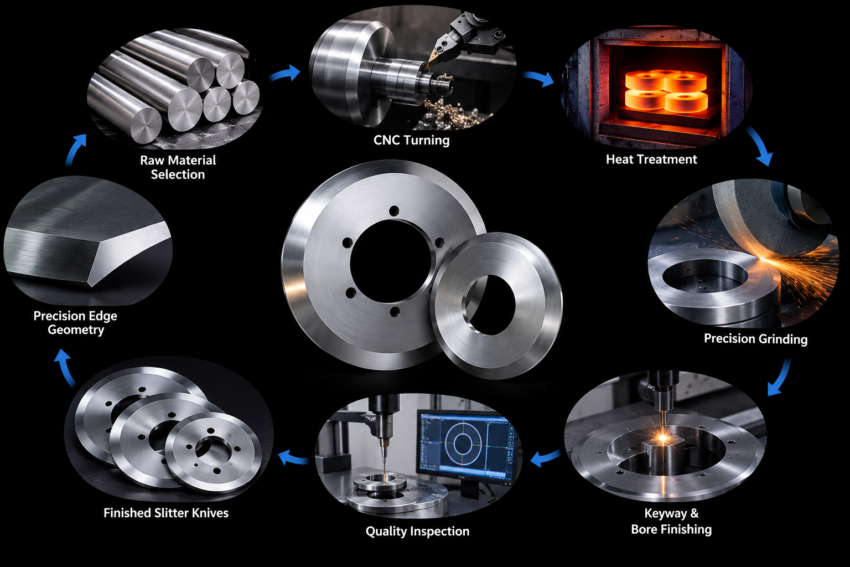
Slitter knives cut large rolls of steel, aluminium, stainless steel, and other sheet material into narrower strips at high speed, and the accuracy of that cut depends entirely on how the knife itself gets made. A knife that runs even slightly out of tolerance produces burrs, camber, or an uneven strip width, and these defects carry through every downstream process the strip enters. Manufacturers building slitter knives for Indian steel service centres, tube mills, and coil processing lines follow a sequence of controlled stages, from raw material selection through hardening, grinding, and final inspection, to hold the tight tolerances that high-speed slitting demands.
This article walks through each stage of that manufacturing sequence and explains why the order and control at each step decide how a finished knife performs on a slitting line. Manufacturers such as Maxwell Slitter Industries run each of these stages in-house, which keeps material traceability and dimensional consistency intact from raw billet to finished blade.
Raw Material Selection and Cutting
Manufacturing starts with selecting the correct tool steel grade for the application. D2 and D3 cold-work steels suit general-purpose coil slitting, HSS M2 and M35 suit stainless and silicon steel, and powder-metal grades suit abrasive, high-volume applications where standard HSS wears out too quickly. A manufacturer sources billets against a specific grade and retains a mill certificate for each heat number, since this document later confirms the raw material used in a given batch of knives.
A bandsaw then cuts the billet into blanks sized close to the final outer diameter, inner diameter, and thickness. Cutting blanks accurately at this stage reduces the amount of material that later machining steps need to remove, which shortens cycle time without affecting final accuracy.
CNC Turning to Near-Net Dimensions
A CNC lathe faces and turns each blank to bring it close to its final outer diameter, inner diameter, and thickness, before the piece goes into hardening. Turning at this stage, rather than machining a knife to final dimension before hardening, matters because hardening changes the internal grain structure of the steel and introduces slight dimensional shifts. Leaving stock for grinding after hardening accounts for this shift and lets the manufacturer correct for it during the finishing stage.
Vacuum Hardening and Tempering
Heat treatment decides how well a finished slitter knife resists wear and how consistently it performs across its working life. A vacuum furnace hardens each batch of blanks in a controlled, oxygen-free environment, which prevents decarburisation on the surface and keeps hardness uniform through the full cross-section of the disc. Multi-stage tempering follows hardening, relieving internal stress and bringing the material to its target hardness range, typically between 58 and 66 HRC depending on the grade selected.
In-house hardening gives a manufacturer direct control over this stage, rather than sending blanks to a third-party heat treater. This control reduces the risk of soft spots, which cause uneven wear and premature chipping once the knife goes into service on a slitting line.
Bore Grinding to Final Tolerance
After hardening, a CNC internal grinder brings the bore of each knife to its final inner diameter, typically within a few thousandths of a millimetre. This step also corrects any dimensional shift introduced during hardening. Bore accuracy matters because the knife mounts directly onto an arbor during operation, and any looseness or misalignment at this interface shows up as runout during the cut, which in turn produces a wandering or dished slot in the finished strip.
Grinding also brings the disc to its final thickness and flatness specification, and a manufacturer checks both figures against the drawing before the knife moves to the next stage.
Keyway Cutting by Wire EDM
Many slitter knives require a keyway to lock the disc to the arbor and prevent rotation under load. Wire EDM cuts this keyway to precise width and depth without introducing mechanical stress or distortion into the hardened disc, which a conventional milling process would risk given the hardness of the material at this stage. Accurate keyway dimensions keep the knife seated correctly on the arbor, which supports consistent cutting performance across the production run.
Surface Finishing and Edge Geometry
Lapping brings the flat faces of each knife to a fine surface finish, which reduces friction during the cut and supports a burr-free edge. The cutting edge itself gets ground to the geometry specified for the application, whether a single bevel, double bevel, dished profile, or radius edge. Edge geometry affects how cleanly the knife separates material and how it interacts with the mating knife in a top-and-bottom slitting arrangement, so this step gets matched to the specific material and gauge the knife will process.
Laser Marking and Final Inspection
Before dispatch, each knife receives a laser-etched marking that records its part number, dimensions, and batch date. This marking gives a plant a way to trace a specific knife back to its production batch later, which matters if a quality question comes up after the knife enters service.
Final inspection covers outer diameter, inner diameter, thickness, flatness, parallelism, and concentricity, typically measured on a coordinate measuring machine, along with a hardness check on each individual knife using a portable hardness tester. A manufacturer that documents these results and ships them with the order, rather than relying on a general specification sheet, gives the buyer a direct basis to verify the knife against its own requirement.
Why the Sequence Matters
Each stage in this sequence exists to correct for the dimensional and structural changes introduced by the step before it. Turning before hardening, grinding after hardening, and cutting keyways by wire EDM rather than conventional milling all reflect the same underlying principle: precision holds only when each stage accounts for what the previous stage changed in the material. Manufacturers such as Maxwell Slitter Industries run this full sequence in-house at a single facility, which keeps every stage traceable back to the same raw material batch and removes the variability that comes from splitting production across multiple subcontractors.
A plant sourcing slitter knives for a high-speed coil line benefits from knowing this sequence, since it explains why tolerance, hardness uniformity, and edge geometry depend as much on the manufacturing process as on the tool steel grade selected at the start.