
Businesses generate enormous amounts of information every single day—and collecting that data manually feels a bit like trying to empty a swimming pool with a coffee mug. Large-scale data collection has become essential for companies that rely on market research, pricing intelligence, customer behavior analysis, and trend forecasting. This is where web scraping changes the conversation entirely. Automated extraction systems gather data quickly, accurately, and continuously without exhausting internal teams. As digital competition grows sharper, businesses increasingly depend on scalable data extraction strategies to stay informed, agile, and just slightly ahead of competitors still copy-pasting spreadsheets at midnight.
Understanding Large-Scale Data Collection
Large-scale data collection refers to gathering massive volumes of structured and unstructured information from websites, platforms, directories, marketplaces, and digital databases. Businesses use this data for analytics, forecasting, customer insights, and operational decisions. Traditional collection methods often struggle with speed, consistency, and human error—especially when thousands of records require updates every hour. Modern companies need real-time information, not reports that become outdated before the coffee cools down. Many organizations eventually discover that the real challenge is not finding data anymore; it is organizing and processing it efficiently enough to create meaningful business value.
What Is Web Scraping and How Does It Work?
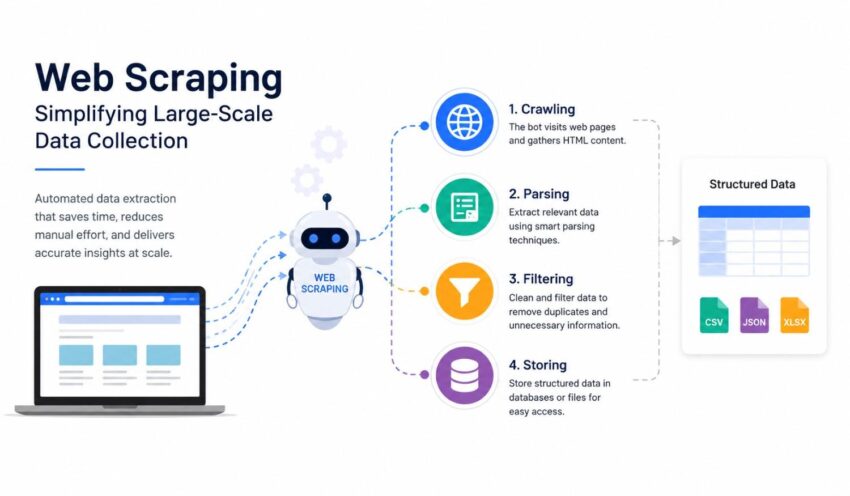
Web scraping is an automated process that extracts information from websites using bots, crawlers, scripts, or intelligent extraction tools. These systems scan web pages, identify target data fields, and convert raw information into structured formats such as CSV, JSON, or databases. Unlike manual research, automated scraping handles thousands of pages in minutes while maintaining consistency and accuracy. The process typically includes crawling websites, parsing HTML, filtering information, and storing usable datasets for analysis. In many ways, web scraping functions like a highly organized research assistant—except it never asks for lunch breaks or vacation approvals.
Why Businesses Are Investing in Automated Data Extraction
Businesses invest in automated data extraction because speed has quietly become one of the most valuable competitive advantages in modern markets. Companies monitor pricing trends, customer sentiment, product availability, competitor updates, and industry changes in real time through scraping systems. Automated collection reduces manual workloads and improves decision-making accuracy across departments. Marketing teams, sales operations, and analysts all benefit from consistent data access. Besides, manually updating giant spreadsheets every day has become something of a corporate ghost story whispered around office meeting rooms. Automation simply removes unnecessary friction while helping teams focus on strategic business growth.
Key Benefits of Web Scraping for Large-Scale Data Collection
Web scraping delivers multiple operational advantages for businesses managing high-volume information workflows. Automated extraction significantly improves speed and efficiency while reducing human errors commonly found in manual research. It also pportsus scalability, allowing businesses to collect millions of records without expanding internal staffing costs. Real-time updates help organizations react quickly to market shifts, pricing changes, and customer behavior patterns. Additionally, scraped data integrates smoothly with ERP, CRM, and analytics platforms for centralized reporting. A Custom web scraping company often helps businesses create tailored extraction systems designed specifically for industry requirements, compliance standards, and long-term scalability goals.
Industries That Benefit Most From Web Scraping
Several industries rely heavily on web scraping to maintain operational efficiency and competitive visibility. ECommerce businesses monitor competitor pricing and inventory trends, while healthcare organizations track pharmaceutical updates and research data. Real estate companies collect property listings, finance firms analyze market signals, and travel businesses monitor dynamic pricing models daily. Recruitment platforms also use extraction systems to organize candidate and job market information. One interesting observation from enterprise operations is that businesses rarely struggle because of “too little” data anymore. The bigger challenge usually comes from managing overwhelming amounts of scattered information across disconnected digital sources.
Common Challenges in Large-Scale Web Scraping
Despite its advantages, large-scale web scraping comes with technical and operational challenges. Many websites use CAPTCHA systems, anti-bot protections, IP blocking, and dynamic JavaScript rendering to prevent automated access. Data formatting inconsistencies and duplicate records can also create quality issues during processing. Additionally, businesses must consider compliance policies, ethical scraping practices, and website usage terms carefully. Poorly designed scraping systems often fail under scale, especially when handling millions of requests daily. Experienced developers play a critical role in building resilient extraction infrastructures capable of adapting to changing website structures and enterprise-level performance demands.
Best Practices for Effective Web Scraping Projects
Successful web scraping projects begin with clearly defined business goals and structured data requirements. Businesses should prioritize scalable infrastructure, automated validation systems, and regular performance monitoring to maintain extraction accuracy. Following ethical scraping practices and respecting website compliance standards are equally important for long-term sustainability. Data cleaning and formatting processes should also be automated to reduce operational bottlenecks. Many organizations underestimate maintenance requirements until websites suddenly change layouts overnight—which, naturally, tends to happen at the least convenient possible moment. Strategic planning and proactive monitoring help ensure scraping systems remain stable, accurate, and efficient over time.
The Role of AI and Automation in Modern Web Scraping
Artificial intelligence is transforming modern web scraping into a far more intelligent and adaptive process. AI-powered systems can recognize patterns, classify content, identify structural changes, and improve extraction accuracy automatically. Machine learning models also help automate categorization, sentiment analysis, and predictive insights from collected data. Instead of simply gathering information, modern scraping platforms increasingly focus on delivering actionable intelligence for business decision-making. Automation now extends beyond extraction into processing, analysis, and reporting workflows. As technology evolves, businesses are moving toward smarter systems capable of interpreting data—not just collecting endless rows of information nobody reads twice.
Why Businesses Prefer Custom Web Scraping Solutions
Ready-made scraping tools often work well for basic extraction tasks, but enterprise businesses usually require more flexibility, scalability, and integration capabilities. Custom solutions allow organizations to build workflows tailored to specific industries, compliance requirements, and operational goals. They also provide greater control over data formats, update frequencies, automation logic, and security protocols. Businesses handling sensitive or large-scale datasets benefit significantly from personalized architectures designed for long-term growth. A generic scraping tool may solve temporary problems, but tailored solutions typically support sustainable business operations without forcing companies into rigid technical limitations later.
How Kanhasoft Helps Businesses Simplify Data Collection
Kanhasoft develops scalable web scraping solutions designed to simplify complex business data collection processes. From custom extraction workflows to cloud-based automation systems, the focus remains on reliability, performance, and integration flexibility. Businesses receive structured datasets that connect seamlessly with internal ERP, CRM, and analytics platforms. Support services also help maintain scraping systems as websites evolve over time. Practical business requirements always guide the development process because technology alone rarely solves operational challenges without thoughtful implementation. Efficient automation ultimately helps organizations spend less time chasing information and more time using it to drive measurable growth.
Future of Large-Scale Data Collection
The future of large-scale data collection will revolve around automation, artificial intelligence, and real-time analytics. Businesses increasingly require faster insights, smarter forecasting, and continuous monitoring systems to remain competitive in rapidly changing industries. Ethical data extraction practices and compliance standards will also become more important as regulations evolve globally. AI-enhanced analytics platforms will likely transform raw datasets into predictive business intelligence with minimal manual involvement. Companies that invest early in scalable automation strategies will gain stronger operational advantages over slower competitors. In many ways, modern business success increasingly depends on collecting smarter data—not simply collecting more of it.
Conclusion
Web scraping has become one of the most effective ways to simplify large-scale data collection across industries. Automated extraction systems improve speed, accuracy, scalability, and operational efficiency while reducing the burden of manual research. Businesses now depend on real-time insights to make faster and smarter decisions in highly competitive digital environments. The organizations leading their industries are often the ones building better data pipelines behind the scenes—quietly, efficiently, and without turning every spreadsheet update into a full-scale emergency meeting. Smart automation ultimately allows businesses to focus less on gathering information and more on creating meaningful business outcomes.
FAQs
What is large-scale data collection?
Large-scale data collection involves gathering huge volumes of information from multiple online sources for analysis, reporting, forecasting, and business decision-making purposes.
Is web scraping legal for businesses?
Web scraping can be legal when businesses follow ethical practices, respect website terms, and avoid accessing restricted or protected information improperly.
How accurate is automated web scraping?
Modern scraping systems provide highly accurate results when supported by automated validation, structured parsing, and continuous monitoring processes.
Which industries use web scraping the most?
ECommerce, healthcare, finance, travel, recruitment, and real estate industries commonly rely on web scraping for operational and market intelligence.
Can web scraping work with dynamic websites?
Yes, advanced scraping systems can handle JavaScript-rendered websites using browser automation tools and intelligent extraction frameworks.
Why choose custom web scraping solutions over ready-made tools?
Custom solutions offer better scalability, flexibility, integration capabilities, and long-term support for enterprise-level business requirements.
How often should scraped data be updated?
Update frequency depends on business needs. Some companies require real-time updates, while others use daily or weekly extraction schedules.
What are the biggest challenges in web scraping projects?
Common challenges include CAPTCHA systems, IP blocking, data inconsistencies, dynamic website structures, and maintaining long-term extraction stability.
How does AI improve web scraping?
AI improves scraping through intelligent pattern recognition, automated categorization, adaptive extraction, and predictive data analysis capabilities.
How can Kanhasoft help with web scraping development?
Kanhasoft provides scalable scraping solutions, custom automation systems, cloud-based extraction workflows, and ongoing technical support for businesses.