

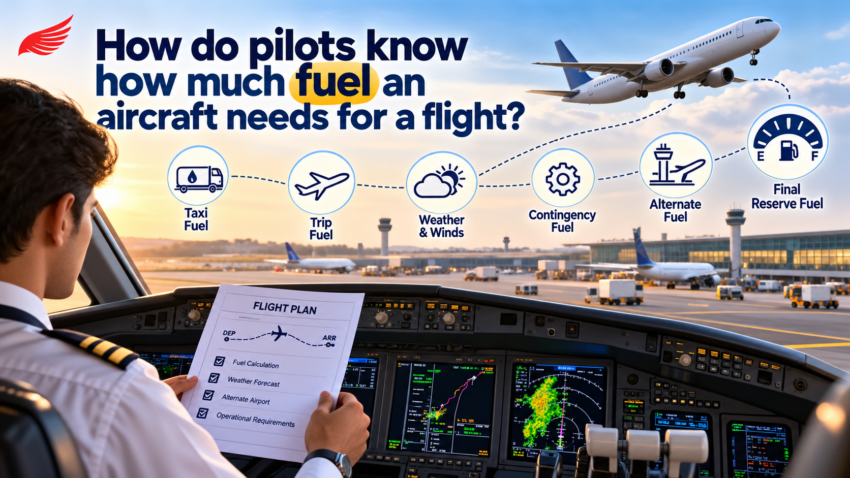
Have you ever looked at an aircraft taking off and wondered how pilots know exactly how much fuel they need for the journey?
Fuel planning is one of the most important parts of flight preparation. It is not simply a matter of filling the aircraft’s tanks and flying to the destination. Pilots and airline operations teams consider the aircraft, route, weather, winds, expected delays, alternate airports and legally required reserves before deciding how much usable fuel is needed.
For students interested in aviation, understanding fuel planning is also a useful introduction to how flight operations, aircraft performance and safety management work together. You can explore more aviation education and career resources through MH Cockpit.
Is Fuel Planning Just About the Distance?
No.
The distance between two airports is only one part of the calculation. The aircraft’s expected fuel consumption, weather conditions, route, air traffic restrictions and operational requirements all influence the final fuel figure.
The FAA explains that fuel planning should consider the fuel required to position the aircraft for takeoff, fly to the destination and carry additional fuel for circumstances such as contingencies, alternates and reserves.
For example, an aircraft flying into strong headwinds may consume more fuel than expected compared with the same route with favourable winds.
This is why professional fuel planning is much more than simply asking:
“How far is the destination?”
What Goes Into an Aircraft’s Fuel Plan?
A simplified fuel plan can be understood through several major categories.
1. Taxi Fuel
Before an aircraft even takes off, it may consume fuel while taxiing from the parking stand to the runway.
The calculation can consider expected taxi time and possible delays before departure.
At a busy airport, an aircraft may spend considerable time waiting for its departure clearance or runway sequence.
2. Trip Fuel
Trip fuel is the fuel required for the actual flight from takeoff to landing at the planned destination.
It includes fuel for phases such as:
- Takeoff
- Climb
- Cruise
- Descent
- Approach
- Landing
Aircraft-specific fuel consumption data, expected winds and weather conditions are important inputs when determining this amount.
3. Contingency Fuel
Real flights do not always happen exactly according to the original plan.
There could be unexpected air traffic delays, weather changes or routing changes. Contingency fuel provides an additional margin for such circumstances. The exact requirements depend on the applicable regulations and operator’s approved fuel policy.
4. Alternate Fuel
What happens if the aircraft cannot land at its planned destination?
Depending on the operation and conditions, a destination alternate may be required. Fuel planning can then include the fuel necessary to execute the required missed approach and proceed to the alternate airport for approach and landing.
This is an important part of aviation safety because the original destination is not always guaranteed to remain usable throughout the flight.
5. Final Reserve Fuel
There is also fuel reserved for situations beyond the normal planned flight.
The exact final-reserve requirement varies according to the type of operation and applicable regulations. For example, FAA guidance for certain turbine operations describes final reserve in terms of a specified holding period, while EASA fuel planning rules separately identify contingency, alternate and final reserve fuel categories.
So when passengers see an aircraft carrying what appears to be “extra” fuel, that fuel is not necessarily unnecessary. Much of it exists because safe flight planning requires margins for situations that cannot be predicted perfectly.
How Do Weather and Wind Affect Fuel?
Weather is one of the biggest variables in fuel planning.
Imagine two flights covering the same route. One experiences strong tailwinds while the other encounters strong headwinds.
The aircraft’s groundspeed and expected fuel burn can differ significantly.
Fuel calculations therefore consider forecast winds and other weather conditions. The FAA specifically identifies wind, weather, expected traffic delays and other factors that may affect the flight as considerations in determining required fuel.
Weather at the destination is also important.
If poor weather could make landing difficult or require an alternate airport, the fuel plan must account for the relevant operational requirements.
For aviation students, this demonstrates why meteorology, aircraft performance and flight planning are closely connected.
Do Pilots Decide the Fuel Completely by Themselves?
Not necessarily.
In commercial aviation, fuel planning is part of a larger operational system. Pilots work with airline procedures, dispatch or flight operations teams, aircraft performance information, weather data and regulatory requirements.
Modern operators also use computer-based flight planning systems to support calculations.
The pilot-in-command remains an important decision-maker and may require additional fuel when operational circumstances justify it, subject to the applicable procedures and regulations. EASA rules, for example, recognise additional or extra fuel requirements and the possibility of additional fuel at the commander’s discretion.
If you are interested in becoming a pilot, you can explore aviation training pathways through MH Cockpit’s training resources and its dedicated pilot training section.
Why Can’t Airlines Simply Carry Maximum Fuel?
It might seem safer to fill the aircraft completely with fuel before every flight.
But there is an important trade-off.
Fuel itself has weight.
Carrying unnecessary fuel means the aircraft has to carry that additional weight, which can increase fuel consumption. EASA notes that additional fuel increases aircraft weight and therefore can increase fuel consumption and emissions.
This creates an interesting aviation management challenge:
Carry enough fuel for safety and operational requirements — but avoid unnecessary weight.
That balance is one reason fuel planning is both a safety function and an operational-efficiency function.
What Happens to Fuel During the Flight?
Fuel planning does not stop once the aircraft leaves the airport.
The crew continuously monitors the aircraft’s fuel state and compares actual fuel remaining with the expected fuel remaining.
If the aircraft encounters unexpected delays, weather or routing changes, the crew can reassess the situation and determine whether the original plan remains appropriate.
This is why fuel management is an ongoing part of flight operations rather than a calculation performed only before departure.
What Aviation Students Can Learn From Fuel Planning
Fuel planning is a good example of how different aviation disciplines connect.
Aviation students studying pilot training, airport operations or aviation management can see connections between:
- Aircraft performance
- Meteorology
- Flight planning
- Air traffic management
- Aviation regulations
- Safety management
- Operational efficiency
- Decision-making
For students exploring aviation as a career, resources such as MH Cockpit can help connect these operational concepts with broader aviation education and career pathways.
Final Takeaway
Pilots do not simply estimate fuel based on the distance between two airports.
The fuel plan considers taxi fuel, trip fuel, weather and wind, expected delays, contingency requirements, alternate fuel, final reserves and other operational factors.
The goal is not to carry the maximum possible amount of fuel. The goal is to carry the appropriate amount required to complete the flight safely while maintaining the necessary operational margins.
That balance between safety, planning and efficiency is one of the many reasons aviation is much more than simply flying an aircraft.
If you’re exploring aviation education or planning a career in the industry, you can discover more through MH Cockpit’s training programs, including pilot training pathways