

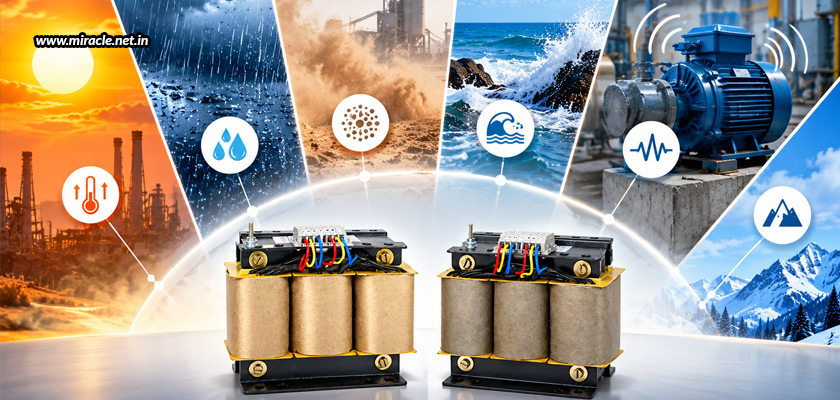
Transformers are designed to deliver reliable electrical performance under demanding conditions, but their performance is influenced by more than load and design specifications. Temperature, moisture, dust, vibrations, and other environmental factors can affect cooling, insulation life, efficiency, and reliability. Prolonged exposure to harsh conditions may accelerate insulation deterioration, increase operating temperatures, cause corrosion, or raise the risk of component failure. Understanding these environmental effects helps maintenance teams identify potential risks and implement preventive measures. It also supports proper transformer selection, ensuring the equipment is suited to the actual installation environment and capable of maintaining dependable performance throughout its service life.
Why environmental conditions matter for transformers
A transformer continuously exchanges electrical and thermal energy with its surroundings, which makes environmental factors very important. Environmental factors can affect transformers by:
- Increasing operating temperature
- Accelerating insulation aging
- Reducing cooling efficiency
- Encouraging moisture accumulation
- Contaminating insulating surfaces
- Increasing corrosion
- Loosening or stressing mechanical components
- Increasing maintenance requirements
Understanding these environmental effects helps maintain transformer efficiency, extend service life, prevent unexpected failures, and ensure reliable performance under varying operating conditions.
Key environmental factors affecting transformer performance
Different environmental conditions can influence transformer operation, component durability, cooling, insulation, and long-term reliability.
- Temperature
Transformers generate lots of heat during operation. When the ambient temperature is high, the transformer has less opportunity to dissipate heat effectively. In such hot environments, when the transformers are continually exposed to excessive temperatures, it affects their cooling system, winding temperature, insulation life, and overall equipment reliability. Even when the ambient temperature is not constant and fluctuates regularly between hot and cool conditions, it can place stress on transformer components. Repeated thermal expansion and contraction can affect mechanical connections, seals, and other components over time. It is thus essential to maintain adequate ventilation and properly maintained cooling systems such as fans, radiators, and other method if the temperature is constantly hot for longer periods, or experiences drastic fluctuations.
- Moisture and humidity
Water can enter a transformer through damaged seals, cracked bushings, faulty breathing systems, leaks, or condensation. High humidity can also increase the possibility of moisture accumulation around exposed components. This can affect insulation performance, leading to unwanted current paths and electrical breakdown. Potential consequences include reduced insulation reliability, accelerated insulation aging, lower dielectric strength, increased risk of electrical faults, and corrosion of internal or external components. In oil-filled transformers, moisture can also affect the condition of the insulating oil and reduce its dielectric strength.
- Chemicals and salts
When the environment involves chemicals and salts, it can contribute to corrosion. Some such areas include coastal areas, industrial facilities with chemical contaminants, and settings exposed to corrosive gases or airborne pollutants. Corrosion can affect transformer enclosures, radiators, fasteners, mounting structures, connections, and cooling components. Progressive corrosion can eventually affect mechanical integrity too and allow moisture to enter protected areas.
- Dust and airborne contaminants
Industrial facilities, construction areas, manufacturing plants, and locations with significant airborne particles can expose transformers to considerable amounts of dust. Dust may accumulate on external surfaces, cooling equipment, bushings, ventilation openings, and other components. All of this can reduce the transformer’s cooling efficiency, and raise the operating temperatures. If the dust becomes contaminated with moisture, oil, chemicals, or other conductive particles, it may also create conditions that reduce surface insulation performance.
- Vibration and mechanical stress
Heavy machinery, nearby motors, compressors, rotating equipment, and industrial processes are all external sources that can transmit mechanical vibrations through floors, foundations, or supporting structures. Such persistent vibration can contribute to loose connections, movement of components, mechanical fatigue, wear of mounting structures, and stress on bushings and connections. In severe cases, vibration can contribute to progressive mechanical deterioration.
- Altitude and reduced air density
At higher elevations, air density decreases. This can influence heat transfer and cooling performance of the transformers, particularly for those that rely on air for cooling. Higher-altitude installations may therefore require appropriate consideration during transformer design and selection. The reduced air density can also affect the electrical characteristics of air-insulated components. For this reason, installation conditions should be considered when determining suitable transformer specifications.
How environmental conditions work together
Environmental factors rarely affect transformers in isolation. Multiple conditions can occur simultaneously and amplify their impact on transformer performance and service life. For example, high temperature combined with dust accumulation can restrict cooling and increase operating temperatures, while moisture combined with contaminants can accelerate corrosion and affect insulation surfaces. Similarly, vibration in a humid or corrosive environment may increase mechanical deterioration over time. These combined effects make it important to evaluate the complete installation environment rather than considering individual factors separately. Understanding how environmental conditions interact allows engineers and maintenance teams to identify potential risks more effectively and make better decisions regarding transformer design, installation, monitoring, and maintenance.
Environmental conditions and transformer service life
The operating environment can have a direct influence on how long a transformer continues to perform reliably. Continuous exposure to excessive heat, moisture, contaminants, corrosion, or mechanical stress can gradually deteriorate insulation, connections, cooling components, and structural parts. While transformers are designed for long-term operation, unsuitable environmental conditions can increase the rate at which individual components age. This does not necessarily lead to immediate failure, but progressive deterioration can reduce performance and increase maintenance requirements over time. Considering environmental conditions from the beginning helps organizations select suitable equipment and establish appropriate operating practices. This supports more predictable transformer performance and helps protect the equipment throughout its expected service life.
Selecting transformers for actual site conditions
Transformer selection should begin with a clear understanding of the environment in which the equipment will operate. Selecting a transformer solely according to rated capacity may overlook environmental factors that can affect cooling, insulation, corrosion resistance, and mechanical stability. Evaluating every environmental condition during the selection process helps ensure that the transformer is appropriately suited to its intended application. It can also support reliable operation, consistent performance, longer service life, and manageable maintenance requirements. A site-specific approach ultimately helps reduce avoidable operational challenges and supports dependable transformer performance. Miracle Electronics is among the transformer suppliers in India, offering transformer solutions designed around different application requirements. Its focus on suitable designs and dependable performance helps businesses select transformers that align with their operational and environmental conditions.
Environmental conditions can have a substantial influence on transformer performance and service life. Temperature, moisture, dust, vibrations, corrosion, altitude, and airborne contaminants can each affect different aspects of transformer operation. When several of these factors occur together, their combined effect can become even more significant. For this reason, transformer selection should consider more than electrical capacity alone. By designing and maintaining transformers according to real-world operating conditions, organizations can protect their electrical infrastructure, reduce unexpected downtime, and support reliable long-term power delivery.