
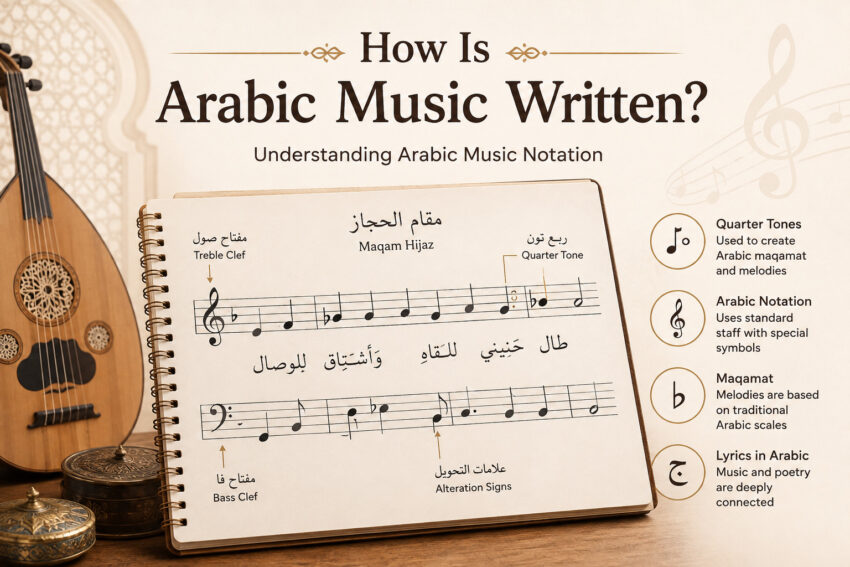
Arabic music is written using standard Western staff notation, with one important addition: special symbols for quarter tones, the in-between pitches that give maqam melodies their distinct color. For centuries this music passed from teacher to student by ear alone, and even today, written notation only captures part of what a performer needs to know.
How Is Arabic Music Written?
At the turn of the 20th century, musicians adopted a simplified system to put Arabic melodies on paper using the same five-line staff found in Western sheet music. Since the microtonal pitches used in Arabic music do not line up neatly with standard notes, the octave is divided into 24 equal quarter tones instead of the usual 12 semitones. A half-flat or half-sharp symbol marks any note that falls between two standard pitches, which lets a Western-trained musician read an Arabic score with a bit of extra training. This system is a practical shorthand rather than a perfect record. Many maqam scales include microtonal shadings that fall slightly off the written quarter tone, which is one reason this music has always been taught largely through listening rather than reading alone.
What Are the 7 Musical Notes?
Written music, Arabic or Western, is built on seven basic notes per octave. In the letter-name system common in English-language notation, these are A through G. In the solfège system used across much of Europe and in vocal training worldwide, the same seven notes are sung as do, re, mi, fa, sol, la, and ti. Arabic notation borrows this same seven-note foundation and staff layout, then layers quarter-tone accidentals on top to represent the additional pitches that Western notation alone cannot show.
What Scales Does Arabic Music Use?
Arabic music is built on maqam, a system of melodic modes rather than fixed major and minor scales. Each maqam defines a specific set of intervals, a home note, and characteristic melodic phrases that give a piece its mood. A maqam scale is typically built from smaller three, four, or five-note building blocks called ajnas (singular jins), joined together to form a full octave or more. Unlike Western scales, most maqam scales are not built on equal-tempered intervals, and many include a quarter tone that shapes the entire emotional character of the piece. Well-known maqam families include Rast, Bayati, Hijaz, and Nahawand, each with its own family of related scales and moods.
How to Learn the Notation of Music
Reading Arabic notation is only half the picture. A useful approach for beginners is to start with the basics of Western staff notation, since Arabic scores use the same note names, clefs, and rhythms as a foundation. From there, learning to recognize the half-flat and half-sharp symbols for quarter tones is the next step, followed by listening closely to recordings of the maqam being studied. According to the Arab tone system entry on Wikipedia, Arabic music written in Western notation uses specific symbols for quarter, half, and three-quarter tone flats and sharps, based on a two-octave range. Reading builds the framework, but the ear fills in the details a page of notation cannot fully capture.
What Is Arab Music Called?
In Arabic, this musical tradition is called al-musiqa al-arabiyya, or simply musiqa, the Arabic word for music. Within that broader tradition, listeners and musicians also use more specific terms. Tarab refers to the emotional, almost trance-like state that classical Arabic music can evoke in a listener, while maqam refers specifically to the melodic mode system that shapes a piece’s scale and character. Regional traditions carry their own names too, such as Andalusi or Arabo-Andalusi music for the classical style that developed in medieval Spain.
Where to Start With Arabic Sheet Music
For choir directors, students, and musicians new to this tradition, a well-prepared score makes the notation far easier to approach. Dozan World’s collections include Arabic and Middle Eastern sheet music with clear notation, transliteration, and translation, so quarter tones and maqam context are never left unexplained. Our guide on the quarter-tone challenge in Arabic music goes deeper into reading these scores, and our vocal solo collection is a practical place to see this notation in action. Founder Dr. Shireen Abu Khader brings decades of training in Arabic and Levantine music theory to every score we prepare.
Notation gives a beginner a starting point, but Arabic music has always lived as much in the ear as on the page. Browse our sheet music collections to find a piece that brings this tradition into your own practice.