
Why India’s Digital Advertising Is Evolving Beyond the Static Banner
The static banner ad — a rectangular image with a headline and a call to action — has been the default unit of digital advertising for three decades. It was the format that made sense when internet connections were slow, when creative production was expensive, and when the primary goal of digital advertising was simply to establish a presence on the web. All three of those conditions have changed fundamentally, and the advertising formats that made sense under those conditions are being supplemented — and in many categories, replaced — by approaches that better match how audiences consume digital content in 2025.
India’s digital advertising market is moving through this transition faster than many other markets because of the combination of mobile-first consumption patterns, rapidly expanding 4G and 5G coverage, and the competitive pressure among brands across categories to find formats that cut through an increasingly noisy digital environment. Understanding what’s replacing the static banner — and why — is increasingly important for any brand making meaningful digital advertising investments.
What Rich Media Advertising Actually Is
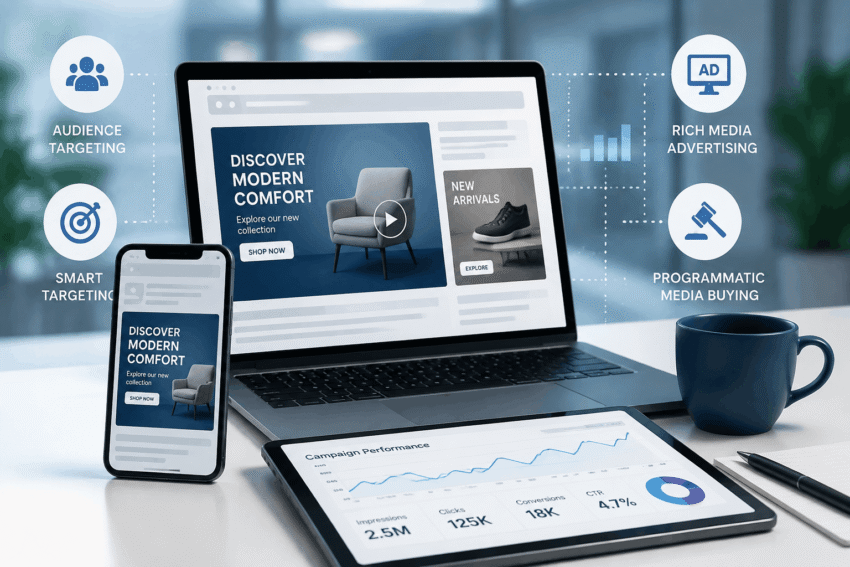
Rich media advertising is the category of digital ad formats that go beyond static images to include interactive, animated, video, and expandable elements that engage audiences in ways static banners cannot.
The range of rich media formats is broad. Expandable ads that respond to user interaction by revealing additional content or functionality. Video ads that auto-play or respond to cursor placement. Interactive ads that allow users to engage with product features, games, or calculators directly within the ad unit. Animated formats that draw attention through motion rather than static visual competition with the surrounding content.
What these formats share is the ability to create a more meaningful brand interaction than a static image impression. A user who hovers over an expandable car configurator ad has a qualitatively different interaction with the brand than one who scrolls past a static banner. A user who engages with an interactive financial calculator has demonstrated intent that a static ad impression doesn’t capture.
The investment in rich media advertising services by Indian brands has grown significantly as mobile device processing power has made rich media formats technically seamless for most users — removing the loading and compatibility barriers that made rich media less practical in earlier mobile infrastructure environments.
The Programmatic Layer — How Buying and Targeting Have Changed
Alongside the evolution in ad formats, the mechanics of how digital advertising inventory is bought and targeted have undergone a transformation that has changed what’s possible for brands at every scale.
Programmatic advertising automates the purchase of digital ad inventory through real-time bidding and data-driven audience targeting, replacing the manual insertion order and flat-rate buying that characterised earlier digital media. The technology allows brands to target specific audience segments — defined by behaviour, demographics, interests, and contextual signals — at a precision and scale that manual buying couldn’t approach.
Understanding the distinction between programmatic advertising vs display in the conventional sense is important for brands trying to allocate their digital advertising budgets intelligently. Conventional display advertising — buying fixed placements on specific websites at agreed rates — gives brands control over the placement environment but limits targeting precision. Programmatic advertising prioritises audience over placement, finding the right person across thousands of potential placements rather than buying a specific location and hoping the right people happen to visit it.
The practical implication is that neither approach is universally superior — they serve different strategic purposes. High-value placement on a specific premium publisher environment where the audience and context alignment is very high can still be worth a fixed placement buy. Reaching a specific audience segment at scale across the open web is better served by programmatic. The brands making the smartest digital advertising decisions in India are combining both approaches rather than treating them as mutually exclusive.
Why Format and Targeting Need to Work Together
The evolution in ad formats and the evolution in targeting mechanics are most powerful when they work together — and this combination is where India’s most sophisticated digital advertisers are operating.
A rich media interactive ad served through programmatic targeting to a specific high-intent audience segment produces results that neither rich media alone nor precise programmatic targeting alone achieves. The format creates an engagement quality that static formats don’t. The targeting ensures that engagement is happening with genuinely relevant audiences rather than broadly distributed impressions. Together, they produce brand interactions with demonstrable downstream impact on consideration and conversion.
This integration of creative format sophistication and targeting precision is the direction that India’s digital advertising market is moving, and brands that are still treating creative production and media buying as separate decisions made at separate stages are leaving significant performance on the table.
What This Means for Brand Strategy
The practical implication for brands thinking about their digital advertising approach in 2025 is that the investment calculus has shifted. The era when digital advertising effectiveness was primarily determined by impression volume — how many times a banner was served across the web — is giving way to an era where engagement quality, audience precision, and format relevance determine outcomes.
Brands that continue investing primarily in static display formats at high volume are buying visibility in a format that declining attention rates are making progressively less effective. Brands that are moving budget toward rich media formats and programmatic audience targeting are buying interaction quality with genuinely relevant audiences — a shift that tends to produce stronger downstream metrics across awareness, consideration, and conversion.
For brands in India evaluating their digital advertising approach, working with an experienced internet ad agency that operates across both rich media creative capabilities and programmatic buying infrastructure provides the integrated strategic and executional support that makes this evolution achievable without requiring brands to build these capabilities internally.
Adomantra operates across this full range — providing rich media advertising services, programmatic campaign management, and the strategic framework that connects format, targeting, and business objective into cohesive campaign approaches rather than isolated executions.
The Transition That’s Already Underway
India’s digital advertising market is large, growing, and increasingly sophisticated. The brands that understand where it’s heading — toward richer formats, smarter targeting, and integrated creative-and-media approaches — are building capabilities and vendor relationships now that will compound in advantage over the next several years. Those that don’t are buying increasingly commoditised inventory in formats whose effectiveness is declining relative to the alternatives now available.
The transition from the static banner era isn’t a future event. It’s underway. The brands positioned for what comes next are the ones investing accordingly today.