
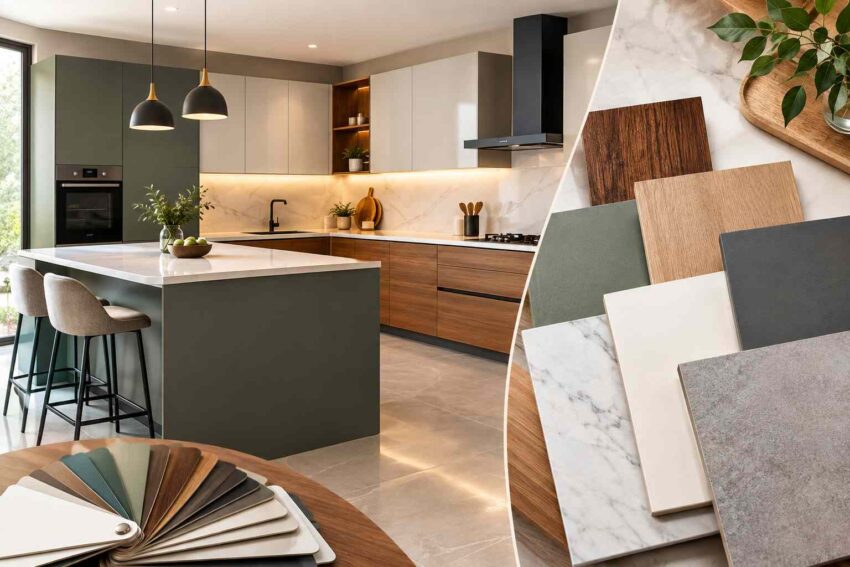
The kitchen is one of the hardest-working spaces in a home. It deals with heat, steam, oil splashes, food stains, frequent cleaning and constant opening and closing of cabinets, all while remaining one of the most visible parts of the house. That makes the choice of cabinet finish more important than it may first appear. A beautiful colour can catch our attention in a catalogue, but the real test begins after the kitchen is installed and used every day. Kitchen laminate has remained a popular choice because it brings together appearance, practical maintenance and a wide range of design possibilities. Current 2026 design discussions are also moving beyond the old idea that kitchens must be either completely glossy or completely neutral, with matte surfaces, wood effects, textured finishes and carefully planned colour combinations becoming increasingly prominent.
Choosing a kitchen surface, however, is not simply a matter of picking the colour we like most. The size of the kitchen, amount of natural light, cabinet location, cooking habits, countertop, backsplash and frequency of cleaning can all change how a particular laminate looks and performs. A high-gloss surface may make a compact kitchen appear brighter, for example, while a textured or matte surface may be more forgiving of everyday marks. Similarly, a dark woodgrain can look striking in a spacious kitchen but may feel visually heavy when used across every cabinet in a small room. The idea is to find a surface that fits the kitchen rather than forcing the kitchen to fit the surface. With that in mind, this guide explores kitchen laminate designs, finishes, colours, thickness, maintenance and selection tips so that the final choice feels considered rather than rushed.
Why Kitchen Laminate Matters More Than You Think
Cabinet finishes occupy a large portion of the visible surface area in most kitchens, so they have a major influence on the room’s overall character. When someone walks into a kitchen, the colour and finish of the shutters are often among the first things they notice, even before looking closely at the hardware or storage arrangement. This is why two kitchens with exactly the same layout can feel completely different simply because one uses warm woodgrain laminates while the other uses a combination of soft grey and white. The surface also affects the practical side of everyday living because some finishes reveal fingerprints, dust and splashes more readily than others. A kitchen is not a showroom that stays untouched; it is a working space, and its finish needs to make sense for that reality.
Recent kitchen design guides continue to position laminate as a practical cabinet finish because it offers extensive choices in colour, pattern and surface treatment while generally requiring less maintenance than some painted or natural-material alternatives.
What Makes a Laminate Suitable for Kitchen Cabinets
A kitchen puts more demands on a cabinet surface than a bedroom wardrobe or living-room console. Steam can settle on nearby surfaces, cooking oil can create residue, utensils can accidentally strike shutters, and hands repeatedly touch handles and cabinet edges throughout the day. That means the laminate should be selected with the intended application in mind rather than simply on the basis of colour.
The first consideration should therefore be quality and suitability for kitchen use, followed by appearance. HPL is commonly used for demanding interior applications, and kitchen-focused guides frequently recommend durable laminate grades for cabinet surfaces. Thickness is another factor to discuss with the manufacturer or fabricator because different thicknesses may suit different applications. Current Indian laminate guides commonly discuss decorative laminate thicknesses ranging from around 0.6 mm to 1.5 mm, although the correct specification depends on the product and application.
Types of Kitchen Laminate Finishes
One of the most useful ways to narrow down a kitchen laminate selection is to start with the finish rather than the colour. Finish changes the way light behaves on the cabinet surface, how prominently fingerprints appear and how much visual texture the kitchen carries. Matte, gloss, textured and woodgrain finishes can all look excellent, but they create very different atmospheres. A bright gloss can feel crisp and contemporary, whereas a soft matte surface can feel calmer and more understated.
Current kitchen laminate guides increasingly show a broad range of finishes rather than a single dominant style. Royale Touche’s 2026 discussion, for instance, highlights anti-fingerprint, super-matte, textured, glossy and matte options, while other current guides discuss woodgrain, stone, metallic and solid-colour surfaces.
Matte Kitchen Laminates
Matte laminate has become a strong choice for contemporary kitchens because it creates a quiet, refined surface without strong reflections. It works particularly well with neutral palettes, clean-lined cabinetry and minimalist hardware. Another practical advantage is that a low-reflection surface can make everyday marks less visually prominent than they might be on a dark, highly reflective surface. That does not mean matte laminates never need cleaning; kitchen surfaces still collect dust, oil and food residue.
Matte surfaces can also be paired with stronger textures elsewhere in the kitchen. A warm matte woodgrain on lower cabinets, for example, can be balanced with a smooth light-coloured upper cabinet. Similarly, a matte green or muted blue can create personality without the mirror-like intensity of a gloss finish. Current 2026 kitchen design coverage frequently mentions matte and super-matte finishes alongside softer, more natural colour palettes.
Glossy and High-Gloss Laminates
Gloss laminates use reflection to create a brighter, sharper visual effect. This can be particularly useful in compact kitchens where additional reflected light can help the space feel more open. White, cream and pale grey gloss surfaces can create an airy appearance, while darker gloss colours can deliver a dramatic, contemporary look. The trade-off is that reflective surfaces can make fingerprints, smudges and other marks more noticeable, particularly on frequently touched cabinet doors.
Gloss does not have to mean that every cabinet in the kitchen should be reflective. One of the more effective approaches is to use gloss selectively. For example, upper cabinets can have a light gloss finish while lower cabinets use a matte or woodgrain laminate, creating a layered appearance without making the entire room feel shiny. Gloss can also work beautifully against a textured backsplash or natural-looking countertop because the contrast between smooth reflection and tactile materials adds visual depth.
Textured and Woodgrain Laminates
Textured laminates are useful when we want the kitchen to feel more tactile and less flat. Woodgrain laminates can reproduce the visual character of timber while offering a consistent decorative surface across cabinet doors. Other textures can imitate stone, linen, concrete or subtle natural materials, allowing the kitchen to gain depth without introducing several different physical materials.
The most successful textured kitchens usually use texture with some restraint. If the cabinet finish has a strong grain, the countertop, backsplash and surrounding walls can remain relatively quiet. This creates a visual hierarchy in which the laminate adds character without competing with everything around it.
Popular Kitchen Laminate Designs and Colours
Colour selection can be surprisingly difficult because the kitchen is a large visual composition rather than a collection of isolated cabinet doors. A colour that looks excellent on a small sample may feel completely different when repeated across several metres of cabinetry. Natural light, artificial lighting, countertop colour and wall paint can all influence how the laminate appears. This is why it helps to evaluate samples in the actual kitchen environment whenever possible. Current 2026 design coverage also points towards more nuanced palettes, including sage, warm neutrals, wood tones, charcoal, white and combinations rather than relying exclusively on all-white cabinetry.
The right colour also depends on how much visual contrast we want. A monochromatic kitchen can feel sophisticated and calm, while two contrasting colours can create a stronger architectural structure. Woodgrain adds warmth, while cool greys can create a more restrained contemporary atmosphere. Green and muted pastel shades can introduce colour without becoming overwhelming.
Neutral and Light-Coloured Laminates
Light-coloured laminates are particularly useful when the goal is to create a clean, spacious kitchen. White, ivory, cream, beige and pale grey can work well in compact kitchens because they do not visually dominate the room. They also provide considerable flexibility when selecting countertops, backsplashes and hardware.
Neutral does not have to mean boring. A beige matte laminate with a subtle texture can feel much richer than a flat white surface, while a pale woodgrain can introduce warmth without making the kitchen feel traditional. Light colours also give us more freedom to introduce small areas of stronger colour. For example, a soft cream kitchen could incorporate a muted green island or dark hardware without becoming visually chaotic.
Dark Kitchen Laminates
Dark laminates can give a kitchen a sophisticated and dramatic personality. Charcoal, deep brown, graphite and darker wood tones can work especially well in larger kitchens or spaces with generous natural light. They can also be effective on lower cabinets because darker surfaces visually ground the composition while lighter upper cabinets prevent the room from feeling enclosed.
Two-Tone Laminate Combinations
Two-tone kitchens have become a practical way to add contrast without relying on complicated decorative elements. The basic idea is simple: one laminate establishes the primary colour, while another introduces contrast or warmth. White with woodgrain, beige with olive, grey with walnut, cream with charcoal and muted green with natural wood are examples of combinations that can create a layered appearance.
How to Choose the Best Laminate for Your Kitchen
The phrase best laminate sounds simple, but there is no single finish that works perfectly for every kitchen. A surface that suits a compact apartment kitchen may not be the right choice for a large family kitchen, and a design that looks beautiful in a showroom may not suit a home with heavy daily cooking. The selection should therefore begin with the conditions in which the cabinets will actually be used. Think about how often the kitchen is cleaned, whether the room receives direct sunlight, how much cooking takes place and whether the cabinets are positioned close to the sink or hob.
Quality should come before appearance, but appearance still matters because the kitchen is part of the home’s visual identity. Look for product information covering thickness, intended application, surface characteristics and care requirements. Also consider the quality of the substrate and installation because the laminate cannot compensate for a weak or poorly protected cabinet structure.
Consider Your Kitchen Size and Lighting
Kitchen size should influence both colour and finish. In a compact kitchen, light colours and reflective finishes can help create a brighter visual environment, while very dark colours may make the cabinetry feel more dominant. That does not mean small kitchens must always be white.
Match the Laminate With the Countertop
The countertop and cabinet laminate should be considered as a pair because they occupy large adjacent surfaces. A heavily patterned countertop combined with a heavily patterned laminate can create visual competition, whereas a quieter cabinet finish can allow a dramatic countertop to become the focal point. The reverse is also true: if the cabinets have a pronounced marble or stone pattern, a simpler countertop can provide breathing space.
Think About Your Cooking and Cleaning Habits
A kitchen used for light cooking during the week has different demands from one where several meals are prepared every day. Frequent cooking can mean greater exposure to oil, steam and food residue, so easy cleaning becomes an important consideration. A household with young children may also want surfaces that are forgiving of fingerprints and everyday contact. In contrast, a kitchen used primarily for occasional entertaining may allow more freedom to prioritise a particular visual effect.
The location of the cabinet matters too. Shutters immediately beside a cooking zone may experience different conditions from cabinets positioned farther away. Areas close to sinks can also see more moisture exposure. Choosing a suitable product and maintaining properly sealed edges and joints are therefore essential.
Kitchen Laminate Thickness and Quality
Thickness is one of the technical details that can easily be overlooked because the design is usually what catches our attention first. Decorative laminates are available in different thicknesses, and the appropriate option depends on the intended application and product specification. Indian design and laminate guides commonly reference decorative thicknesses ranging from around 0.6 mm to 1.5 mm, with 1 mm and heavier options frequently discussed for cabinet exteriors.
Why Laminate Thickness Matters
A thicker laminate can provide a different feel and may be appropriate for applications where greater surface robustness is required, but thickness alone does not determine overall cabinet quality. The substrate, adhesive, pressing process, edge finishing and installation all influence the finished result. A high-quality laminate poorly bonded to an unsuitable board can still develop problems.
For kitchen projects, the external shutter finish and internal cabinet surfaces may also use different specifications depending on the project. Interior liners, for example, are commonly treated separately from decorative external shutters.
Kitchen Laminate vs Acrylic, PU and Other Finishes
Laminate is not the only option for kitchen cabinetry. Acrylic can provide a highly reflective, contemporary appearance, while PU-painted surfaces offer extensive colour customisation and a different visual character. Veneer brings natural timber variation, while membrane finishes offer another route for creating particular cabinet styles. The right choice depends on the appearance, maintenance, budget and practical requirements of the project rather than on one finish being universally superior.
Laminate’s strength lies in its combination of design variety and practical usability. Current Indian cabinet-finish comparisons generally describe laminate as a relatively low-maintenance and cost-conscious option compared with several premium finishes. Acrylic can create a more mirror-like appearance but may show fingerprints and scratches more clearly. PU can deliver a painted appearance but requires a different finishing process and care considerations. When comparing options, we should therefore look at the complete ownership experience rather than simply comparing showroom appearance.
| Finish | Visual Character | Maintenance Consideration | Common Kitchen Appeal |
|---|---|---|---|
| Matte laminate | Soft and understated | Generally easy to maintain | Contemporary, calm interiors |
| Gloss laminate | Reflective and bright | Fingerprints can be more visible | Modern and compact kitchens |
| Textured laminate | Tactile and dimensional | Depends on texture depth | Natural and statement designs |
| Acrylic | High-gloss, mirror-like | Can require more attention to marks | Premium contemporary kitchens |
| PU | Smooth painted appearance | Requires appropriate care | Custom-colour interiors |
| Veneer | Natural wood character | Typically needs more care | Warm, natural interiors |
Maintenance Tips for Laminated Kitchen Cabinets
Even the best-looking kitchen surface will eventually show signs of daily life if it is not maintained properly. The good news is that laminate cabinet surfaces generally do not require complicated maintenance. Regular dusting and wiping with a soft cloth can prevent the gradual accumulation of grease and residue. Spills should be addressed rather than allowed to remain for long periods, particularly around cabinet edges and joints. Cleaning recommendations should always follow the specific manufacturer’s instructions because different finishes can have different care requirements.
Avoid treating a laminate cabinet as if it were a countertop designed to withstand every kind of abuse. Direct exposure to excessive heat, standing water, harsh abrasive cleaners or sharp objects can damage surfaces or their surrounding construction. Steam and moisture should also be managed through proper ventilation and sensible cleaning habits. The cabinet itself matters as much as the decorative sheet: prolonged water exposure can affect the underlying substrate even when the laminate surface remains visually intact. Proper ventilation, careful use and routine cleaning can therefore help maintain both appearance and performance over time.
Common Mistakes to Avoid When Choosing Kitchen Laminates
One of the most common mistakes is selecting a laminate from a tiny sample without considering how it will look across the complete kitchen. Scale changes perception. A subtle grain on a small sample may become a strong visual feature when repeated over twenty cabinet shutters. The same is true for marble veins, concrete textures and dark colours. Large samples are much more useful when making the final decision because they reveal the actual pattern scale and surface character.
Another mistake is choosing the finish before considering maintenance. A highly reflective dark surface may look spectacular in a showroom but require more frequent wiping in a busy household. Similarly, combining several strong textures can make the kitchen feel cluttered even when each individual material looks attractive. Current kitchen design guidance also cautions against using too many competing textures or very dark laminates in small kitchens. A balanced kitchen usually has one clear visual direction, with other materials supporting rather than fighting against it.
It is also easy to overlook the relationship between laminate and lighting. A colour can shift considerably under warm or cool artificial lights, while textured surfaces can appear dramatically different depending on the direction of illumination. Another frequent oversight is focusing on the laminate while ignoring the board, edge treatment and installation quality. A cabinet is a system, not just a decorative sheet. The best result comes from considering the surface, substrate, adhesive, hardware, edge finishing and installation together.
Conclusion
Choosing a kitchen laminate is ultimately about finding the right balance between appearance and everyday practicality. The market now offers an impressive range of matte, gloss, woodgrain, stone-inspired, textured, metallic and solid-colour surfaces, giving homeowners and designers far more freedom than the limited choices associated with older kitchen designs. Current 2026 trends show growing interest in softer matte finishes, natural wood effects, textured surfaces, muted colours and carefully planned two-tone combinations. Yet trends should be treated as inspiration rather than instructions. A kitchen needs to work for the people who actually use it.
The best laminate for one kitchen may not be the best choice for another. A compact apartment may benefit from lighter or reflective surfaces, while a large kitchen may comfortably accommodate darker woodgrain or dramatic stone patterns. A busy family kitchen may prioritise easy maintenance, while a design-led kitchen might place greater emphasis on texture and colour. By considering the kitchen’s size, lighting, cooking habits, countertop, cabinet construction, laminate quality and maintenance requirements together, we can arrive at a surface choice that looks good not only on installation day but as part of everyday life.