
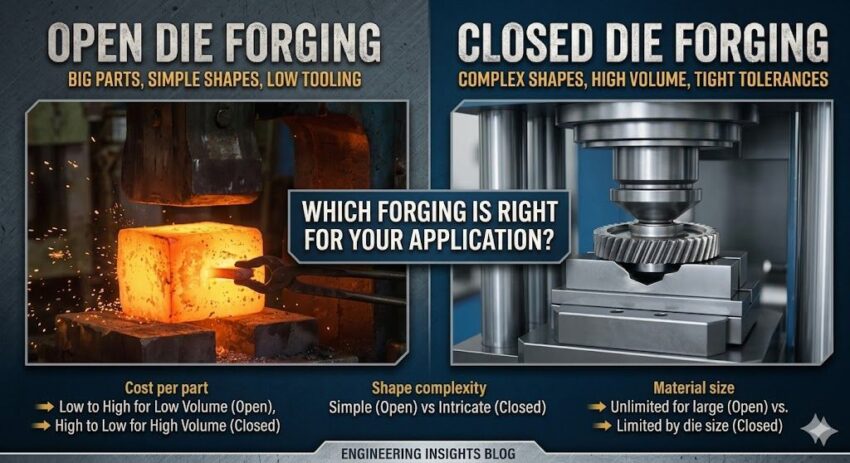
Which Is Right for Your Application?
Table of Contents
What Is Open Die Forging?
What Is Closed Die Forging?
Open Die vs. Closed Die: Side-by-Side Comparison
Advantages of Open Die Forging
Advantages of Closed Die Forging
How to Choose the Right Forging Method
Industry Applications
Material Selection & Its Role
Frequently Asked Questions (FAQs)
Why Choose CHW Forge?
Conclusion
Introduction
Open die forging is one of the most versatile and widely used metal-forming processes in heavy industry — but how does it compare to closed die forging, and which should you choose for your next project?
Whether you’re sourcing forged shafts for a power plant, flanges for an oil refinery, or structural components for aerospace, the forging method you select has a direct impact on cost, lead time, tolerances, and performance.
At CHW Forge — one of South Asia’s leading forging manufacturers since 1956 — we help engineers, procurement managers, and project teams make this decision every day. In this guide, we break down the key differences between open die forging and closed die forging, their respective advantages, and a practical framework for choosing the right method.
1. What Is Open Die Forging?
Open die forging — also called free forging or smith forging — is a metalworking process in which a heated metal workpiece is shaped by compressive forces applied through flat, V-shaped, or simple-contoured dies. Unlike closed die forging, the dies do not fully enclose the material, allowing it to flow outward freely as it is worked.
The operator repeatedly repositions the workpiece between press strokes to gradually achieve the desired shape. This technique is ideal for producing large, custom, or structurally critical components where size and grain integrity are paramount.
Open die forging is typically used to produce:
• Large shafts and stepped shafts
• Seamless rolled rings and gear rings
• Hollow cylinders, sleeves, and nozzles
• Forged discs, hubs, and tubesheets
• Forged blocks for tooling and dies
2. What Is Closed Die Forging?
Closed die forging — also called impression die forging — is a process in which heated metal is pressed or hammered into a pair of custom-machined dies that fully enclose the workpiece. The metal fills the die cavity to form the precise shape of the finished part. Excess metal (called “flash”) escapes along the parting line and is trimmed after forging.
Closed die forging delivers tight dimensional tolerances, excellent repeatability, and complex geometries — making it ideal for high-volume production of precision components.
Closed die forging is commonly used to produce:
- Forged flanges and pipe fittings
- Gear blanks and gear rings
- Valve bodies and bonnet forgings
- Automotive components (connecting rods, crankshafts, wheel hubs)
- Aerospace structural parts and brackets
3. Open Die Forging vs. Closed Die Forging: Side-by-Side Comparison open die forging and closed die forging across the most important decision factors:
Note: The right choice depends on your specific part geometry, volume, material, and budget. CHW Forge’s technical team can evaluate your drawings and recommend the optimal approach.
4. Advantages of Open Die Forging
Open die forging offers several critical advantages, particularly for large and custom industrial components:
✔ Handles Extremely Large Workpieces
Open die forging can process ingots and billets weighing from a few kilograms up to hundreds of tonnes — far exceeding what any closed die process can achieve. This makes it the go-to method for pressure vessel shells, large turbine shafts, and marine forgings.
✔ Superior Internal Grain Structure
The repeated compression and repositioning of metal in open die forging refines the grain structure, eliminates internal porosity, and improves directional mechanical properties. The result: superior fatigue strength, impact resistance, and ductility in the finished component.
✔ Lower Tooling Cost
Because open die forging uses simple flat or contoured dies rather than custom impression tooling, the upfront tooling investment is minimal. This makes it cost-effective for prototypes, one-off orders, and short production runs.
✔ Flexibility Without Retooling
Shape modifications can be made without the need to manufacture new dies, giving open die forging exceptional flexibility for custom and engineer-to-order parts — something closed die forging cannot match.
✔ Ideal for Specialty and High-Value Alloys
When working with expensive materials such as titanium, Inconel, duplex stainless steel, or super alloys, open die forging minimises material waste during initial shaping before final machining.
5. Advantages of Closed Die Forging
Closed die forging excels in environments where precision, repeatability, and volume efficiency are the key drivers:
✔ Near-Net Shape and Tight Tolerances
Components produced by closed die forging require minimal post-forging machining, as they emerge very close to their final dimensions. This reduces overall manufacturing time and downstream costs significantly.
✔ High-Volume Production Consistency
Once the dies are manufactured and qualified, closed die forging delivers exceptional batch-to-batch consistency — critical for supply chains in automotive, defence, and aerospace that demand identical components at scale.
✔ Better Surface Finish
The enclosed die cavity produces a smoother surface finish than open die forging, reducing the need for grinding, polishing, or finishing operations.
✔ Complex Geometries
Closed die forging can produce intricate 3D shapes — undercuts, flanges, ribs, bosses — that would be impossible or impractical to achieve through open die methods.
✔ Optimised Grain Flow
Note: The right choice depends on your specific part geometry, volume, material, and budget. CHW Forge’s technical team can evaluate your drawings and recommend the optimal approach.
4. Advantages of Open Die Forging
Open die forging offers several critical advantages, particularly for large and custom industrial components:
✔ Handles Extremely Large Workpieces
Open die forging can process ingots and billets weighing from a few kilograms up to hundreds of tonnes — far exceeding what any closed die process can achieve. This makes it the go-to method for pressure vessel shells, large turbine shafts, and marine forgings.
✔ Superior Internal Grain Structure
The repeated compression and repositioning of metal in open die forging refines the grain structure, eliminates internal porosity, and improves directional mechanical properties. The result: superior fatigue strength, impact resistance, and ductility in the finished component.
✔ Lower Tooling Cost
Because open die forging uses simple flat or contoured dies rather than custom impression tooling, the upfront tooling investment is minimal. This makes it cost-effective for prototypes, one-off orders, and short production runs.
✔ Flexibility Without Retooling
Shape modifications can be made without the need to manufacture new dies, giving open die forging exceptional flexibility for custom and engineer-to-order parts — something closed die forging cannot match.
✔ Ideal for Specialty and High-Value Alloys
When working with expensive materials such as titanium, Inconel, duplex stainless steel, or super alloys, open die forging minimises material waste during initial shaping before final machining.
5. Advantages of Closed Die Forging
Closed die forging excels in environments where precision, repeatability, and volume efficiency are the key drivers:
✔ Near-Net Shape and Tight Tolerances
Components produced by closed die forging require minimal post-forging machining, as they emerge very close to their final dimensions. This reduces overall manufacturing time and downstream costs significantly.
✔ High-Volume Production Consistency
Once the dies are manufactured and qualified, closed die forging delivers exceptional batch-to-batch consistency — critical for supply chains in automotive, defence, and aerospace that demand identical components at scale.
✔ Better Surface Finish
The enclosed die cavity produces a smoother surface finish than open die forging, reducing the need for grinding, polishing, or finishing operations.
✔ Complex Geometries
Closed die forging can produce intricate 3D shapes — undercuts, flanges, ribs, bosses — that would be impossible or impractical to achieve through open die methods.
✔ Optimised Grain Flow
In closed die forging, the grain flow conforms to the shape of the component, aligning fibre lines with the stress paths of the finished part. This produces a stronger, lighter component compared to a machined billet of the same design.
6. How to Choose the Right Forging Method
Use the following decision framework when selecting between open die forging and closed die forging:
Choose Open Die Forging if:
• Your component is large, heavy, or uniquely sized (multi-tonne parts)
• You need a low-volume, custom, or prototype component
• Near-net shape is not required — post-machining is acceptable
• You want to reduce tooling costs and lead time
• You’re working with specialty alloys that require careful thermal handling
• The part is a shaft, ring, disc, hollow cylinder, or block
Choose Closed Die Forging if:
• Your part requires complex geometry and precise dimensions
• You’re running medium-to-high production volumes
• Tight dimensional tolerances are non-negotiable
• Surface finish and aesthetic quality matter
• You want to minimise downstream machining costs
• The part is a flange, gear blank, valve body, or automotive component
7. Industry Applications: Where Each Method Is Used
Open Die Forging Applications
• Oil & Gas: Pressure vessel shells, nozzles, hollow cylinders, large flanges
• Power Generation: Turbine shafts, generator rotors, large disc forgings
• Nuclear: Thick-walled nozzles, reactor pressure vessel components
• Marine: Propeller shafts, rudder stocks, anchor chain components
• Heavy Engineering: Press columns, mine equipment shafts, mill rolls
• Defence: Large structural forgings, armour components
Closed Die Forging Applications
• Aerospace: Engine components, landing gear parts, structural brackets
• Automotive: Connecting rods, crankshafts, steering knuckles, wheel hubs
• Valves & Fittings: Valve bodies, bonnets, high-pressure fittings
• Defence: Precision weapon components, vehicle structural parts
• General Engineering: Gear blanks, coupling flanges, tool holders
• Oil & Gas (Small parts): High-pressure valve components, compact flanges
8. Material Selection and Its Role in Forging Method Choice
The forging method alone does not determine component quality — the choice of material is equally important. At CHW Forge, we supply forgings in a comprehensive range of materials:
9. Frequently Asked Questions (FAQs)
These are the most common questions buyers ask when choosing between open die forging and closed die forging — structured to align with how people search online.
Q1. What is the main difference between open die forging and closed die forging?
The primary difference lies in die configuration and part size. In open die forging, the metal is worked between flat or simple dies that do not enclose it, making it suitable for very large components. Closed die forging uses custom impression dies that fully enclose the workpiece, ideal for smaller, complex, precision parts.
Q2. Which forging process produces stronger components?
Both processes produce components stronger than castings or machined billets due to forging’s grain refinement effect. Open die forging typically delivers superior grain integrity for large parts, while closed die forging offers better grain flow alignment for complex geometries.
Q3. Is open die forging more cost-effective than closed die forging?
For low-volume or one-off orders, open die forging is generally more cost-effective due to lower tooling costs. For high-volume production runs, closed die forging becomes more economical as tooling cost is spread across many units.
Q4. What sizes can open die forging produce?
Open die forging can produce components ranging from a few kilograms to over 100 tonnes. CHW Forge manufactures large-scale open die forgings for critical industries including oil & gas, power generation, and nuclear sectors.
Q5. Can CHW Forge manufacture both open die and closed die forgings?
Yes. CHW Forge has full capabilities for both open die and closed die forging across a wide range of materials including carbon steel, alloy steel, stainless steel, duplex steel, aluminium, and titanium. Contact our team at chwfourge for a custom quote.
Q6. Which industries use open die forging most commonly?
Open die forging is widely used in Oil & Gas, Power Generation, Nuclear, Marine, Heavy Engineering, and Defence sectors — wherever large, structurally critical components with superior mechanical properties are required.
10. Why Choose CHW Forge for Your Forging Requirements?
With over 68 years of manufacturing expertise, CHW Forge is one of India’s most trusted forging suppliers — serving global clients across Europe, the Americas, the Middle East, and Asia.
Our Forging Capabilities Include:
• Open die forgings in carbon, alloy, stainless, duplex, and specialty steel
• Aluminium and titanium alloy forgings
• Seamless rolled rings up to large diameters
• Forged flanges, shafts, discs, gear blanks, and nozzles
• Self-reinforced nozzles, hollow cylinders, and pressure vessel components
Infrastructure & Quality:
• 160,000 sq. meter manufacturing facility in Ghaziabad & Greater Noida, UP
• 4.5 MW on-site solar power — commitment to sustainable manufacturing
• Microsoft Business Central ERP — end-to-end traceability and quality records
• ISO-certified quality management with records retained up to 30 years
• International certifications: PED, ASME, NORSOK, AD2000 and more
• Proud supplier to clients in Germany, Ukraine, and across South Asia
11. Conclusion
Open die forging and closed die forging are both proven, high-integrity manufacturing processes — each optimised for a different set of requirements. Open die forging wins when you need large parts, low volumes, and design flexibility. Closed die forging is the right choice when you need precision, repeatability, and complex geometries at scale.
The best decision depends on your component’s size, shape, tolerances, production volume, and material. When these factors are carefully matched to the right forging method, the result is a component that performs better, lasts longer, and costs less over its service life.
At CHW Forge, our engineering team works closely with clients to evaluate every requirement and recommend the optimal forging approach — backed by decades of hands-on expertise and a world-class manufacturing facility.