
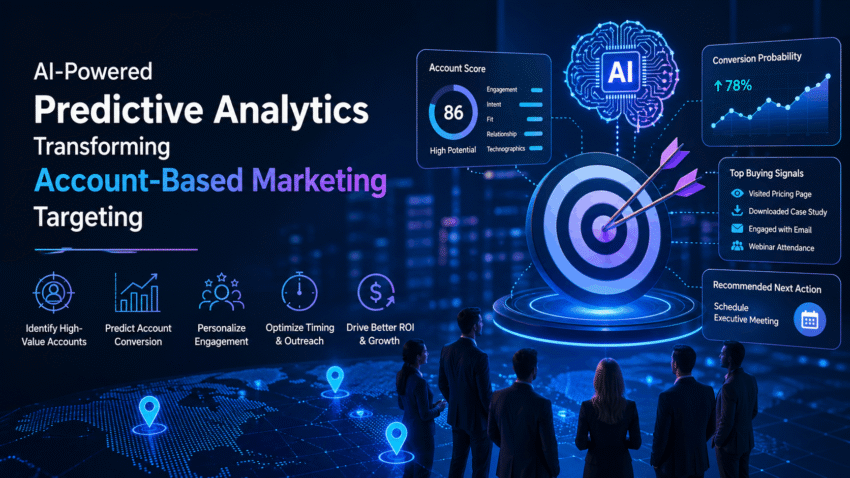
Account-Based Marketing (ABM) has evolved from a niche B2B strategy into a cornerstone of modern revenue generation. At its core, ABM focuses on identifying high-value accounts and delivering highly personalized marketing and sales experiences tailored to those accounts. However, as data volumes explode and customer journeys become increasingly complex, traditional ABM approaches often struggle to keep up. This is where predictive analytics powered by artificial intelligence (AI) is reshaping the landscape.
Predictive analytics is no longer just a “nice-to-have” capability—it is becoming essential for organizations aiming to scale ABM effectively. By leveraging historical data, behavioral insights, and machine learning algorithms, predictive analytics empowers marketers to anticipate customer needs, identify high-potential accounts, and deliver hyper-targeted campaigns with greater precision than ever before.
Understanding Predictive Analytics in ABM
Predictive analytics in ABM refers to the use of advanced data modeling techniques to forecast which accounts are most likely to convert, expand, or churn. Instead of relying on static segmentation or manual analysis, AI-driven models continuously learn from past interactions, engagement signals, and external data sources to generate actionable insights.
In traditional ABM, marketers often rely on firmographic data such as company size, industry, and revenue to define target accounts. While useful, these parameters only scratch the surface. Predictive analytics goes deeper by incorporating behavioral data, intent signals, technographic insights, and engagement patterns to build a more comprehensive view of each account.
The result is a dynamic, data-driven approach to segmentation and targeting—one that evolves in real time as new data becomes available.
The Role of AI in Enhancing Customer Targeting
AI plays a critical role in enabling predictive analytics within ABM. Machine learning algorithms analyze vast datasets to uncover patterns that would be impossible for humans to detect manually. These insights help marketers answer key questions such as:
- Which accounts are most likely to convert in the next quarter?
- What content or messaging resonates best with specific accounts?
- When is the optimal time to engage a particular decision-maker?
By automating data analysis and decision-making, AI allows marketing and sales teams to focus on strategy and execution rather than manual data processing.
Key Benefits of Predictive Analytics in ABM
- Improved Account Prioritization
One of the biggest challenges in ABM is determining which accounts deserve the most attention. Predictive analytics assigns scores to accounts based on their likelihood to convert or generate revenue. This enables teams to prioritize high-value opportunities and allocate resources more effectively.
Instead of spreading efforts thin across a broad list of accounts, organizations can concentrate on those with the highest probability of success.
- Hyper-Personalized Engagement
Predictive models analyze past interactions and preferences to determine what type of content or messaging will resonate with each account. This allows marketers to deliver highly personalized experiences across channels, including email, social media, and website interactions.
Personalization at this level goes beyond simply addressing a prospect by name—it involves tailoring the entire customer journey based on predictive insights.
- Enhanced Sales and Marketing Alignment
Predictive analytics provides a shared data foundation for both marketing and sales teams. By using the same scoring models and insights, teams can align their efforts more effectively.
Sales teams gain visibility into which accounts are “sales-ready,” while marketing teams can refine campaigns based on real-time feedback. This alignment leads to shorter sales cycles and higher conversion rates.
- Real-Time Decision Making
Traditional ABM strategies often rely on static data that quickly becomes outdated. Predictive analytics, on the other hand, enables real-time decision-making by continuously updating models based on new data.
For example, if an account suddenly shows increased engagement or intent signals, the system can automatically trigger targeted campaigns or notify sales teams to take action.
Core Components of Predictive Analytics in ABM
To fully leverage predictive analytics, organizations must integrate several key components:
- Data Collection and Integration
Data is the foundation of predictive analytics. Organizations must gather data from multiple sources, including CRM systems, marketing automation platforms, website analytics, and third-party intent data providers. - Data Cleansing and Enrichment
Raw data is often incomplete or inconsistent. Data cleansing ensures accuracy, while enrichment adds valuable context such as firmographics, technographics, and behavioral insights. - Machine Learning Models
These models analyze data to identify patterns and generate predictions. Common techniques include regression analysis, classification models, and clustering algorithms. - Predictive Scoring
Accounts are assigned scores based on their likelihood to achieve specific outcomes, such as conversion or upsell. These scores guide prioritization and targeting strategies. - Activation and Execution
Insights must be translated into action. This involves integrating predictive analytics with marketing and sales workflows to trigger campaigns, personalize content, and guide outreach efforts.
Challenges in Implementing Predictive Analytics in ABM
While the benefits are compelling, implementing predictive analytics in ABM comes with its own set of challenges.
Data Quality and Availability
Predictive models are only as good as the data they rely on. Incomplete, outdated, or inaccurate data can lead to flawed predictions and poor decision-making.
Integration Complexity
Integrating predictive analytics with existing systems and workflows can be complex. Organizations must ensure seamless data flow between platforms to maximize effectiveness.
Skill Gaps
Implementing and managing predictive analytics requires specialized skills in data science, machine learning, and analytics. Many organizations face challenges in building or acquiring these capabilities.
Model Transparency and Trust
AI-driven models can sometimes operate as “black boxes,” making it difficult for stakeholders to understand how predictions are generated. Building trust in these models is essential for adoption.
Privacy and Compliance
With increasing regulations around data privacy, organizations must ensure that their use of predictive analytics complies with legal and ethical standards.
Conclusion
Predictive analytics is transforming Account-Based Marketing by enabling smarter, more precise customer targeting. By harnessing the power of AI, organizations can move beyond traditional segmentation and embrace a dynamic, data-driven approach that delivers measurable results.
While challenges remain, the benefits far outweigh the obstacles. Organizations that invest in predictive analytics today will be better positioned to identify high-value accounts, deliver personalized experiences, and drive sustainable growth in an increasingly competitive landscape.
In the era of data-driven marketing, predictive analytics is not just an enhancement—it is a necessity for successful ABM.
Read More: https://intentamplify.com/blog/ai-powered-customer-segmentation/