
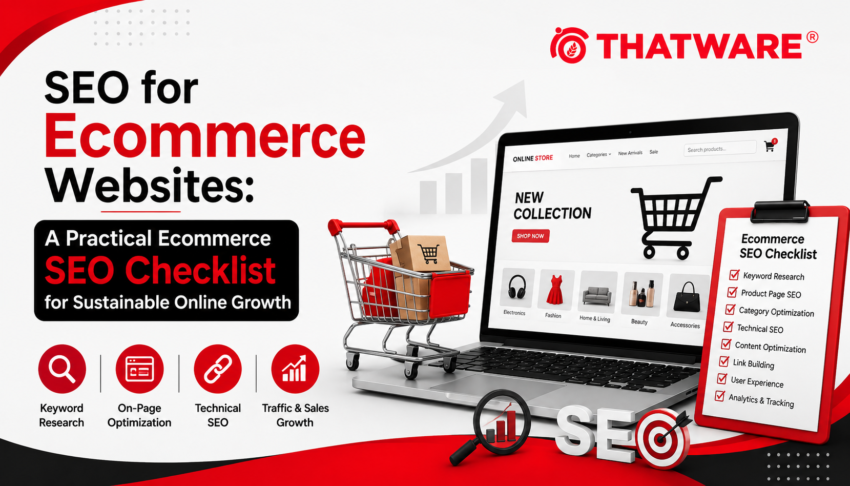
Ecommerce competition is becoming increasingly intense. Thousands of online stores may sell similar products, making search visibility a critical factor in attracting shoppers without depending entirely on paid advertising. A well-optimized ecommerce website can help customers discover products at the exact moment they are researching, comparing, and preparing to buy.
This is where SEO for ecommerce websites becomes essential. Ecommerce SEO connects technical optimization, product content, category architecture, internal linking, search intent, user experience, and authority building to create a stronger organic search presence.
For businesses planning their ecommerce strategy, an ecommerce SEO checklist provides a practical framework for identifying optimization opportunities and maintaining consistency across hundreds or even thousands of URLs. With the right approach, organic search can become a sustainable acquisition channel rather than simply another traffic source.
Why SEO for Ecommerce Websites Matters
Online shoppers rarely interact with a website immediately after discovering it. They may search for a product, compare alternatives, read reviews, investigate prices, and return several times before making a purchase. Search engines therefore play an important role throughout the buying journey. Effective SEO for ecommerce websites helps businesses appear for different types of searches, from broad informational queries to highly specific product searches.
A shopper searching for “running shoes” may still be exploring options, while someone searching for “men’s waterproof trail running shoes size 10” has a much stronger commercial intent. Ecommerce SEO should account for both audiences.
Organic visibility can also reduce dependence on continuously increasing advertising costs. When product and category pages earn strong organic visibility, they can continue attracting qualified visitors without requiring a payment for every click. The key is to optimize the entire ecommerce ecosystem rather than concentrating exclusively on keywords.
Start With a Strong Ecommerce SEO Checklist
A reliable ecommerce SEO checklist should begin with the technical and structural foundation of the website. Search engines need to efficiently discover and understand important pages before those pages can compete for visibility.
The first stage should examine crawlability, indexability, site architecture, URL structures, canonicalization, redirects, XML sitemaps, mobile usability, and page performance. Website architecture is especially important for ecommerce businesses because stores often contain numerous categories, subcategories, product variations, filters, and informational pages.
A logical structure makes navigation easier for customers and helps search engines understand relationships between products and categories.For example, a clothing store could organize its architecture around: This structure provides context and creates opportunities for relevant internal links.
An ecommerce SEO checklist should also include duplicate URL investigation. Product filters, sorting parameters, tracking parameters, and variant URLs can sometimes create multiple versions of similar content. Managing these correctly helps search engines focus on the URLs that matter most.
Optimize Category and Product Pages
Product and category pages are often the commercial heart of an ecommerce website. Their optimization should therefore be a central component of SEO for ecommerce websites.
Category pages should explain what shoppers can find within the category while naturally incorporating relevant terminology. A short, useful introduction can help establish topical relevance without overwhelming visitors. Product pages require even greater attention. Each important product page should provide original information that helps customers make informed decisions. Strong product pages can include detailed descriptions, specifications, dimensions, materials, usage information, availability details, shipping information, customer reviews, and high-quality images.
Generic manufacturer descriptions can create problems when dozens of competing stores publish identical copy. Original product content gives a website a better opportunity to distinguish itself. Image optimization is also important. Descriptive filenames and useful alt text can improve accessibility and help search engines understand image context. Alt text should describe the image naturally rather than become a place for repetitive keyword insertion.
Build Content Around Ecommerce Search Intent
An effective ecommerce SEO checklist should extend beyond product pages. Customers search for information before, during, and after the buying process. A footwear retailer, for example, could create useful resources covering topics such as choosing running shoes, understanding shoe materials, comparing trail and road shoes, or caring for specific footwear.
This type of content can attract users earlier in the buying journey and internally connect them to relevant products. The strongest content strategy considers several search intents. Informational pages answer questions, comparison pages help shoppers evaluate alternatives, category pages support product discovery, and product pages address purchase-focused searches.
This creates a connected search journey rather than a collection of unrelated articles. Internal linking is particularly valuable here. An article about choosing hiking boots could link to the relevant hiking boot category, while the category could link to specific products. Such connections help users discover products while creating a logical relationship between related pages.
Improve Ecommerce Technical Performance
Technical performance is another major part of SEO for ecommerce websites. Online shoppers are often impatient, particularly when browsing on mobile devices. Slow pages, confusing navigation, intrusive elements, or broken links can damage both user experience and conversion potential. Google’s Core Web Vitals focus on loading performance, responsiveness, and visual stability, making page experience an important consideration for modern websites. Ecommerce businesses should regularly evaluate page performance across product, category, checkout, and informational pages.
Technical reviews should also look for: Broken internal links can prevent users and crawlers from reaching valuable pages. Redirect chains can make URL management unnecessarily complicated. Missing canonical tags can create uncertainty around duplicate or similar URLs. Incorrect robots directives can accidentally restrict important pages from crawling.
Poor mobile layouts can create usability problems for shoppers using smartphones. An effective ecommerce SEO checklist should therefore be revisited whenever major website changes, migrations, redesigns, or platform updates occur.
Strengthen Internal Linking and Site Architecture
Internal linking is often underestimated in ecommerce marketing. Yet it can help distribute relevance throughout a website and guide customers toward related products.
A well-planned structure can connect high-level categories with subcategories, buying guides, product collections, and individual products. For instance, a home furniture retailer might publish a guide about choosing a dining table. The article can connect to dining table categories, while individual product pages can link to matching chairs and accessories.
This creates a stronger topical ecosystem. Anchor text should also be descriptive and relevant. Instead of repeatedly using generic phrases such as “click here,” ecommerce websites can use natural descriptions that tell visitors what they will find after clicking.
Use Off-Page SEO to Build Ecommerce Authority
On-page optimization is only one part of SEO for ecommerce websites. External signals can also contribute to a website’s broader authority and visibility. However, ecommerce businesses should prioritize relevance and quality rather than pursuing large quantities of backlinks.
Useful off-page strategies can include digital PR, expert contributions, product reviews from relevant publications, industry partnerships, resource-based outreach, brand mentions, and collaborations with credible creators. A sustainable approach focuses on earning attention because the website provides something useful, original, or newsworthy.
For example, an ecommerce brand selling sustainable clothing could publish original research about consumer preferences, produce an industry report, or create a useful sustainability resource. Such assets can naturally attract mentions and links. This is more valuable than generating large volumes of unrelated backlinks solely for SEO purposes.
Measure What Actually Drives Ecommerce Growth
An ecommerce SEO checklist should finish with measurement. Ranking positions can provide useful information, but they should not be the only performance indicators.
Businesses should monitor organic traffic, product visibility, category performance, conversion rates, qualified sessions, revenue generated through organic search, indexed pages, and engagement trends. Search Console can help website owners understand search queries, impressions, clicks, and indexing-related information. Analytics platforms can then provide deeper insight into visitor behavior and conversions.
Performance should be evaluated over meaningful periods rather than based on isolated daily fluctuations. Ecommerce demand can change significantly because of seasons, promotions, holidays, product launches, and market conditions. The purpose of measurement is to discover what works and reinvest resources into the pages, topics, and strategies that generate genuine business value.
Turn Your Ecommerce SEO Strategy Into Long-Term Growth
Successful SEO for ecommerce websites is not created by adding keywords to product descriptions and waiting for rankings to improve. It requires a coordinated approach that combines technical health, useful content, search intent, product optimization, internal linking, authority development, and continuous measurement.
The ecommerce SEO checklist should be treated as a living framework rather than a one-time task. Search behavior changes, competitors publish new content, product inventories evolve, and ecommerce platforms introduce technical changes. Regular audits allow businesses to identify problems before they become significant obstacles. For ecommerce brands looking to strengthen organic visibility, ThatWare LLP can provide customized, data-driven SEO strategies designed around search intent, technical performance, content quality, and sustainable growth.
#SEOForEcommerce #EcommerceSEO #EcommerceSEOChecklist #EcommerceMarketing #ProductSEO #TechnicalSEO #OrganicTraffic #EcommerceGrowth #ThatWareLLP