
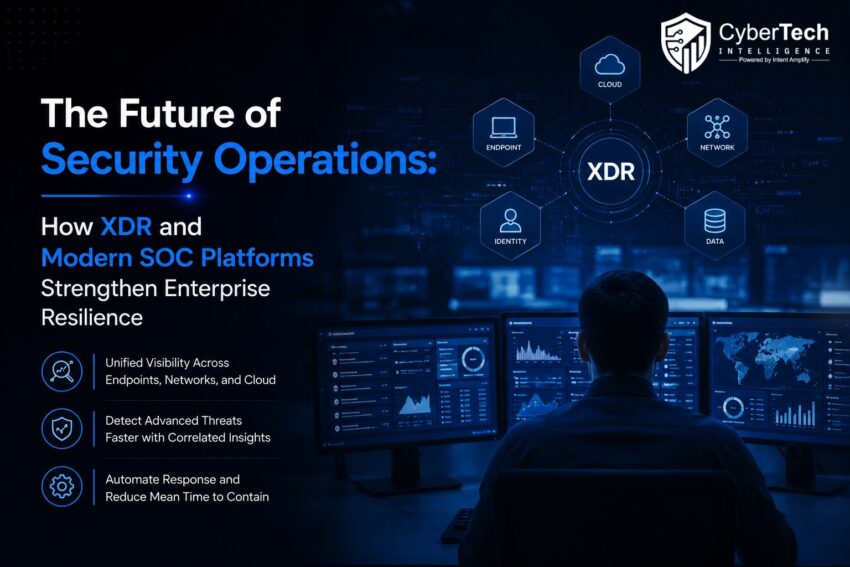
Cyber threats no longer target a single device, application, or network. Modern attacks span endpoints, cloud environments, email systems, identities, servers, and third-party platforms simultaneously, making it increasingly difficult for security teams to understand the complete scope of an incident.
Traditional security operations often rely on multiple disconnected tools that generate thousands of alerts every day. Analysts spend valuable time switching between consoles, manually correlating events, and investigating incidents with limited context. As attack techniques become more sophisticated, this fragmented approach slows response times and increases organizational risk.
Extended Detection and Response (XDR) and modern Security Operations Center (SOC) platforms address these challenges by bringing security telemetry together into a unified operational environment. By combining data from multiple security controls, organizations gain broader visibility, faster investigations, and more coordinated incident response.
Rather than responding to isolated alerts, security teams can understand the full attack lifecycle and act before threats escalate into business disruption.
Why Traditional Security Operations Are Struggling
Today’s enterprise environments include cloud infrastructure, hybrid workforces, SaaS applications, remote devices, and interconnected business systems.
Security teams must monitor activity across:
- Endpoints
- Cloud workloads
- Identity platforms
- Email systems
- Networks
- Applications
- Third-party services
Managing these environments through separate security tools creates blind spots that attackers increasingly exploit.
XDR reduces this complexity by correlating security events across the enterprise and presenting analysts with unified investigations instead of disconnected alerts.
The Core Capabilities of XDR and Modern SOC Platforms
Unified Threat Detection
XDR continuously collects and correlates telemetry from multiple security layers.
Instead of analyzing endpoint alerts separately from identity or cloud events, XDR combines these signals to identify coordinated attack activity.
This broader visibility enables earlier detection of sophisticated threats.
Accelerate Incident Response
Modern SOC platforms automate repetitive investigative tasks, allowing analysts to focus on higher-value decisions.
Automation can assist with:
- Alert enrichment
- Threat prioritization
- Incident triage
- Evidence collection
- Initial containment actions
This significantly reduces the time required to investigate and respond to incidents.
Improve Analyst Productivity
Security teams continue to face growing alert volumes and cybersecurity talent shortages.
XDR platforms reduce analyst fatigue by consolidating duplicate alerts, providing contextual investigations, and highlighting the highest-priority threats.
The result is improved operational efficiency without increasing staffing requirements.
Strengthen Threat Hunting
Proactive threat hunting has become an essential component of mature cybersecurity programs.
Modern SOC platforms provide analysts with centralized visibility, historical telemetry, and behavioral analytics that enable them to identify hidden attacker activity before significant damage occurs.
Industry Spotlight: Manufacturing
Manufacturing organizations depend on interconnected operational technology, industrial automation, cloud platforms, and enterprise systems to maintain production continuity.
A modern XDR platform enables security teams to monitor endpoints, production environments, and identity systems from a centralized platform, improving visibility into attacks that could disrupt manufacturing operations or compromise intellectual property.
As factories become increasingly connected, integrated detection and response capabilities become critical for operational resilience.
Industry Spotlight: Technology & Telecommunications
Technology and telecommunications providers manage expansive digital ecosystems supporting millions of users, applications, and connected services.
Modern SOC platforms help these organizations identify sophisticated attacks across cloud infrastructure, customer platforms, and enterprise networks while improving investigation speed and reducing operational complexity.
Integrated detection capabilities also strengthen protection against rapidly evolving identity-based and cloud-native threats.
Why XDR Supports Business Resilience
XDR extends beyond traditional threat detection by improving the overall effectiveness of enterprise security operations.
Organizations adopting XDR often benefit from:
- Faster incident response
- Reduced alert fatigue
- Better visibility across hybrid environments
- Improved threat hunting
- Stronger security automation
- Enhanced operational efficiency
These improvements enable organizations to respond confidently to evolving cyber threats while supporting ongoing digital transformation initiatives.
Building a Modern SOC Strategy
Organizations implementing XDR should prioritize:
- Integrating security tools across cloud and on-premises environments
- Centralizing detection and investigation workflows
- Automating repetitive SOC processes
- Expanding behavioral analytics
- Incorporating threat intelligence
- Continuously validating incident response procedures
- Measuring SOC performance through operational metrics
Successful SOC modernization requires close collaboration between security leadership, IT operations, and executive stakeholders.
Organizations looking to modernize their Security Operations Center can improve enterprise resilience by implementing XDR capabilities that unify threat detection, accelerate investigations, and automate incident response across cloud, identity, endpoint, and network environments.
The Future of XDR and SOC Platforms
Security operations will increasingly become intelligence-driven.
Future advancements are expected to include:
- AI-assisted SOC analysts
- Autonomous investigation workflows
- Predictive threat detection
- Adaptive response automation
- Integrated exposure management
- Continuous attack path analysis
These innovations will help organizations respond to increasingly sophisticated cyber threats with greater speed and accuracy.
Final Thoughts
Modern cyberattacks demand a modern security operations strategy. Organizations can no longer rely on disconnected tools and manual investigations to defend increasingly complex digital environments.
XDR and modern SOC platforms provide unified visibility, intelligent detection, and faster response capabilities that strengthen both cybersecurity operations and business resilience.
Organizations investing in integrated security operations today will be better prepared to defend against tomorrow’s evolving threat landscape while enabling secure innovation.