
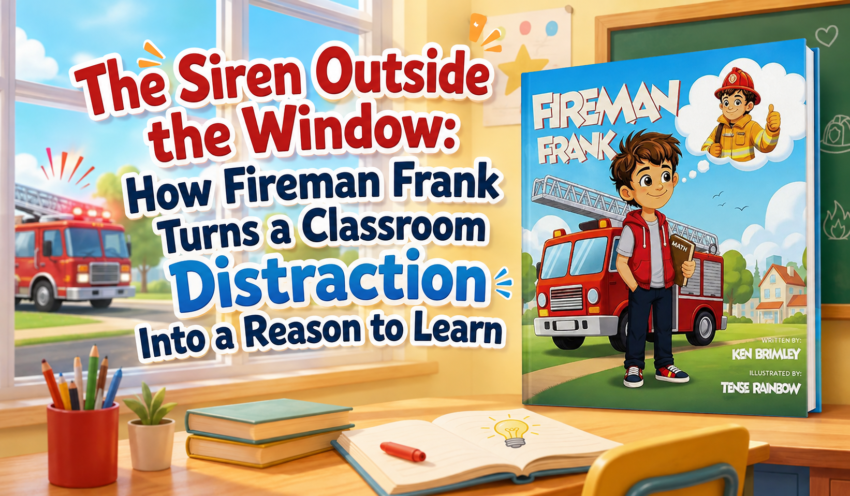
A child can sit in the right seat, open the right book, and still have his mind somewhere else. That familiar classroom truth sits at the heart of Fireman Frank: Learning Math to Save the Day, a children’s story that begins with an ordinary lesson and a very loud interruption.
Franklin Spencer is ten years old, in fifth grade at Lincoln Elementary, and generally a good student. He likes kickball, swimming, pizza, and spending time with friends. Yet one interest towers over the rest: fire trucks. Frank does not merely think they are exciting. He imagines a future in which he is the firefighter behind the wheel, answering calls, using the radio, handling equipment, and racing toward people who need help.
That dream becomes a problem on the day Mrs. Bartholomew is teaching division. When a siren grows louder outside the school, everyone looks up. The fire engine passes. Most students return to their books. Frank does not. In his imagination, he is already in the cab. Soon the math assignment in front of him has lost the competition for his attention, and his pencil is moving across a different sheet of paper, drawing a hook-and-ladder truck.
It is a small act of classroom distraction. The story understands, however, that small moments can carry large educational consequences.
The Teacher Who Changes the Direction of the Moment
Mrs. Bartholomew is not written as a teacher who ignores expectations. She is nice, but strict. Her students know that her classroom is not a place for fooling around. When she discovers Frank drawing instead of doing the assigned work, her first reaction is stern. Frank is startled, the class notices, and embarrassment quickly enters the room.
Then something important happens. Mrs. Bartholomew could keep scolding. Instead, she becomes curious about the reason beneath the behavior. Frank explains that the passing fire truck made him think about what he wants to become. After a playful misunderstanding about whether he wants to grow up to be a fire truck, he clarifies that he wants to be a fireman more than anything.
That answer gives his teacher a doorway. She does not tell him to stop caring about fire trucks. She does not treat his dream as the enemy of schoolwork. She connects the dream to the work.
Her question is simple: if becoming a great firefighter matters so much, why not focus on math?
At first, Frank cannot see the relationship. He thinks of firefighting in terms of driving, radios, hoses, tools, and courage. Mrs. Bartholomew guides him toward the numbers hidden inside those responsibilities. Firefighters need to understand gauges. They deal with water flow, pressure, temperature, tank levels, measurements, and percentages. The equipment that fascinates Frank is not separate from learning. It depends on learning.
Suddenly, math is no longer a page number in a textbook. It is part of the future he can already picture.
Relevance Can Change the Emotional Meaning of a Subject
Children frequently meet school subjects before they understand why those subjects matter. Adults know that foundational skills accumulate over time, but “you will need this someday” can feel distant to a ten-year-old. Fireman Frank gives that vague someday a uniform, a steering wheel, a radio, and a purpose.
This is what makes the book’s central idea useful beyond one character. Frank does not become motivated because math suddenly becomes easier. He becomes motivated because math becomes relevant. The material acquires an emotional destination. The numbers on the page connect with the person he hopes to become.
That distinction matters. Interest is not the same as entertainment, and relevance is not the same as making every lesson effortless. Mrs. Bartholomew does not replace math with fire trucks. She uses Frank’s fascination to help him understand why the math deserves his attention.
In other words, she does not lower the expectation. She strengthens the reason for meeting it.
That is a surprisingly respectful message for young readers. The story assumes that children are capable of working hard when they understand what their effort is building toward. It also suggests that a dream is more than something pleasant to imagine. A dream can create responsibility.
If Frank truly wants the future, he has work to do in the present.
From Daydreaming to Discipline
The ending does not rely on magic. Frank does not instantly become a firefighter, and the book does not skip straight from inspiration to success. His immediate change is smaller and more believable: he promises to pay complete attention during math.
Then he follows through. He finishes his assignments and eventually earns one of the highest math scores in the class. The dream remains the same, but Frank’s relationship with preparation changes. That is the real achievement of the story.
For parents and teachers, this creates a useful conversation. What does a child love enough to talk about repeatedly? What job, hobby, animal, machine, sport, place, or idea captures that child’s attention? Instead of viewing that fascination only as a distraction, could it become a bridge into reading, mathematics, science, history, communication, or responsibility?
The answer will not always be obvious. That is part of the work. A child who loves cooking can discover fractions and measurement. A child fascinated by sports can meet statistics. A future builder can encounter geometry. A young animal lover can find a reason to read science more closely. The specific connection will differ, but the educational principle is recognizable: meaning often increases willingness.
Fireman Frank makes that principle visible through one boy, one teacher, one math lesson, and one siren.
Learning in Service to Something Bigger
The book’s dedication adds another layer to the story. The Fireman Frank series is dedicated to teachers who helped communicate that learning is a gift and that greater learning can be used in service to others.
That idea quietly changes the meaning of Frank’s ambition. He wants the excitement of firefighting, certainly. He loves the truck, the equipment, and the image of being in the action. But firefighting is also service. The skills he is being asked to learn are not presented only as tools for earning a grade or proving that he is smart. They are preparing for doing a demanding job well when other people may depend on him.
That is a powerful destination for an educational children’s story.
The message is not “study because adults said so.” It is not even simply “study so you can get a good job.” The deeper message is that learning increases what a person may someday be able to do for someone else.
That is why the story feels less like a lecture about mathematics and more like a conversation about purpose. It respects the spark that makes a child look out the window, then asks what might happen if that spark were connected to patience, practice, and preparation. Curiosity begins the journey; learning gives it direction.
A siren pulls Frank away from his math book. A thoughtful teacher uses that same siren to lead him back. By the end, the page in front of him has not changed. Frank has