
In industries like oil and gas, aerospace, and power generation, the integrity of a forged component is non-negotiable. Whether it is a flange, a ring, or a complex gear blank, the quality of the forging determines the safety and longevity of the entire assembly.
At CHW Forge, we prioritize precision at every stage of manufacturing. However, for procurement managers and quality assurance teams, knowing what to look for during a final inspection is critical.
Here are the top 5 quality checks you must perform before accepting a forged component.
1. Dimensional Accuracy and Tolerance Verification
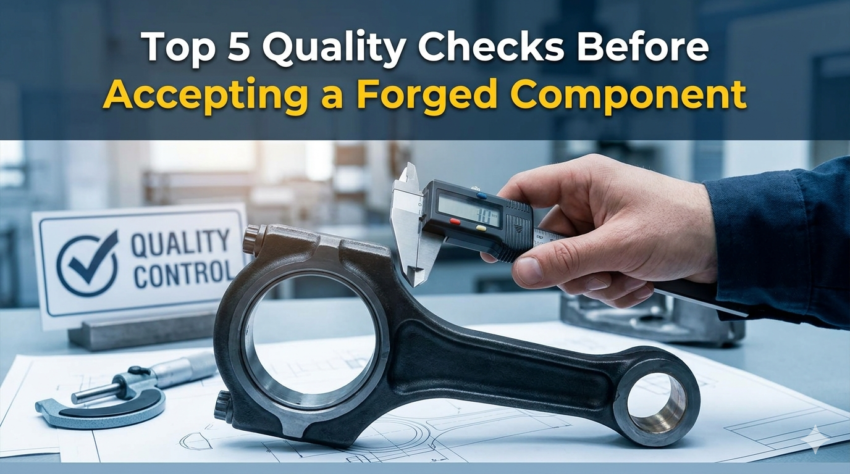
The most fundamental check is ensuring the component matches the engineering drawings. Forgings often require precise tolerances to ensure they fit perfectly during subsequent machining or assembly.
- What to check: Use calibrated instruments (micrometers, vernier calipers, or CMM) to verify diameters, thickness, and concentricity.
- Why it matters: Even a few millimeters of deviation can lead to assembly failure or excessive machining costs.
2. Surface Integrity and Visual Inspection
A forged part should be free from physical defects that occur during the heating or pressing process.
- What to check: Look for “laps,” “seams,” “cracks,” or “folds.” These are surface discontinuities where the metal has folded over itself without fusing. Also, check for “pits” caused by excessive scale being pressed into the surface.
- The CHW Forge Standard: Our components undergo rigorous descaling and surface treatment to ensure a clean, defect-free finish.
3. Material Composition (PMI Testing)
Accepting a component made from the wrong grade of steel can be catastrophic. Positive Material Identification (PMI) is a non-destructive method to verify the chemical composition of the alloy.
- What to check: Ensure the carbon, manganese, chrome, or nickel levels align with the Mill Test Report (MTR).
- Why it matters: Using a lower-grade alloy in high-pressure or high-temperature environments can lead to premature stress corrosion or brittle failure.
4. Internal Soundness (Ultrasonic Testing)
Surface beauty can be deceiving. The internal structure of a forging must be dense and free from voids, inclusions, or internal ruptures.
- What to check: Request Ultrasonic Testing (UT) reports. UT uses high-frequency sound waves to “see” inside the metal.
- Why it matters: Internal flaws act as stress concentrators. Under operational loads, a small internal void can expand into a major crack, leading to sudden component failure.
5. Hardness and Grain Flow Analysis
Forging is superior to casting because it aligns the “grain flow” of the metal to the shape of the part, increasing strength.
- What to check: * Hardness Testing: Ensure the Brinell or Rockwell hardness meets the specified range.
- Grain Flow: In critical applications, a macro-etch test can verify that the grain flow follows the contour of the component, providing maximum impact resistance.
- Why it matters: Proper grain flow ensures the part can handle fatigue and directional stress better than any other manufacturing process.
Conclusion
Quality is not an act; it is a habit. When you partner with a manufacturer like CHW Forge, you are investing in a legacy of precision and world-class testing standards. By performing these five essential checks, you ensure that your projects remain safe, efficient, and durable.
Looking for high-quality forged solutions? Visit CHW Forge to explore our range of products and our commitment to uncompromising quality.