

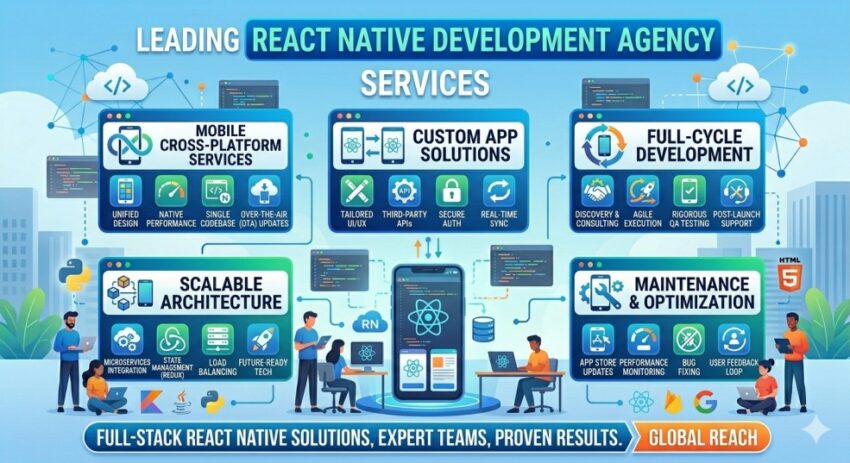
Not every React Native development agency offers the same services. Some build the app and hand over a repository. Others manage the entire product lifecycle from idea validation through post-launch iteration. The difference between these two types of partners determines whether your React Native app becomes a product users love — or a codebase you need to rebuild when the first growth inflection arrives.
This blog covers the core React Native app development services that a serious agency should offer, and what to look for at each stage to separate genuine capability from sales claims.
1. Product Discovery and Technical Scoping
The most expensive React Native project is one that starts development before the scope is properly defined. A credible React Native development agency does not jump from ‘I have an idea’ to writing code. They invest two to four weeks in a structured discovery process that produces the foundation everything else is built on.
What a strong discovery phase produces:
- User research synthesis: who your users are, what they need, what existing solutions they find frustrating
- Feature prioritization matrix: what goes in MVP version one versus later versions
- Technical architecture plan: state management approach, navigation structure, API design, third-party integrations
- Clickable prototype: a high-fidelity Figma prototype of core user flows that can be validated with real users and shown to investors
- Fixed-price development quote based on defined scope — not a guess
Discovery typically costs $3,000 to $8,000 and saves multiples of that by preventing scope surprises mid-development. Any React Native development agency that skips discovery is optimizing for their onboarding speed, not your project success.
2. UI/UX Design for React Native
React Native app design is not the same as web design. Mobile navigation patterns, gesture-based interactions, touch target sizing, platform-specific component behavior (iOS versus Android conventions), and performance constraints of the JavaScript rendering layer all influence design decisions that a web-first designer will miss.
Look for React Native development agencies that have in-house mobile UX designers — not agencies that outsource design to a separate vendor after engineering is already underway. Design and engineering decisions in React Native apps are tightly coupled. Separating them into sequential, siloed processes is a structural way to produce inconsistent results.
What strong React Native design services include:
- User flow mapping across all primary and edge-case journeys
- Wireframes that respect platform UI conventions (Material Design for Android, Human Interface Guidelines for iOS)
- High-fidelity UI design with a documented component library
- Prototype testing with real users before development commitment
- Animation and micro-interaction specification
3. Full-Cycle React Native Development
The core service of any React Native development agency is the app itself. What ‘full-cycle’ actually means, when delivered properly:
- Frontend development: React Native components, navigation, state management, platform-specific behavior handling
- Backend API development: REST or GraphQL APIs, database architecture, authentication, business logic
- Third-party integrations: payment gateways (Stripe, Razorpay), mapping (Google Maps, Mapbox), analytics, push notifications, CRM connectors
- Real-time features: WebSocket connections for live messaging, location tracking, collaborative tools
- Performance optimization: bundle size reduction, lazy loading, memory management, scroll performance
- Accessibility implementation: WCAG compliance, screen reader support, keyboard navigation
Agencies that only deliver the React Native layer and expect you to hire backend, QA, and design separately are not offering full-cycle services — they are offering a component of a service at a full-service price.
4. React Native Migration Services
A significant segment of React Native engagements in 2026 is not new builds — it is migrations. Companies that built native iOS and Android apps separately now want to consolidate into a shared React Native codebase to reduce maintenance overhead and accelerate feature development. Companies that built with Ionic, Cordova, or older hybrid frameworks want to migrate to React Native for performance and modern architecture.
Migration is a specialized service that requires:
- Code audit of the existing application to identify migration complexity
- Feature parity mapping: every existing feature documented and prioritized for migration order
- Incremental migration strategy: replacing components module by module rather than a full rewrite that creates a big-bang risk
- Regression testing at each migration phase to ensure existing users are not affected
Not every React Native development agency has migration experience. Ask specifically about this before engaging any agency for a migration project.
5. React Native Performance Optimization
Many businesses discover after launch that their React Native app has performance problems they were not aware of during development: slow list rendering with large datasets, sluggish navigation transitions, memory leaks in components that mount and unmount frequently, excessive re-renders from poor state management.
React Native performance optimization is a specialized service that uses profiling tools — React Native’s built-in performance monitor, Hermes engine tracing, Flipper — to identify and resolve specific bottlenecks. A React Native development agency that includes performance profiling as a standard part of delivery (not an optional add-on) is one that understands the common failure points of the framework.
6. Post-Launch Support and Iteration
Launch is not the finish line. For any React Native app in production, ongoing support covers:
- React Native version upgrades: the framework releases regularly, and staying current requires active maintenance
- iOS and Android OS compatibility: Apple and Google release major OS updates annually that require testing and patching
- Bug fixes from production usage: real users find edge cases that QA environments never simulate
- Performance monitoring and optimization as user load grows
- Feature iteration based on real user feedback and analytics data
Industry standard for React Native app maintenance is 15 to 20 percent of the original build cost annually. An agency that does not establish this clearly before you sign is one that will either disappear after delivery or create a new commercial negotiation for every post-launch request.
What Strong React Native Development Services Look Like End-to-End
|
Service Phase |
Duration |
Typical Cost (USD) |
Output |
|---|---|---|---|
|
Discovery & Scoping |
2–4 weeks |
$3,000 – $8,000 |
Architecture plan, prototype, fixed-price quote |
|
UI/UX Design |
3–6 weeks |
$5,000 – $20,000 |
Component library, tested prototype, design system |
|
React Native Development |
8–24 weeks |
$25,000 – $200,000+ |
Production-ready cross-platform app |
|
QA & Testing |
Concurrent + 2 weeks |
15–20% of dev cost |
Bug-free release across device matrix |
|
App Store Launch |
1–2 weeks |
$2,000 – $5,000 |
Optimized store listings, live deployment |
|
Post-Launch Support |
Ongoing |
15–20% of build/year |
Maintenance, updates, iteration |
Conclusion
The React Native development agency that serves your business best is the one that covers the full delivery lifecycle — not just the code. Discovery, design, development, QA, launch, and post-launch support are all parts of the same product, and the agency that manages them as a unified whole produces consistently better outcomes than the one that delivers components in isolation. Evaluate agencies on the breadth and depth of their React Native app development services — not just on their hourly rate.