

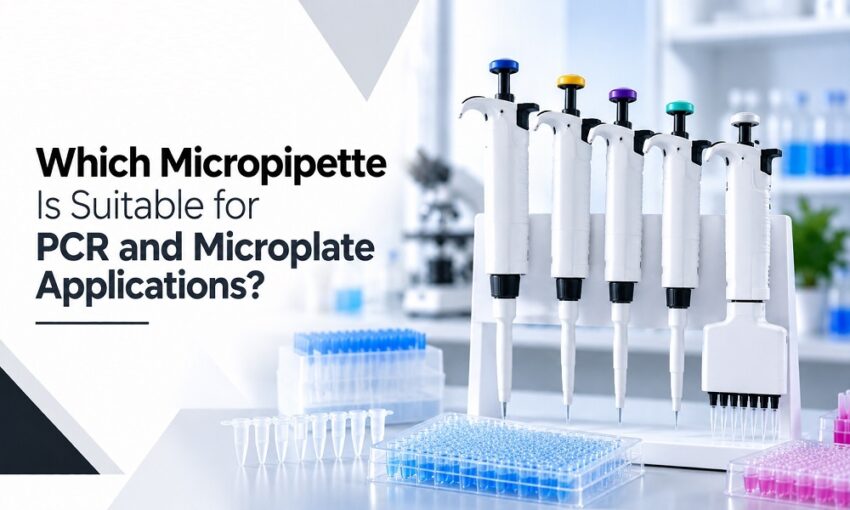
PCR and microplate-based workflows require accurate, consistent, and efficient liquid handling. Even small differences in reagent volume can affect experimental consistency, particularly when working with multiple samples simultaneously. Choosing the right micropipette therefore depends on factors such as sample volume, number of wells, labware format, required throughput, and the level of flexibility needed during the workflow.
Accumax offers a broad range of air-displacement micropipettes, including single-channel, multi-channel, mechanical, electronic, and adjustable tip-spacing models. The range covers applications from small-volume liquid handling to higher-volume laboratory workflows, with models designed around different laboratory requirements.
Why Micropipette Selection Matters for PCR and Microplates
PCR preparation often involves transferring small and precise quantities of DNA, primers, enzymes, buffers, and other reagents. When several reactions are prepared at once, manually transferring liquid into each tube or well with a single-channel micropipette can require repetitive movements.
Microplate applications create a similar requirement. Whether working with 96-well or 384-well plates, laboratories may need to transfer the same reagent across multiple wells. A multi-channel micropipette can help perform several transfers in a single operation, making it particularly useful for repetitive plate-based workflows.
The appropriate pipette should therefore match both the volume being transferred and the number and configuration of samples being processed.
Single-Channel Micropipettes for Flexible PCR Workflows
A single-channel micropipette can be useful when PCR preparation involves individual tubes, selected wells, or varying sample volumes. It provides flexibility when every transfer is not identical or when the user needs to access individual positions on a plate.
Accumax offers several single-channel options across different volume ranges. The broader range includes mechanical variable-volume models as well as electronic options, allowing laboratories to select a format based on their liquid-handling requirements. Accumax micropipettes are designed according to ISO 8655 requirements and include autoclavable models.
For laboratories performing occasional PCR setup, sample preparation, reagent dispensing, or individual well transfers, a single-channel micropipette can provide the flexibility needed for routine work.
Multi-Channel Micropipettes for Microplate Applications
For laboratories regularly working with microplates, a multi-channel micropipette can simplify repetitive liquid transfers. Accumax provides 8- and 12-channel micropipette configurations across several product ranges. The standard multi-channel options include volume ranges suitable for different laboratory applications.
An 8-channel micropipette can align with a row of a conventional 96-well plate, while a 12-channel configuration can support workflows organized around columns. This can make repeated reagent addition or sample transfer more efficient than performing each transfer individually.
Multi-channel micropipettes are particularly relevant to PCR preparation, ELISA workflows, screening assays, and other applications involving repeated transfers between wells.
FabFLEX® for PCR Strips and Multiple Microplate Formats
When a laboratory works with different types of labware, an adjustable tip-spacing micropipette can provide another level of flexibility. Accumax FabFLEX® is designed with adjustable spacing and is available in 4-, 6-, 8-, and 12-channel configurations. Depending on the model, its volume range extends from 2 µL to 1200 µL, while tip spacing can be adjusted from 4.5 mm to 33 mm.
This flexibility makes FabFLEX® relevant to workflows involving PCR strips, tubes, reservoirs, agarose gels, and 12-, 24-, 48-, 96-, and 384-well plates. Instead of relying on a fixed tip arrangement for every format, users can adjust the spacing according to the labware being used.
For laboratories that frequently move between PCR strips and different microplate formats, this adjustable approach can help reduce the need to switch between different multi-channel pipettes.
How to Choose the Right Micropipette for PCR
When selecting a micropipette for PCR applications, consider the volume range first. PCR protocols commonly involve relatively small liquid volumes, so choosing a pipette whose operating range matches the required volume is important.
The next consideration is throughput. If reactions are prepared individually, a single-channel micropipette may provide the required flexibility. If many reactions need identical reagent additions, an 8- or 12-channel micropipette can support simultaneous transfers.
Tip compatibility, ergonomic operation, calibration, and contamination-control practices should also be considered. Accumax provides mechanical and electronic micropipette options, while its product range includes models designed for different handling requirements.
Selecting a Micropipette for 96-Well and 384-Well Plates
Microplate format is another important selection factor. A conventional fixed-spacing multi-channel micropipette may be suitable when the laboratory primarily works with one standardized plate format.
However, laboratories using several formats may benefit from adjustable tip spacing. FabFLEX® is designed to accommodate multiple well-plate configurations, including 12-, 24-, 48-, 96-, and 384-well plates, as well as PCR strips and other laboratory vessels.
This makes the choice less about selecting a single pipette based only on channel count and more about matching the instrument to the complete workflow.
Accuracy, Calibration and Ergonomics Matter
PCR and microplate workflows depend on repeatable liquid handling. Accumax states that its micropipette range is manufactured to ISO 8655, with ISO 8655-6 calibration specified for many models. The range also includes ergonomic features and, in selected models, low-force operation for repetitive pipetting.
Ergonomics can be particularly relevant when a laboratory performs hundreds of transfers during a single session. Features such as comfortable handling, appropriate tip loading, and smooth operation can support more consistent day-to-day use.
Choosing the Right Micropipette for Your Laboratory
There is no single micropipette configuration that suits every PCR or microplate workflow. A single-channel model can provide flexibility for individual transfers, while an 8- or 12-channel micropipette can support repetitive multi-well applications. For laboratories working across different plate formats, PCR strips, tubes, and reservoirs, an adjustable tip-spacing option such as Accumax FabFLEX® provides additional versatility.
Ultimately, the right choice should be based on the required volume, number of samples, labware format, workflow frequency, and desired flexibility. By matching these factors with the available micropipette configuration, laboratories can establish a liquid-handling workflow suited to PCR preparation, microplate assays, molecular biology, and other precision laboratory applications.