
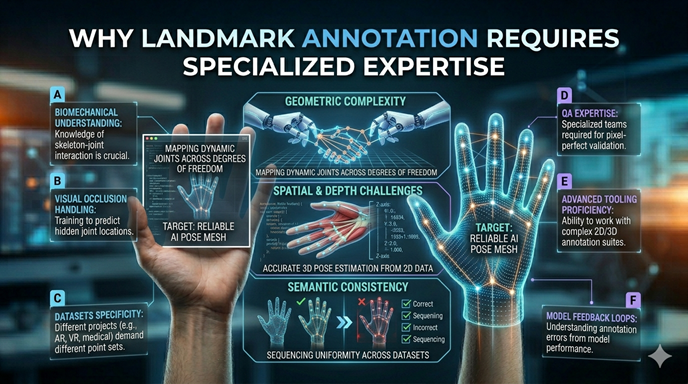
In the rapidly evolving landscape of artificial intelligence and computer vision, data quality remains the single most critical factor influencing model performance. Among the many annotation techniques used to train AI systems, landmark annotation stands out as one of the most precise and technically demanding. From facial recognition and pose estimation to medical imaging and autonomous systems, landmark annotation plays a pivotal role in enabling machines to interpret fine-grained spatial relationships.
At Annotera, we understand that delivering high-quality annotated data is not just about labeling images—it’s about combining technical proficiency, domain expertise, and rigorous quality control. This is why landmark annotation requires specialized expertise that goes far beyond conventional labeling approaches.
Understanding Landmark Annotation
Landmark annotation involves identifying and marking specific key points—often called keypoints—on objects within an image. These points represent critical structural features such as facial landmarks (eyes, nose, lips), human joints (elbows, knees), or anatomical markers in medical scans.
Unlike bounding boxes or semantic segmentation, landmark annotation focuses on precision at the pixel or sub-pixel level. Even a minor deviation in point placement can significantly impact downstream model performance, especially in applications requiring geometric accuracy.
The Complexity Behind Precision
The primary reason landmark annotation requires specialized expertise lies in its inherent complexity. Annotators must not only identify visible features but also infer the correct placement of points under challenging conditions such as occlusion, motion blur, or poor lighting.
For example, in pose estimation tasks, annotators must understand human anatomy to accurately place joints even when partially hidden. Similarly, in facial landmarking, subtle variations in expressions demand consistent interpretation across thousands of images.
A professional image annotation company like Annotera invests in skilled annotators who are trained to handle such nuances. This level of precision cannot be achieved through generic annotation workflows or untrained resources.
Domain Knowledge is Non-Negotiable
Landmark annotation often intersects with specialized industries such as healthcare, automotive, and augmented reality. Each domain introduces its own set of complexities and standards.
- Healthcare: Annotating anatomical landmarks in X-rays or MRIs requires medical knowledge to ensure accuracy and compliance.
- Automotive: Identifying vehicle parts or road elements demands an understanding of dynamic environments.
- Retail and AR: Accurate body or facial landmarks are essential for virtual try-on and personalization systems.
This is where data annotation outsourcing becomes strategic. Partnering with a data annotation company that has domain-specific expertise ensures that annotations are both accurate and contextually relevant.
Consistency Across Large Datasets
One of the biggest challenges in landmark annotation is maintaining consistency across large-scale datasets. Unlike simple labeling tasks, landmark annotation requires uniform interpretation of point placement across thousands—or even millions—of images.
Inconsistent annotations can introduce noise into training data, leading to poor model generalization. For instance, slight variations in how different annotators mark the same facial feature can degrade the performance of a facial recognition model.
At Annotera, we address this through:
- Detailed annotation guidelines
- Multi-level quality assurance processes
- Continuous annotator training and calibration
This systematic approach ensures that every dataset meets the highest standards of consistency and reliability.
Advanced Tooling and Technical Proficiency
Landmark annotation is not just about human skill—it also depends heavily on the tools used. Advanced annotation platforms enable features such as:
- Sub-pixel accuracy
- Automated keypoint suggestions
- Real-time validation checks
- Integration with AI-assisted labeling
However, these tools require trained professionals who understand how to leverage them effectively. Misuse of tools can lead to systematic errors, which are often difficult to detect at scale.
A specialized image annotation outsourcing provider like Annotera combines cutting-edge tools with expert workflows, ensuring optimal results for complex annotation projects.
Handling Edge Cases and Ambiguities
Real-world datasets are rarely perfect. Images often contain edge cases such as:
- Occluded objects
- Unusual poses
- Low-resolution inputs
- Multiple overlapping subjects
Handling these scenarios requires more than just basic instructions—it demands critical thinking and experience. Annotators must make informed decisions while adhering to project-specific guidelines.
This is another reason why landmark annotation cannot be effectively crowdsourced without oversight. A professional data annotation company ensures that edge cases are handled consistently and accurately.
Impact on Model Performance
The quality of landmark annotation directly influences the performance of AI models. Poorly annotated keypoints can lead to:
- Inaccurate predictions
- Reduced model robustness
- Increased training time
- Higher operational costs
On the other hand, high-quality landmark annotation enables:
- Precise object tracking
- Improved pose estimation
- Enhanced facial recognition accuracy
- Better user experiences in AR/VR applications
Investing in specialized expertise at the annotation stage ultimately reduces downstream costs and accelerates AI deployment.
Scalability Without Compromising Quality
Scaling landmark annotation projects is particularly challenging due to the level of precision required. Unlike simpler tasks, increasing volume does not mean lowering standards.
At Annotera, we balance scalability and quality through:
- Dedicated annotation teams
- Workflow automation
- Layered quality checks
- Flexible resource allocation
This makes data annotation outsourcing a viable solution for organizations looking to scale without compromising on accuracy.
Compliance and Data Security
In industries like healthcare and finance, data privacy and compliance are critical. Landmark annotation projects often involve sensitive data, requiring strict adherence to regulatory standards.
A reliable image annotation company ensures:
- Secure data handling protocols
- Compliance with global standards
- Confidentiality agreements
- Controlled access environments
Annotera prioritizes data security at every stage, giving clients confidence in their outsourcing decisions.
Why Choose Annotera for Landmark Annotation
As a trusted data annotation company, Annotera combines expertise, technology, and scalability to deliver high-quality landmark annotation services. Our approach is built on:
- Expert annotators trained in domain-specific requirements
- Robust quality assurance frameworks
- Advanced annotation tools for precision and efficiency
- Flexible outsourcing models tailored to client needs
Whether you are developing a cutting-edge AI application or improving an existing model, our image annotation outsourcing solutions are designed to meet the highest standards.
Conclusion
Landmark annotation is far more than a technical task—it is a specialized discipline that demands precision, expertise, and consistency. From handling complex datasets to ensuring domain-specific accuracy, every aspect of landmark annotation requires a deep understanding of both the data and its application.
Organizations that underestimate this complexity often face challenges in model performance and scalability. By partnering with an experienced data annotation company like Annotera, businesses can unlock the full potential of their AI systems with reliable, high-quality training data.
In a world where AI success is driven by data quality, investing in specialized landmark annotation expertise is not just beneficial—it is essential.