
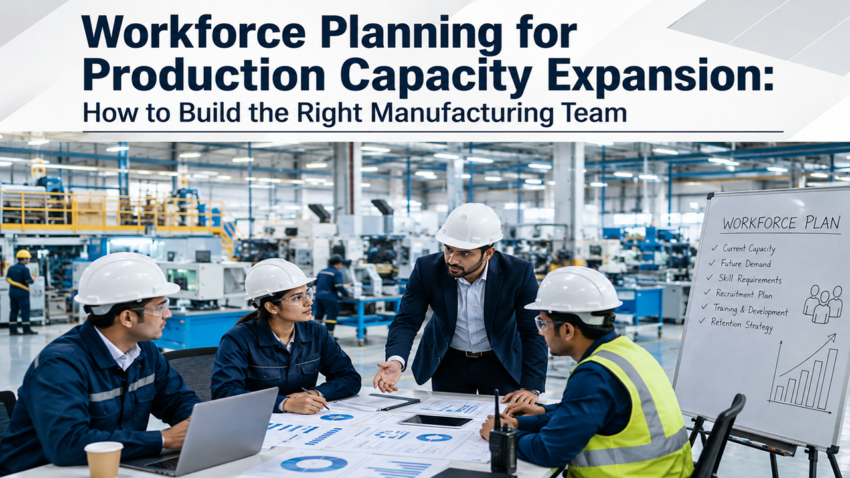
Brownfield expansion is rarely as simple as adding another production line and hiring more people. An existing plant has established processes, experienced employees, operating constraints, equipment interfaces, shift patterns, and maintenance practices. When capacity increases, these factors change together.
The workforce therefore needs to be planned around the future operating model, not just the additional number of machines or production volume.
A practical workforce plan for brownfield expansion should answer four questions: What work will increase? What new capabilities will be required? Which existing employees can transition into those roles? And where will external technical staffing be necessary?
This becomes increasingly important as manufacturers adopt automation and digital systems. Deloitte’s 2025 Smart Manufacturing survey found that 48% of respondents reported moderate-to-significant difficulty filling production and operations management roles, while 46% reported similar challenges for planning and scheduling positions.
Why Workforce Planning Becomes More Complex During Brownfield Expansion
In a greenfield project, the workforce can be designed around a new facility from the beginning. Brownfield expansion is different because the new operating model must coexist with an existing one.
An expansion may introduce:
- Additional production lines or equipment
- Higher production volumes
- New products or processes
- Additional shifts
- Greater maintenance requirements
- Automated inspection and material handling
- PLC, SCADA, MES or other digital systems
- New quality and compliance requirements
- Additional utilities and support infrastructure
As a result, headcount does not necessarily increase in direct proportion to production capacity.
For example, a plant may increase output substantially through automation and better equipment utilisation while requiring relatively few additional operators. At the same time, it may need more automation engineers, maintenance specialists, quality personnel and technically capable supervisors.
The planning question is therefore not simply “How many employees should we add?” It is “What capabilities will the expanded plant need to operate reliably?”
Start With the Future Operating Model
A useful workforce assessment should work backward from the planned operation:
Production requirement → Process requirements → Equipment → Automation level → Shift structure → Activities → Skills → Roles → Workforce
This sequence helps prevent a common mistake: deciding the number of employees before understanding how the expanded plant will actually operate.
The assessment should establish:
Production Requirements
Define the expected:
- Production volume
- Product mix
- Number of SKUs
- Production cycle
- Operating hours
- Shift pattern
- Ramp-up requirements
Equipment and Process Changes
Identify new or modified:
- Production equipment
- Packaging systems
- Utilities
- Material-handling systems
- Inspection systems
- Automation platforms
- Control systems
Operating Model
Determine who will operate, maintain, inspect and supervise the expanded process, and whether responsibilities will remain centralised or become line-specific.
This produces a more defensible workforce requirement than applying a historical employee-to-output ratio.
Assess the Existing Workforce Before Hiring
Hiring should not automatically be the first response.
Start by mapping the existing workforce against the future requirements. Review:
- Current roles and responsibilities
- Technical qualifications
- Equipment experience
- Shift coverage
- Overtime dependence
- Productivity constraints
- Retirement or attrition exposure
- Cross-functional skills
- Supervisory capability
- Training history
The objective is to separate available capacity from available capability.
An experienced technician may have enough capacity to support another line but lack the skills needed for a new automated system. Conversely, an existing operator may be capable of moving into a higher-value role after structured training.
This distinction can prevent unnecessary recruitment while revealing critical skill gaps that headcount reports often miss.
Build a Technical Skill-Gap Matrix
A skill-gap assessment should compare current capabilities with those required after expansion.
|
Capability |
Current Level |
Future Requirement |
Gap |
Response |
|
Equipment operation |
High |
High |
Low |
Redeploy |
|
Preventive maintenance |
Medium |
High |
Medium |
Upskill |
|
PLC troubleshooting |
Low |
High |
High |
Train/Hire |
|
Robotics |
Low |
High |
High |
Specialist hiring |
|
Quality systems |
Medium |
High |
Medium |
Training |
|
Production supervision |
High |
High |
Low |
Retain |
The exact scoring method can vary by plant, but the principle remains the same: identify the capability gap before deciding the staffing action.
The World Economic Forum’s Future of Jobs Report 2025 estimates that 39% of workers’ existing skill sets could be transformed or become outdated between 2025 and 2030. It also identifies technological literacy, analytical thinking, AI and big data, networks and cybersecurity among increasingly important skills.
For manufacturing expansion, this reinforces the value of treating workforce planning as a continuous capability exercise rather than a one-time recruitment activity.
Plan Workforce Requirements Across Expansion Phases
The workforce required during construction and commissioning may be very different from the permanent workforce.
1. Expansion Planning
Early-stage requirements can include:
- Project engineers
- Production engineers
- Maintenance representatives
- EHS personnel
- Planners
- Process specialists
2. Installation
As equipment arrives, requirements may shift toward:
- Installation supervisors
- Mechanical technicians
- Electrical technicians
- Instrumentation specialists
- OEM representatives
- Safety personnel
3. Commissioning
Commissioning often requires concentrated technical capability, including:
- Commissioning engineers
- Equipment specialists
- Automation engineers
- Operators
- Maintenance technicians
- Quality personnel
4. Production Ramp-Up
The emphasis moves toward:
- Production operators
- Supervisors
- Maintenance teams
- Quality teams
- Process engineers
- Planning personnel
5. Stabilised Operations
Once production reaches a stable state, temporary project resources can reduce while the permanent operating structure takes over.
This phased approach helps avoid two opposite problems: bringing permanent employees into the plant too early or discovering critical skill shortages immediately before production startup.
Automation Changes Skills, Not Just Headcount
Automation is one of the most important reasons brownfield workforce planning should not rely on simple manpower ratios.
Deloitte’s 2025 survey found that 46% of respondents ranked process automation among their first- or second-priority investment areas for the following two years, while 37% did so for physical automation.
Automation can reduce repetitive manual work while increasing the importance of:
- Controls engineering
- PLC and SCADA troubleshooting
- Instrumentation
- Robotics
- Industrial networking
- Preventive and predictive maintenance
- Data interpretation
- Digital production systems
NITI Aayog has similarly highlighted skill gaps among operators, technicians and supervisors, including limited exposure to modern equipment and manufacturing techniques.
The implication is straightforward: an automated expansion may require fewer traditional operators but stronger technical depth around the production system.
Decide Between Redeployment, Upskilling and Hiring
Once gaps are identified, each role should be assigned an appropriate staffing strategy.
Redeploy
Consider redeployment where existing employees have transferable skills and sufficient capacity.
Upskill
Training can be appropriate when:
- The employee understands the existing process
- The future role builds on current knowledge
- Training can be completed before deployment
- The skill is strategically important to retain internally
Hire
External recruitment may be necessary when the plant requires:
- Rare technical expertise
- Experience with unfamiliar technology
- Immediate commissioning capability
- Certified or highly specialised personnel
Use Specialist Support
Temporary or project-based technical resources can be useful for:
- Equipment commissioning
- OEM support
- Automation integration
- Specialised troubleshooting
- Technology transfer
- Short-term ramp-up assistance
Deloitte’s 2025 research found that 40% of surveyed manufacturers reported using contract or contingent labour to supplement capabilities. The same research found substantial hiring difficulty across technology-focused areas and significant use of external support for IT, OT, cybersecurity, analytics and automation.
The right model may therefore be a combination of permanent employees, internal development and specialist external resources.
Create a Workforce Deployment Timeline
Recruitment and training should be connected to the project schedule.
A practical sequence is:
Identify → Recruit → Train → Shadow → Deploy → Validate → Stabilise
Critical employees should ideally become familiar with relevant equipment and procedures before they are expected to independently operate the expanded process.
The deployment plan should identify:
- Role
- Required competency
- Start date
- Training requirement
- Reporting structure
- Shift assignment
- Equipment/process responsibility
- Readiness criteria
This creates a direct connection between project execution and operational readiness.
Measure Whether the Workforce Plan Is Working
Workforce planning should continue after expansion begins.
Useful indicators include:
- Critical positions filled before commissioning
- Training completion before production trials
- Time to competency
- Overtime hours
- Absenteeism
- Skill-gap closure
- Shift coverage
- Output per employee
- Maintenance response time
- Equipment downtime
- Ramp-up productivity
- Employee turnover
These measures can reveal whether the original staffing assumptions were realistic.
For example, persistent overtime may indicate insufficient staffing, poor shift allocation, excessive downtime or inefficient work allocation. A high headcount with low productivity may point toward process or equipment constraints rather than a simple labour shortage.
Common Workforce Planning Mistakes in Brownfield Expansion
Avoiding predictable mistakes can significantly improve workforce readiness.
Hiring Based Only on Capacity Increase
A 20% capacity increase does not automatically mean a 20% increase in headcount.
Ignoring Maintenance
Additional equipment can increase technical maintenance requirements even when operator involvement decreases.
Hiring Too Late
Critical technical personnel may need time for equipment familiarisation and training before commissioning.
Treating Operators as the Entire Workforce
Engineering, quality, maintenance, utilities, planning and EHS requirements can also change.
Ignoring Shift Design
The required workforce depends on operating hours and coverage, not just the number of production lines.
Failing to Reassess After Commissioning
Actual production conditions may reveal workload, competency or staffing requirements that were not visible during planning.
How IMARC Engineering Can Help
IMARC Engineering can support brownfield expansion workforce planning by connecting technical staffing requirements with the plant’s planned processes, equipment, capacity and operating model. Its support can include workforce requirement assessment, technical role mapping, skill-gap identification, staffing strategy, workforce deployment planning and coordination of technical resources for expansion and commissioning activities. This engineering-led approach helps manufacturers distinguish between roles that can be redeployed or developed internally and capabilities that may require external technical staffing or specialist support.
Speak With An Expert: https://www.imarcengineering.com/contact?service=workforce-planning-and-technical-staffing
Conclusion
Effective workforce planning for brownfield expansion is not simply about increasing employee numbers. It is about ensuring that the right capabilities are available at the right stage of the project and in the right operating structure. By linking production targets, equipment, automation, shifts, skills and staffing requirements, manufacturers can build a workforce plan that supports commissioning as well as long-term operations. Regular review after startup is equally important because actual workload and equipment performance can change the original workforce assumptions.
Contact Us:
IMARC Engineering
Phone: +91-120-433-0800
Email: sales@imarcengineering.com
India: C-130, Sector 2, Noida, Uttar Pradesh 201301
LinkedIn: https://www.linkedin.com/showcase/imarc-engineering/