
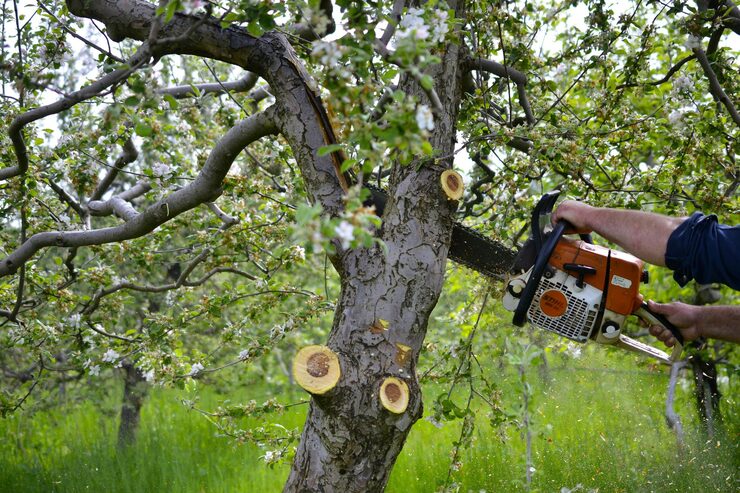
Cherokee County has a way of making you love your trees. Drive through Canton, Woodstock, Holly Springs, or Ball Ground and you will see why. Mature white oaks canopy over subdivision streets, tall loblolly pines line the back edges of properties that border undeveloped land, and sweetgums and tulip poplars fill in everywhere in between. The county has been one of the fastest-growing areas in Metro Atlanta for over a decade, and with that growth comes thousands of newer properties backed up against natural treelines that their previous owners never had to manage.
That combination of beloved trees, rapid growth, and the fierce summer thunderstorms that roll through North Georgia every season means Cherokee County homeowners have real reasons to stay ahead of their tree maintenance.
The problem is that most people do not think about their trees until something forces them to. This guide is designed to help you get ahead of that moment. Here are 10 specific signs that your trees need professional attention explained with the local context that makes Cherokee County’s tree care needs different from anywhere else in Georgia.
1. Dead Branches Are Hanging Over Your Home, Driveway, or Outdoor Living Area
Dead branches are the most urgent and most overlooked warning sign on Cherokee County properties. They do not need a storm to fall. They can come down on a perfectly calm afternoon, without any wind at all. That makes their location not just their condition the critical factor.
A dead limb hanging over an open field is a nuisance. A dead limb hanging over your roof, your parked vehicles, or the deck where your family spends summer evenings is a genuine hazard that should be removed without delay.
Cherokee County’s mix of mature hardwoods and tall pines means deadwood can develop at heights that are completely invisible from the ground during the growing season. Once leaves fill in, dead scaffold limbs on oaks and sweetgums can hide entirely until they fall. The best time to identify deadwood is early spring before full leaf-out, or late fall after the leaves have dropped both windows give you a cleaner view of the upper canopy.
If you know deadwood is present over a target regardless of the season a professional tree trimming service in Cherokee County, GA should be your next call.
2. You Notice Pine Trees With Fading, Yellowing, or Reddish-Brown Needles
This sign is specific to Cherokee County and the broader North Georgia region, and it is serious enough to warrant its own entry.
Loblolly and longleaf pines are dominant on properties throughout Cherokee County particularly on lots that back up to undeveloped land or that were built on former timberland. These trees are beautiful and fast-growing, but they carry a specific threat: Southern Pine Beetles.
Southern Pine Beetles bore into pine bark and introduce a fungus that cuts off the tree’s water and nutrient transport. Once a pine is actively infested, its needles begin fading from green to yellow to reddish-brown, starting at the top and working downward. By the time the color change is visible from the ground, the infestation is typically advanced.
Beetle-infested pines do not fall on a predictable schedule. A pine that looks “mostly green” on Monday can become a brittle, structurally compromised tree by the following month. Worse, beetles spread from tree to tree across a property and into neighboring lots. If you spot a pine on your Cherokee County property that is changing color from the top down especially during warmer months this is not a wait-and-see situation. Get a professional tree service in Cherokee County, GA on site immediately to assess whether trimming, targeted removal, or preventive treatment of nearby healthy pines is the right response.
3. Branches Are Touching or Growing Over Your Roofline
This is one of the most consistent findings on Cherokee County properties during professional tree assessments and one of the most consistently ignored by homeowners until it causes real damage.
When a branch rests on or rubs against your roof during a wind event, it does not simply rest there harmlessly. It grinds against the shingle surface, wearing down the granules that protect the roofing material from UV exposure and moisture. Over time, that abrasion creates soft spots and entry points for water. In Cherokee County’s wet summers, that moisture can find its way under damaged shingles quickly.
Branches overhanging the roof also create a direct access route for squirrels, raccoons, and carpenter ants pests that use those limbs as a highway from the trees to your attic. If you have noticed unexplained animal activity near your roofline, check whether any tree branches are making contact.
Professional tree trimming service in Cherokee County, GA establishes appropriate clearance based on the specific species, its growth rate in North Georgia’s climate, and the type of structure it overhangs. This is not simply cutting the nearest branch, it is a calculated clearance that keeps your roof protected for several growing seasons.
4. Your Trees Have Not Been Professionally Trimmed in Five or More Years
Cherokee County’s growing season is long and productive. Trees here do not grow at the same pace as those in drier, cooler climates. A canopy that seemed well-managed five years ago has often added several feet of new growth in multiple directions since then extending toward structures, developing new branch conflicts, and accumulating deadwood in the upper reaches.
The five-year mark is a useful general guideline for most mature hardwoods in this region. It is not a rule that every tree hits at the same pace faster-growing species like water oaks and Bradford pears may need attention sooner, while slower-growing species may be fine slightly longer but it is a reasonable trigger for scheduling a professional walkthrough of your property.
What a professional assessment at the five-year mark typically uncovers: deadwood that has accumulated in the upper canopy, branches that have grown into new clearance conflicts with structures or utility lines, developing co-dominant stems that were small enough to ignore previously but have now become structurally significant, and canopy imbalances that have slowly worsened as the tree has grown toward available light.
Getting back on a regular tree service in Cherokee County, GA maintenance cycle before small issues compound is always less expensive and less disruptive than addressing them after they become urgent.
5. The Tree Has Developed a Lean That Was Not There Before
Cherokee County’s geography adds a specific dimension to this warning sign that many homeowners do not consider.
Much of Cherokee County sits on rolling terrain the county sits at the northern edge of Metro Atlanta, where the piedmont begins transitioning toward the Blue Ridge foothills. Properties in Canton, Waleska, and Ball Ground often have slope gradients that affect both how trees grow and how their root systems are anchored.
On sloped terrain, trees already grow with some natural lean toward the downhill side as they compensate for gravity. What concerns professionals is not a stable, long-standing lean it is a lean that has changed. A tree that was upright six months ago and now has a noticeable tilt, particularly after a period of heavy rainfall, may have experienced root plate movement.
Cherokee County’s red clay soil the same saturated clay that defines much of North Georgia’s terrain loses its grip on root systems significantly during prolonged wet periods. Trees on slopes are particularly vulnerable because gravity adds additional force to an already loosened root structure.
If you notice that a tree on your property is leaning in a direction it was not leaning before, especially toward your home or any frequently occupied outdoor space, schedule a professional inspection before the next heavy rain compounds the situation.
6. You See Mushrooms, Bracket Fungi, or Conks at the Base of the Tree
Fungal growth at the base of a tree is one of the most misunderstood warning signs in tree care. Homeowners frequently dismiss it as a seasonal occurrence or a minor landscaping nuisance. It is neither.
When mushrooms, shelf fungi, or bracket-shaped conks appear at the root flare or on the lower trunk, they are indicating that fungal activity is breaking down the internal wood structure of the tree from the inside out. By the time fruiting bodies are visible on the exterior, decay inside the trunk is typically already significant the external sign is a lagging indicator, not an early one.
The practical implication for Cherokee County homeowners: a tree with visible fungal growth at the base may look perfectly healthy from twenty feet away. The canopy may be full and green. The bark may show no obvious damage. But internally, the structural capacity of the trunk may have been significantly reduced.
This is not necessarily a death sentence for the tree. The location of the decay, its extent, and the species all influence how much structural capacity remains and what options are available. A professional tree service in Cherokee County, GA can assess the situation accurately and tell you whether targeted trimming to reduce canopy load, monitoring, or removal is the right course of action.
7. Branches Are Growing Into or Near Utility Lines
Cherokee County’s rapid residential development over the past two decades means many subdivision lots were carved from wooded land, and the trees that were preserved during development have continued to grow toward everything around them including overhead utility lines.
Trees growing into power lines, cable lines, or telephone infrastructure are a serious safety concern. In Georgia, utility companies maintain the right to trim or remove vegetation that conflicts with their infrastructure and their clearance work is typically aggressive and indiscriminate. Utility-cut trees are often left looking severely misshapen, with large wounds and unbalanced canopies that create new structural problems over time.
The far better approach is proactive tree trimming service in Cherokee County, GA that keeps branches at a safe distance from utility lines before they reach the point where the utility company intervenes. This gives you control over how the trimming is done, preserves more of the tree’s natural form, and eliminates the risk of power outages caused by storm-related branch contact with lines.
If any branches on your property are already touching or closely approaching utility lines, do not attempt to address this yourself. Contact a qualified, insured professional this is among the most hazardous scenarios in residential tree work.
8. You Can See Cracks, Splits, or V-Shaped Unions in Major Branches
This sign requires getting close enough to the tree to actually look at how the major branches attach to the trunk, something most homeowners do not do on a regular basis.
Where a large branch meets the trunk, the shape of that attachment tells you a great deal about its structural integrity. A wide, U-shaped union indicates a strong connection where the branch and trunk have grown together properly. A narrow, V-shaped union, particularly one where you can see bark tissue trapped between the two stems, is a significantly weaker attachment that carries a much higher risk of failure under load.
This condition, called included bark, is common on Cherokee County’s mature oaks and sweetgums. It develops when two competing stems grow so closely together that bark gets embedded at the union rather than being pushed aside as the stems fuse. The result is an attachment point that looks solid from the outside but has far less tensile strength than it appears.
Visible cracks along the length of a major branch, or at the point where it joins the trunk, are even more urgent. Depending on the size of the limb and what is positioned below it, a cracked branch union on a large hardwood can represent a significant falling hazard that should be evaluated by a professional as soon as it is identified.
9. The Canopy Is Visibly Unbalanced or Growing Heavily to One Side
A well-maintained tree develops a reasonably balanced canopy over time, distributing its weight in a way that puts manageable stress on the trunk and root system. When the canopy becomes heavily weighted to one side whether through uneven growth toward light, storm damage that removed branches from one side, or simply years of growth in a constrained space the mechanical dynamics of the tree change in ways that matter.
An unbalanced canopy concentrates wind load on the heavy side during storms. Cherokee County experiences severe thunderstorms with straight-line winds regularly through the summer months. A tree with a canopy that is significantly heavier on one side facing the prevailing wind direction is carrying a disadvantage that a balanced tree does not have.
On properties that back up to undeveloped land or wood lines common throughout Cherokee County’s newer subdivisions trees often grow heavily toward the open areas where light is more available, gradually creating canopies that extend far more toward the back of the property than the front. Over time, that asymmetry can become pronounced.
Corrective trimming by a qualified professional reduces end-weight on the heavy side without over-reducing the canopy. This is structural work that directly improves the tree’s storm resilience and its long-term health.
10. Branches Are Consistently Dropping After Mild Weather Events
Every tree drops some debris. Small twigs after a heavy rain, a few leaves in a windstorm that is normal. What is not normal is a pattern of medium to large branches falling after weather events that would not typically cause branch failure on a healthy tree.
If you regularly find branches of significant size anything thicker than your thumb or longer than a few feet on the ground after moderate rain or wind, your tree is telling you something. The branches falling are not the primary concern. The branches still attached, in the same condition as the ones that have already fallen, are the ones to worry about.
This pattern typically indicates one of a few things: significant deadwood accumulation in the upper canopy, weak branch attachments that have been developing over time without correction, pest activity that has compromised the wood internally, or a combination of all three. A professional tree trimming service in Cherokee County, GA will identify the source of the problem and address it systematically, rather than simply cleaning up what has already fallen.
Cherokee County’s Tree Regulations: What Homeowners Should Know
Understanding when to call a tree service in Cherokee County, GA also means understanding the local regulatory landscape because what you can and cannot do with your trees without prior approval varies significantly depending on where in the county your property sits.
Unincorporated Cherokee County properties generally give private landowners considerable flexibility. For most single-family residential lots, tree removal does not require a county-issued permit unless the project involves larger land disturbance activity, proximity to stream buffers or floodplains, or is part of a new development plan governed by Cherokee County’s Article 27 Tree Preservation and Replacement Ordinance.
Canton city limits apply a different set of rules. Properties within Canton may face additional requirements for removing large, healthy trees particularly those in conservation areas, buffer zones, near wetlands, or on properties subject to approved landscape plans. Most single-family residential properties in Canton are not heavily restricted for routine tree work, but it is worth confirming before undertaking removal of any significant tree.
Woodstock and Holly Springs have their own municipal ordinances that may differ from both unincorporated county rules and Canton’s requirements. Homeowners in these communities should verify local requirements before scheduling tree removal of any scale.
HOA-governed communities — which are common throughout Cherokee County’s newer subdivision developments in Canton, Holly Springs, and Woodstock often layer their own requirements on top of municipal rules. Many HOAs require written approval before any tree above a certain diameter is removed. Failing to follow HOA procedures can result in fines even when the underlying work is legally permitted by the county.
A reputable local tree service company familiar with Cherokee County will know the applicable rules for your specific location and can advise you on what is required before any work begins.
What to Look for When Hiring Tree Trimming Service in Cherokee County, GA
Recognizing that your trees need attention is the first step. Choosing the right professional to handle that work is the second and in Cherokee County, where properties often include large, mature trees in challenging terrain, it matters significantly.
Start with insurance verification. Before any crew sets foot on your property, request current certificates of general liability insurance and workers’ compensation coverage. Both should be verified in writing. A company that hesitates to provide this documentation is one you should not hire, regardless of price or how long they have been in business.
5 FAQs Cherokee County Homeowners Ask About Tree Trimming
Q1. When is the best time for tree trimming in Cherokee County, GA?
November through February is ideal for most species. Avoid trimming oaks April through July due to beetle risk. Dead or hazardous branches should come down immediately, no matter the season.
Q2. Do I need a permit for tree trimming in Cherokee County, GA?
Usually not for routine trimming on residential properties. Rules vary by city Canton, Woodstock, and Holly Springs each have their own requirements. HOA communities often need written approval. Check before any major work begins.
Q3. How often should trees in Cherokee County be professionally trimmed?
Every three to five years for most mature trees. Cherokee County’s warm, wet climate pushes growth faster, so lean toward three years. Pines need annual beetle inspections rather than routine trimming.
Q4. Can I trim my own trees in Cherokee County?
Small, low branches from the ground yes. Anything needing a ladder, near power lines, or over structures hire a professional. Cherokee County’s sloped terrain makes DIY work riskier than most homeowners expect.
Q5. How do I know if my tree needs trimming or full removal?
Only an on-site inspection tells you for sure. Most issues deadwood, clearance conflicts, canopy imbalance are resolved with trimming. Removal is needed when decay is advanced or the risk cannot be fixed by trimming alone.